Anselm Kiefer "Meteor Shower" Special Exhibition
(Fig. 1 Left) Panoramic view of Kiefer's "Meteor Shower" special exhibition at the Grand Palais-Glass Palace. (Fig. 1 Right) Panoramic view of the house exhibition room, showing its vastness through human scale comparison. (Fig. 2 Left) Upon entering, one is immediately struck by a unique visual and
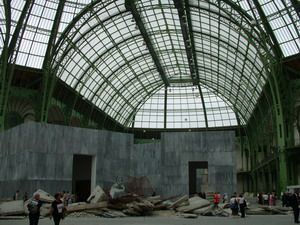
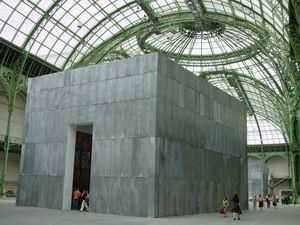
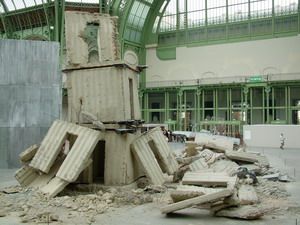
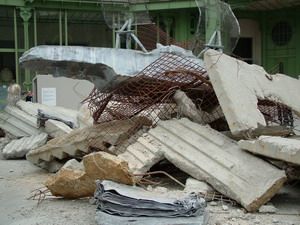
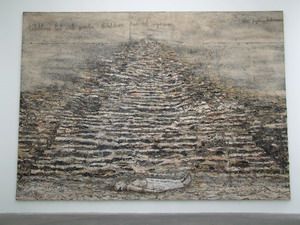
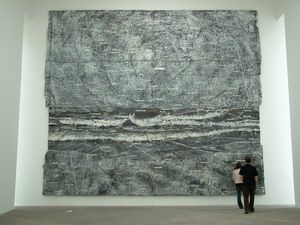
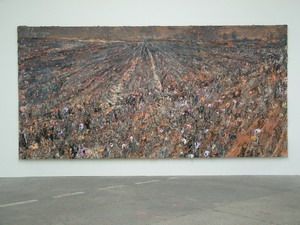


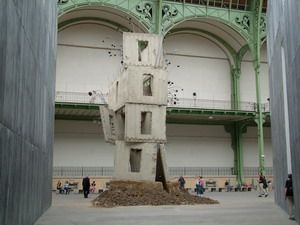
(Fig. 1 Left) Panoramic view of Kiefer's "Meteor Shower" special exhibition at the Grand Palais-Glass Palace. (Fig. 1 Right) Panoramic view of the house exhibition room, showing its vastness through human scale comparison. (Fig. 2 Left) Upon entering, one is immediately struck by a unique visual and spiritual shock from this monumental sculptural environmental installation. (Fig. 2 Right) On this landscape of concrete ruins and rubble, an unexpectedly grounded warship titled "Unexpected Expectation." (Fig. 3 Left) The emotionally moving large painting "Misty Homeland." (Fig. 3) The dazzling, sparkling cosmic arch "Milky Way." (Fig. 4 Left) "The Opening of the Earth," inspired by the Bible, suggests rebirth. (Fig. 4 Right) Detail from the painting "Journey to the End of the Night," based on the novel by famous French writer Louis Ferdinand Céline. (Fig. 5 Left) A magnificent scene from the most poetic "Palm Sunday." (Fig. 5 Right) The monumental sculptural-architectural memorial work "Sun Boat."
The Anselm Kiefer "Meteor Shower" (Chute d'étoiles) special exhibition ran from May 30 to July 8 in Paris at the Grand Palais. This is the annual Monumenta 2007 special exhibition, described as the most spectacular and grand show of the year. German artist Anselm Kiefer was the first artist for this Monumenta series. He is also a rare German artist who left his homeland to settle in France, showing concern not just for German and French humanities and history, but broadly for European civilization and humanity. Since 1993, he has lived in Barjac near Nîmes, spending over ten years in rural life and creation. The house studio plans and works exhibited here come from his unique studio space scenes and outdoor sculpture and architectural installation experiments in Barjac.
This special exhibition uses the poetic theme "Meteor Shower," displayed in the transparent and vast exhibition space of the Grand Palais-Glass Palace (40 meters high, 200 meters long, totaling 13,500 square meters). From noon to midnight daily, day and night alternate in the "Meteor Shower" venue; the atmosphere of the works shifts with time, light, and the starry night sky. Whether during the day or under the quiet night sky, meteors streak across time and space in the Glass Palace. These meteors cross not only the Paris skyline but also historical time and space. Almost all works in this Monumenta special exhibition were custom-made by Anselm Kiefer for this grand venue (Grand Palais), so these enormous, extraordinary, and spectacular works are perfectly established in this unique spatial setting. The exhibition is dedicated to the humanitarian ideas he has cared about and explored for many years, commemorating the works of German-Jewish poet Paul Celan (1920-1970) and Austrian poet Ingeborg Bachmann (1926-1973) regarding humanity.
Under the magnificent dome of the Grand Palais, seven large houses (exhibition rooms) are displayed under seven major themes, including bewitching paintings, sculptures, objects, and installations. Starting from the left:
- Misty Homeland: Inspired by Austrian poet Ingeborg Bachmann, presenting a magnificent large painting featuring a huge earth pyramid with a symbolic heart hanging above and a poet lying below. This ancient Egyptian pyramid metaphorically represents the fate of civilization, while the heart becomes the core of current affairs, all existing between life and death, reality and memory. On the left wall, charcoal writing displays poet Bachmann's thematic sentence: "I see the heart of smoke, I swallowed the heart of smoke."
- Secret of Ferns: Referencing poet Paul Celan's work, one wall of this exhibition room is covered with 44 fern paintings in various states (fern and soil mixed media) and three cement wall desolate war cries sculptural installation buildings. Through resilient growing ferns and cement structures, it presents possibilities of growth challenging stubbornness and concealment.
- Milky Way: A highly poetic themed hall. Under the Grand Palais dome hangs a massive monumental-style giant painting of the Milky Way (7.10m x 8m), dazzling with sparkling cosmic arcs. It depicts the deep, boundless azure galaxy, prompting thoughts on the vastness of the universe and the insignificance of human life and history, as well as the fleeting nature of time and space, illusion, and rebirth. Within the vast Milky Way painting, numerous connecting numbers correspond to NASA's galactic planetary terminology classification. Shining glass fragments and sunflower seeds reinforce these symbolic echoes.
- Aperiatur (The Opening of the Earth): Inspired by the Bible, suggesting rebirth. Three large monumental-style field landscape paintings (2.8m x 7.6m) are displayed on three walls. Deep perspective fields and cracked material surfaces create extraordinary visual tension. Flowers bloom everywhere on the land, releasing unprecedented vitality with colorful hues, hinting at the possibility of new life.
- Journey to the End of the Night: Based on the novel by famous French writer Louis Ferdinand Céline (1894-1961), Kiefer uses this theme to express the encounters and tragic experiences of German (or human) history. Like a journey in the dead of night amidst unbearable circumstances, it reflects on the human condition and fate. Two walls in this venue are hung with paintings of "ships" and "waves" in various states. On rusted surfaces, material tension and sensibility are strengthened. Outgoing warships, grounded warships, capsized warships, small boats, or large ships face the historical storms of overturning vessels in surging waves.
- Meteor Shower - Library: A romantic poetic theme, metaphorically representing the fleeting time and space (individual human life) as the eternity of the light of thought (preserving transmitted thoughts and wisdom - library). This venue features a monumental-style library (6m high x 4m long). On spectacular shelves are nearly two hundred lead books interspersed with many transparent glass pieces. Below the bookshelves lies shattered glass, contrasting the soft nature of lead with the fragility of glass, poetically and imaginatively proving this symbolic meteoric method.
- Palm Sunday (Dimanche des rameaux): This attractive Catholic festival subject is a creative reimagining by Kiefer, depicting Jesus Christ's triumphant entry into Jerusalem. Contrasting this glorious triumphal entry with the impending Passion. One wall in this venue hangs 33 mixed-media paintings of palm leaves in various states, the most poetic series exhibited. On the ground, a dried-up coconut tree uprooted lies diagonally, occupying almost the entire venue, forming a strong contrast with the wall paintings of palm leaves. The artist uses symbolism and metaphor to present the situation of Christ or human destiny.
Upon entering this "Meteor Shower" special exhibition, one is immediately confronted by a unique visual and spiritual shock, attracted by the huge, extraordinary "Meteor Shower" monumental sculptural environmental installation (2m wide x 17m high). Amidst a pile of leaning concrete walls and rubble, a seemingly lucky yet collapsing abandoned building resembles a scene of catastrophic disaster (metaphorically referencing post-war Germany or natural disasters), contrasting with the steel and glass structure of the Grand Palais. This unbalanced ruin brilliantly references concentration camp watchtowers rather than the Babel Tower full of human hope or traditional monuments (perhaps more accurately, a disaster monument). On this landscape of concrete ruins and rubble, an unexpectedly grounded warship titled "Unexpected Expectation" metaphorizes the destruction and end of ruthless war, hoping for a beautiful future and rebirth.
Between the sixth and seventh exhibition houses, another striking monumental sculptural environmental installation, poetically titled "Sun Boat" (8m high x 4m wide x 7m long), is an extraordinary, rhythmic architectural sculptural monument. However, its cement structure is not very stable; people can see protruding steel bars, tilted walls, and underlying soil (symbolizing the intimate relationship between humans and the land). Paying highest tribute to Austrian poet Ingeborg Bachmann (the Sun Boat theme comes from the poet), it simultaneously implies the distant prospect of possible rebirth for humanity (or civilization). Series of sunflowers grow between the windows of this architectural sculptural monument, pointing to strong sunlight while echoing Vincent van Gogh's favored subject.
Kiefer's works demonstrate powerful painting materials, sensibility, and excellent aesthetics. In paintings that resemble sculptural or architectural memorial environmental installations, he explores basic human existence experiences against history and mythology, constantly questioning the essence of human existence. Of course, beyond deep reflection on history and awakening humanity, he constructs prospects for the rebirth of human civilization.
Anselm Kiefer, born in 1945, is one of the most representative artists of German Neo-Expressionism. All his creations revolve around the historical emotions and literary romanticism of the Germanic past, exploring how to reconstruct the remnants of national characteristics after committing historical sins under the weight of history. He studied law and Latin languages early on and loved art. He studied at the Karlsruhe Academy of Fine Arts in 1969 and entered Joseph Beuys' influential studio in Germany in 1970 to study modern art. He is currently the German art world's most skilled user of multimedia materials. His art is founded on Germanic literary heritage and historical plots, specifically using Germanic landscapes of deep spatial fields or scenes of symbolic historical buildings and mysterious spaces. His works demand a restoration of relationships with traditional rigor, displaying deep reflection and introspection on past history, magnificent sorrow, full of sensibility, visual shock, and the effect of tragic poetry.
Influenced by Beuys in multi-medium application and historical perspective, combined with the thickness of German literature, he strengthens painting texture and deep consciousness. His landscape paintings have intimate relationships with place names, poems, and nursery rhymes. They retain memories of many important German classic works, which is his innovation (such as the national tradition of Niebelungen poetry, the peak of Romanticism Friedrich Hölderlin, or on the comparatively tragic slopes of famous poet Paul Celan). Often through painting, he expresses fields and ashes materially, in dark brown murky colors, sensual rough brushstrokes, and reinforced natural materials (thick mud, plaster, wheat straw, lead, burnt wood, etc.). Restlessly, in these burnt earth tones, these blackened tombs and buildings, and a magnificent twilight landscape, he maintains entry into these battlefields and ruins, and a comprehensive lyricism with conventional cultural symbols, emitting a deep-rooted emotion, profoundly and magnificently presenting German Romantic sentiment, epic images in figurative, imaginative, fantastic, emotional, even mournful and moving ways, deeply displaying the weight of Germanic historical legacy. (Biographical data for Kiefer refers to the article "European Postmodern Art - German Neo-Expressionism" published by Artist Press.)