Pioneers of Plein Air Painting: Boudin and Jongkind
Boudin, Trouville Beach, 26x48 cm, 1864, Musée d'Orsay, Paris


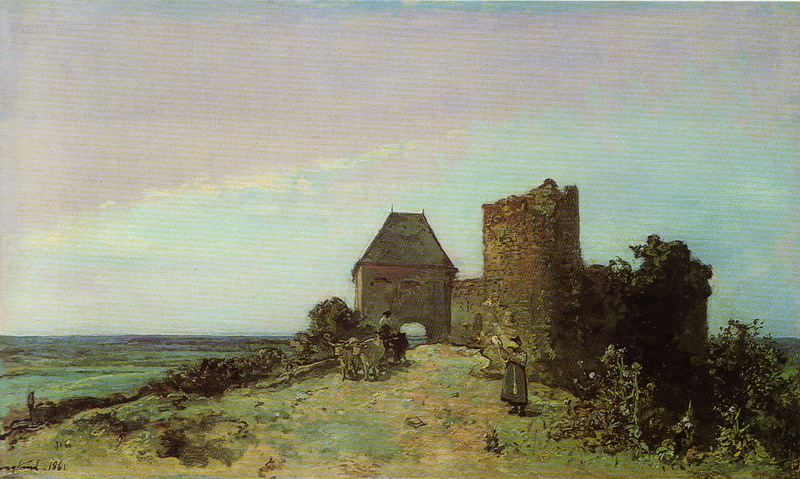
Pioneers of Plein Air Painting: Boudin and Jongkind. With the advancement of industrial technology in the 1850s, the invention of paint tubes (such as packing paint into lead tubes as done today) provided painters with greater convenience, especially for plein air painting. Guided by the Barbizon School's outdoor landscape paintings, Boudin and Jongkind moved their studios outdoors starting in 1858, truly facing natural scenery to pioneer plein air painting. They specialized in depicting natural landscapes under light, particularly the seamless blend of sea and sky at beaches and harbors, extending towards the infinitely changing skies and atmosphere. Art critic Geffroy wrote, "They immersed themselves in the sky of blue heavens and white clouds, approaching the familiar clouds, blocks hanging, disappearing into a gray mist in the distance, while the air emitted a dazzling azure." He concluded, "Black does not exist; the air is clear and transparent." Their works, through fluid and bright painting and subtle brushstrokes, manifested nature's bright light and poetic atmosphere, opening unprecedented painting perspectives and styles, becoming precursors to Impressionism. When the famous Impressionist painter Monet paid his highest tribute to his earliest master, he said, "I became a painter thanks to Boudin's teachings" (the young Monet met Boudin early on in Havre).