Fontainebleau Palace
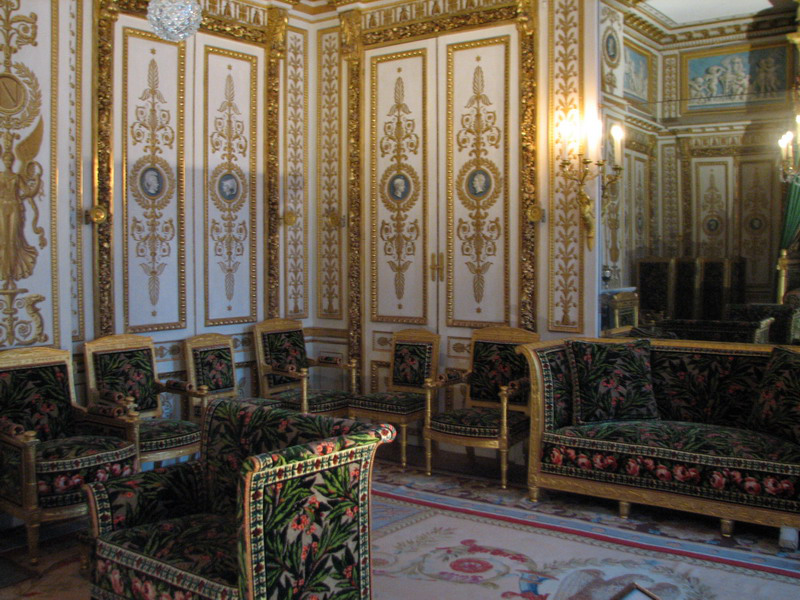
Napoleon I’s luxurious apartments, entirely furnished and decorated in the Neoclassical style.


(Image files provided by Lu Ren-Yang for the Musée National du Château de Fontainebleau) Musée National du Château de Fontainebleau: Address: Chateau du Fontainebleau 77300 Fontainebleau. Phone: 64222740, 64223439. Transport: Take the train from Gare de Lyon towards Chateau-Lilas to Fontainebleau. By car, take exit Porte d’Italie onto N7, then proceed directly to Fontainebleau; or enter via Porte de Vitry onto N19, transfer to N16 (you can also enter via Porte de Vincennes onto N6), pass through Melun, and go straight to Fontainebleau. Opening hours: 9:30–12:30, 14:00–17:00. Closed: Tuesdays. Visit duration: approx. 2 hours. Website: www.musee-chateau-fontainebleau.fr.
Origin of Fontainebleau Palace: Among French royal palaces, the Louvre and Versailles are well-known, whereas Fontainebleau Castle may seem less familiar to us. However, with a slight knowledge of French history, one will recall that Francis I, Henry II, Henry IV, up to Napoleon III—a total of 32 kings and queens—once lived or stayed here. Eight centuries of French history unfolded within Fontainebleau Castle; visiting it guides us into the core of French history.
Origin of Fontainebleau Castle: Located southwest of Greater Paris, between the Seine and Rhône rivers, surrounded by forests and marshes (currently the largest forest area in Greater Paris), and adjacent to the famous Barbizon, Fontainebleau is renowned worldwide for its magnificent castle and is a sanctuary of the French Renaissance. Since the early 12th century, Louis VI frequently hunted here and built a simple hunting lodge. During the reign of Louis VII, a small chapel was added; under Louis IX (Saint Louis), the castle and monastery were expanded, remaining a hunting base for French monarchs until the late 15th century. When Francis I returned victorious from conquering Madrid in 1527, he decided to make Paris his capital. On the site of Saint Louis’s old castle, he commissioned architect Le Breton to plan a new Roman city and specifically invited Italian Florentine painter Rosso and Roman painter Primaticcio to decorate his castle, creating a completely new Renaissance-style palace. Within this refined French Mannerist style, the “Fontainebleau School” of painting was born.
After Francis I died in 1547, Henry II inherited his predecessor’s grand vision. The renowned architect Delorme continued completing Fontainebleau’s most luxurious ballroom and the famous spiral staircase in the White Horse Courtyard.
Henry IV also loved Fontainebleau Castle, continuing to expand the palace and completing the Prince’s Courtyard. At this time, a new decorative art gradually emerged, breaking away from Italian artistic influence and favoring paintings of ancient Greek-Roman or heroic epic themes, becoming a characteristic of the secondary Fontainebleau School of painting.
The main structure of Fontainebleau Castle was largely completed during Henry IV’s reign. Subsequent Bourbon dynasty rulers made many changes and additions. Louis XV finalized the Prince’s Courtyard, and in 1634, architect Du Cerceau rebuilt the perfect spiral staircase in the White Courtyard.
During the French Revolution, Fontainebleau Castle was severely looted. It later became Napoleon’s preferred palace until April 20, 1814, when Napoleon held a grand abdication ceremony in the White Horse Courtyard, never returning after being exiled to Saint Helena Island. During the Restoration, France’s last king, Louis Philippe, renovated it, turning it into the museum we see today.
Visiting Fontainebleau Palace:
The Little Chapel: Built during Francis I, completed under Henry II, and decorated under Henry IV, the entire church is adorned with paintings by artist Freminet on the theme of “Atonement.” In front stands a solemn and sacred altar; in symmetrical niches flanking it are colored marble columns housing two statues (left: Francis I, right: Saint Louis). Louis XV’s grand wedding was held here, and Napoleon III was baptized here in 1810.
Francis I Gallery: This magnificent gallery is the most majestic place in Fontainebleau Castle, built between 1528 and 1530. It is 64 meters long, 6 meters wide, and 5 meters high, serving as a corridor connecting the small chapel and the great apartments. Its dazzling wall decorations are composed of exquisite faux-marble reliefs. These paintings and sculptures clearly display Francis I’s grand political achievements, with 12 major works created by the Italian painter Rosso.
King’s Staircase: Originally the suite of Francis I’s favorite mistress, Madame d’Étampes, featuring mythological wall decorations by the Italian painter Rosso. During Louis XV’s reign, it was changed into a spectacular staircase, with railings adorned with Louis XV’s insignia.
Ballroom: This luxurious ballroom is the most beautiful room in Fontainebleau Castle, built during Francis I and completed under Henry II. It is 30 meters long and 10 meters wide, used for royal celebrations. Striking octagonal gilded and silvered royal insignias and painted patterns on the ceiling perfectly contrast with the intricate octagonal designs on the floor, exuding elegance and grandeur.
Madame de Mailly’s Apartment: Although King Louis XIV (the Sun King) spent most of his time at his new palace, Versailles, he occasionally came to Fontainebleau to hunt and kept his mistress, Madame de Mailly, here in a golden house. This splendid apartment features a loggia (a recessed balcony) and Rococo-style furniture in the living room.
King’s Apartment: This magnificent large apartment faces the Oval Courtyard, mostly built during Francis I. Under Louis XV, it was converted into an reception hall or guard room. Notable for its intricately carved fireplace, it features a central bust of Henry IV surrounded by relief sculptures of child prodigies, and two gentle female statues on either side symbolizing peace.
Reception Hall: Opened into an arcade leading directly to the Saint Louis Hall by Louis XV, the exquisite wall panels are decorated with paintings by Fontainebleau School painter Amboise Dubois.
Saint Louis Hall: Located exactly at the center of Louis IX’s old site, this was once the king’s suite. Under Henry IV, it was changed into a dining room and reception hall, where the king ate before the fireplace. The Louis XIII Hall was originally the suite of Queen Marie de’ Medici. In 1601, the future French King Louis XIII was born here, hence its current name. The entire room is decorated with frescoes inspired by Ethiopian stories. On the way to the painted hall of Francis I, patterns of the royal surname letters (Henry IV and Marie de’ Medici) are painted.
Francis I Great Hall: Over successive dynasties, this hall served multiple functions. The entire hall is decorated with luxurious 18th-century Flemish tapestries, and the perfect coffered ceiling was replaced during Louis Philippe’s reign.
Diana Gallery: Built under Henry IV, rebuilt under Napoleon I, and finished decorating during the Restoration, the entire ceiling depicts the story of the moon goddess Diana. Originally, the gallery exhibited 25 large paintings describing French history; under Napoleon III, it was converted into a library.
Queen’s Apartments: From the Diana Gallery to the Council Chamber belong to the Queen’s Apartments. Facing the Diana Garden, the white living room is also known as the Queen’s Small Salon, originally the place of Henry IV’s wife, Marie de’ Medici. In this delicate and elegant 18th-century living room, the walls are decorated with paintings by Fontainebleau School painter Dubois.
Music Room: Decorated in Italian Pompeian and Ancient Egyptian revival styles, the four corners of the ceiling feature Austrian eagles. It was specially designed for Queen Marie Antoinette, who came from Austria.
Queen’s Suite: All four walls of the suite are decorated with elegant floral wallpaper. The gold-carved headboard is engraved with the Queen’s initial “M.” This has been the suite for queens from the 17th century to the Third French Empire (from Henry IV to Napoleon III), also known as the “Six Marias Suite” because six queens named Maria resided here. The decorations and furniture we see today were left behind by Queen Antoinette.
Reception Room: Like the Music Room, this originates from the masterpiece of the Italian painter Rosso.
Throne Hall: Built under Charles IV, this was the suite for kings from Henry IV to Louis XV. Under Napoleon I, it was changed into a throne court. Directly ahead, the most attractive feature is Napoleon’s throne, inscribed with the emperor’s surname on the circular backrest. A magnificent canopy (blue inside, red outside) hangs from a large crown above the throne. A pair of golden pillars stand on either side, topped with an eagle spreading its wings, standing on a round sculpture of the imperial insignia, full of sacred atmosphere.
Council Chamber: Built under Charles IV, it was an apartment during Francis I and only changed into a council chamber under Louis XIV. The elegant Rococo-style decoration is a work of the Louis XV era. The elegant ceiling is a masterpiece by the famous 18th-century painter Boucher, and the exquisite frescoes are works by Van Loo and Pierre. All furniture is in the style of the French Empire period.
Napoleon I’s Great Apartment: Napoleon I’s Great Apartment is a building parallel to the Francis I Gallery (built under Louis XVI). From 1804 to 1807, it served as Napoleon’s office, and after 1810, became his main living space. The luxurious and comfortable suite is entirely in the Neoclassical style. In the elegant decoration stands a magnificent golden bed (not large, as Napoleon was less than 150 cm tall); the bed curtains feature gold-carved olive leaves. After Napoleon I suffered defeat at the Battle of Waterloo in 1813, he signed his abdication document here on April 5, 1814, in the Red Living Room (whose entire wall surface is decorated with red silk), so this room is also called the Abdication Room. The Red Living Room was previously Louis XVI’s library, became a living room during the French Empire, and displays some Neoclassical furniture.
Queen Mother and Pope’s Apartment: Located in the right wing of the White Horse Courtyard (near the Koi Pond), facing the Fountain Courtyard, this apartment was prepared to host the Queen Mother, but after Henry II’s death, his wife settled here. It is also called the “Pope’s Apartment.” In 1804, Napoleon specially invited Pope Pius VII to cross the ocean to Paris to participate in his grand coronation ceremony, and he stayed in this apartment.
Additionally, there are two museums: The Napoleon I Museum, with a visit duration similar to the Great Apartment, about 40 minutes. Founded in 1986, it is located in the Louis XV Wing on the left side of the White Horse Courtyard. It specializes in exhibiting relics of Napoleon I and his family, including royal family portraits, coronation certificates, crown swords, Napoleon’s magnificent coat, legendary hats, embroidered costumes, activity tents during Napoleon I’s expeditions, marching beds, and portable folding chairs. Another is the Chinese Art Museum, with a visit duration of about 1 hour, located below the Queen Mother’s Apartment, accessible from the Fountain Courtyard entrance. It houses an extremely rich collection of Chinese art works, all fine pieces presented as tributes to the French royal family by various countries, and treasures plundered from China during the Eight-Nation Alliance.
Fontainebleau Gardens: The Fontainebleau Gardens are the precursor to the Versailles Gardens, divided into five main parts: the French Garden, the Koi Pond, the Diana Garden, and the Flower Beds. Among them, there is a pavilion in the Koi Pond (if you have the chance, bring more bread to feed the koi). In the garden, there are fountains, waterfalls, pavilions, a 1-kilometer-long canal, and the King’s Vineyard, etc. (Visit duration: approx. 40 minutes).