Claire
Wall-Small Surface 199x105x6 cm, 2007. Floor-White Commune 270x351x9 cm, 2007.
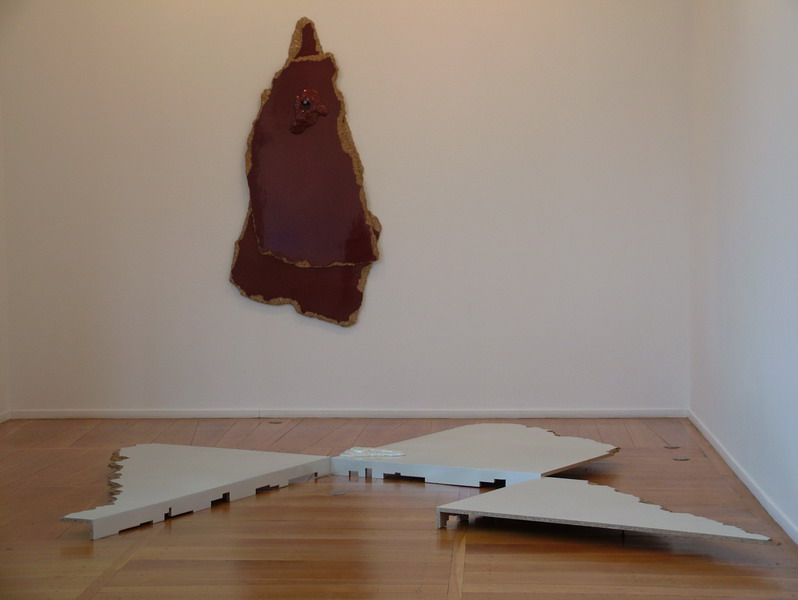


Neither sexy nor decadent in a rock-and-roll sense. Untitled 210x60 cm, 2007. Claire-Jeanne Jézéquel’s solo exhibition “dé-finir”: on view at Xippas Gallery from February 16 to March 26. Born in 1965, Claire-Jeanne Jézéquel is one of the most distinctive female artists of the 1990s in France. Her work explores the space between painting-sculpture and sculpture-architecture; in these three-dimensional sculptural-architectural works, she often evokes the illusion of painting because her pieces are highly flattened, constructing forms against walls and floors that unfold along an imagined spatial horizon. She aims to make viewers aware of systematic spatial bodies as images of mental states, where place becomes a perceptual measure of space yet remains immeasurable.
Claire-Jeanne Jézéquel favors simple materials: starting with plywood (from 1988), moving to aluminum sheets (from 2002), and today using lead. Recently, she has torn plywood and painted it with colors or lacquer, intentionally revealing an extraordinary painterly world. Art critic Jean-Marc Réol writes: “Jézéquel’s sculptures are constructed according to a plan—leaning against the wall and extending along the floor, resembling a relief-like charter. This attitude is based on an ethical stance; she says, ‘The concept of large-scale works is also a kind of failure.’” This stance reflects a dialectic in the desire for form, akin to the fortuitous encounter between spiritual and material development and inevitable destruction and damage. Her works demand “brilliance and destruction,” attempting to incorporate a dissatisfaction with formal perfection. The sculptural process contains this primary tension, manifesting in the formal tension of each piece, allowing her to narrate matter piece by piece. Introduced into this system of primary destruction, they often present accidental volumes that suggest an established poetic incompleteness, opening these works to complex associations: landscapes, ruins, and debris settle into the viewer’s comprehension.” (Note—referencing the solo exhibition press release)