Cubism
Picasso Violin 65x50 Collage 1907 Musée Picasso Paris Collection
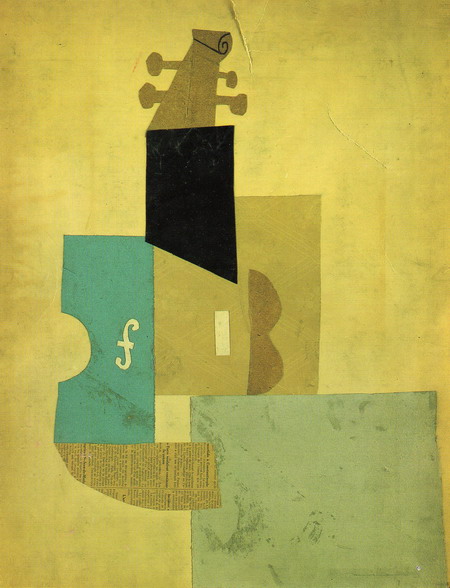
In 1907, when Cézanne held a retrospective at the Salon d'Automne, Picasso completed Les Demoiselles d'Avignon that same year. The following year, Braque held his first solo exhibition at Galerie Kahnweiler, where art critic Louis Vauxcelles used the word "cubes" and later described Braque as reducing everything to "geometric outlines, cubes." Thus, Picasso and Braque had no choice but to keep this name, which gave rise to Cubism.
Cubism was influenced by Cézanne's concept of planning nature (treating nature through cylinders, spheres, and cones) and African sculpture. They abandoned traditional naturalistic imagery, presenting objects reorganized into simple geometries from multiple viewpoints, under simplification, flattening, organization, and abstraction. In short, Cubism is an exploration of form itself; within its rational, precise analysis and combination, it leads perception to expression, or in its process, guides perception toward imagination, opening the door to Western modern plastic arts.