Duchamp-Villon
Horse, Bronze, 150×97×153cm, 1914, Centre Pompidou Collection
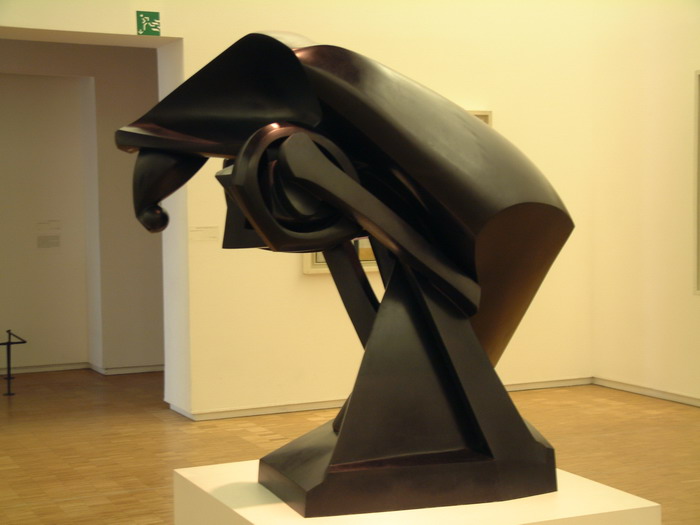
Duchamp-Villon (1876–1918) was a French sculptor and the older brother of the Dada artist Marcel Duchamp. Among their family’s six siblings, three were painters, but he alone pursued sculpture, initially influenced by Rodin. After 1910, he adopted a simplified natural form language to explore cubism, developing his most famous work, Horse, by establishing expression through light and movement within more concrete Cubist features. This piece represents the culmination of his most important modern sculptural aesthetics in his lifetime. Is this a horse? What does a galloping horse look like? In this black static sculpture, the artist captures natural vitality through the horse’s simplified form—grasping its main anatomical muscle structure—and under the energy of simple, powerful, mutually influencing rhythmic forms and concave-convex sculptural shapes, creates a visual dynamic that seems to dance and leap. Synthesizing two-dimensional dynamic imagery with three-dimensional mass and light, it endows the viewer with a strong sense of speed and perfectly presents the aesthetic of a new artistic era—the Industrial Age.