Futurism
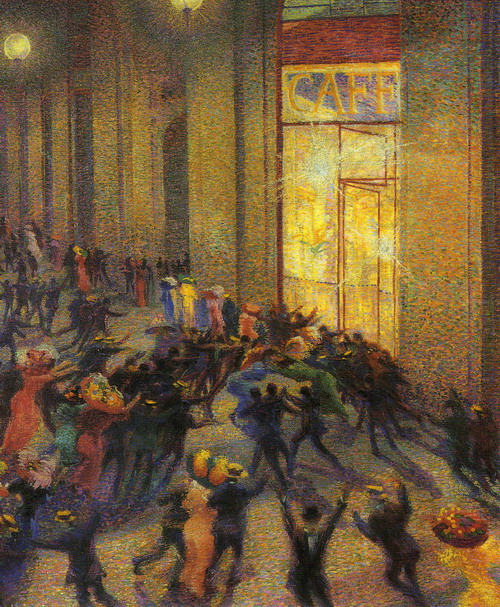
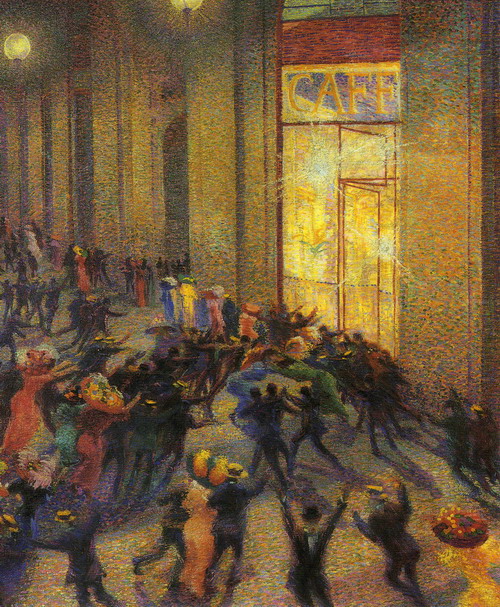
Boccioni - Larixe In the Universe 76x64cm 1910 Milan Pinacotheque Museum Collection
Carra - Galli Funeral of the Anarchist Galli 185x260cm 1911 New York Museum of Modern Art Collection
Futurism was born in Italy. The poet Marinetti published a manifesto in 1909, declaring that past art was dead, and announcing the birth of Futurism and a new aesthetic standard: "A racing car is more beautiful than the Victory of Samothrace." In 1910, a group of painters (Boccioni, Carra, Russolo, Balla, and Severini) jointly published the Manifesto of Futurist Painters: "Everything moves, everything is in constant change. The contours of things are not static in our eyes, but constantly appearing and disappearing, disappearing and appearing. Things in motion appear to multiply in our eyes, chasing each other, trembling rapidly in their space of movement. A running horse has twenty legs, not four, and its leg movements form triangles." Here, a new absolute—speed—is declared, a new vision—modern life—and a new cause—technology. Under an optimistic drive, Futurists emphasized the dynamics of modern life: using Divisionist (Neo-Impressionist) techniques, under the influence of Cubism's interlocking forms, rhythm, color, and light, to express an optimistic feeling, a state of simultaneity, and the diverse structures of the visible world. Futurist experience foreshadowed the arrival of Dadaism, Surrealism, and the Happenings art of the 1970s.