Giotto (1266–1337) – The Lamentation of Christ (1304–1306)
The Lamentation of Christ (1304–1306), 200×185 cm, fresco. A Florentine, he was the most important painter of Italy’s Proto-Renaissance and the founder of modern Western painting.
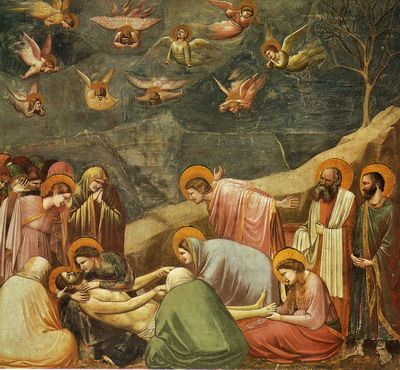
The Lamentation of Christ (1304–1306), 200×185 cm, fresco. A Florentine, he was the most important painter of Italy’s Proto-Renaissance and the founder of modern Western painting. He pioneered naturalistic realism in Western art history, breaking through the rigid forms of Italo-Byzantine art to create solid, spatial paintings with highly natural and three-dimensional figures. Infusing his passion and imagination into the scenery, this spirit of factual representation became the mainstream of Western painting.
The Lamentation of Christ (1304–1306): 200×185 cm, fresco, Scrovegni Chapel, Padua. The fresco is housed in the Scrovegni Chapel near Venice in Padua. Giotto presents one of the most tragic moments from the Bible, expressing human despair, heartbreak, and pain. Jesus Christ appears to have just been taken down from the cross and laid on the ground. The Virgin Mary, dressed in black, mournfully embraces his lifeless body. One female saint supports his hand, while another (Mary Magdalene) holds his feet. The weeping scene is surrounded by saints with solemn expressions. On the left, two female saints—one raises her hands in disbelief and disappointment, the other clasps her hands beneath her face in grief—followed by a crowd. On the right, two male saints display solemn demeanors; the central figure may be Saint John, leaning forward in despair with arms outstretched in a wail. In the foreground, two figures wrapped in garments provide viewers with an illusion of participating in the event.
The painting is clearly divided by diagonal rocks into heaven and earth. Ten little angels in various postures and expressions convey their deep mourning. This severe rocky landscape intensifies the sorrowful atmosphere of the celestial and earthly tragedy. Giotto moved away from the volume-less medieval style and discarded gilded backgrounds, entering a three-dimensional world of pictorial illusion that welcomed new light and emotion. His lifelike figures under solid naturalistic realism create a sense of photographic truth, making viewers feel as if they are witnessing the heartbreaking event firsthand. This profoundly moves the human soul, conveys sincere religious sentiment, and ushered painting art into a new era.