Honoré Daumier - Radical Sensibility in Realism
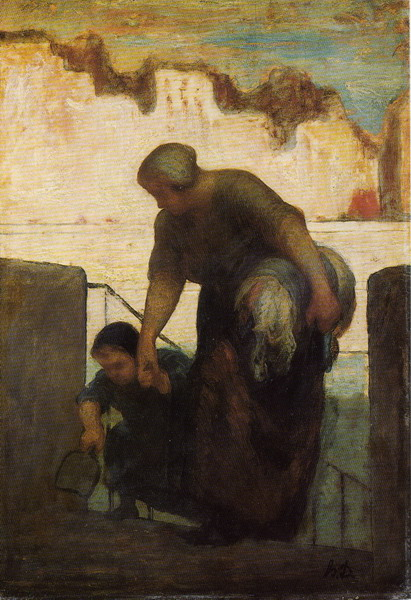
Daumier (H. Daumier) Woman Washing and Ironing Clothes, 49×33.5 cm, 1863, held at the Musée d'Orsay, Paris ;;

Daumier (H. Daumier) Servant and Cunning Man, 60.5×82 cm, 1864, held at the Musée d'Orsay, Paris. Honoré Daumier (1808–1879) was famous for his social and political satirical cartoons. In his extraordinary paintings and sculptures, he presented a radical realism with critical power through subjective forms and expressive colors, foreshadowing the arrival of Expressionism driven by subjective consciousness.
Following the Enlightenment of the 18th century and the French Revolution, civil society gradually flourished. Radical artists abandoned utopian ideals, delving into the realities of life to express concern for the lower classes. These two works, Woman Washing and Ironing Clothes and Servant and Cunning Man, are examples. With a sensitive eye and sharp depiction, Daumier used expressive forms and chiaroscuro to boldly reveal the will to survive and living conditions of the lower class in Woman Washing and Ironing Clothes. Servant and Cunning Man dramatically exposes another dark side of societal collusion.
Additionally, there is his series of 36 bust-sized polychrome terracotta statues. Using satirical techniques, Daumier depicted famous political and social figures of the time, including politicians, journalists, poets, and ministers of the interior. These oil-painted sculptures, nearly cartoon-like, reveal the artist’s daily observations of society. His sharp and awe-inspiring works demonstrate his keen insight into criticizing the dark sides of society.