Mont Saint-Michel Abbey (Le Mont
The breathtaking Mont Saint-Michel Abbey is the world's most unique church, built upward around a granite mountain in a pyramid shape. Situated on the peak, it is supported by platforms of small chapels bearing the weight of the 80-meter-high structure. One of the world's ten wonders, it was designa
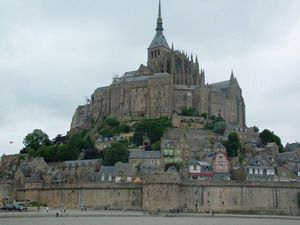
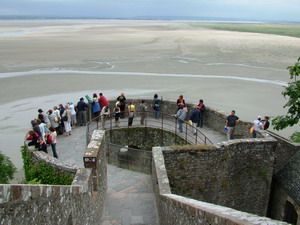
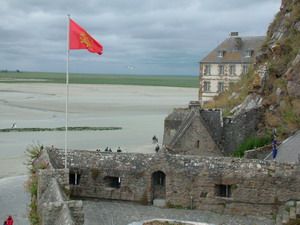
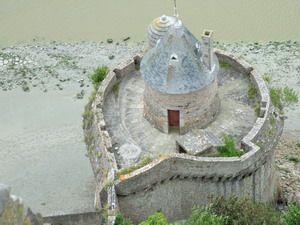
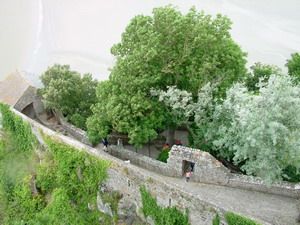
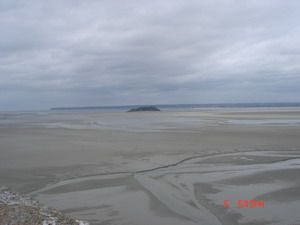
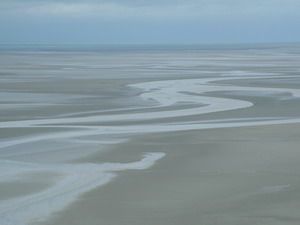
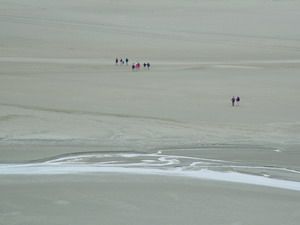
The breathtaking Mont Saint-Michel Abbey is the world's most unique church, built upward around a granite mountain in a pyramid shape. Situated on the peak, it is supported by platforms of small chapels bearing the weight of the 80-meter-high structure. One of the world's ten wonders, it was designated a UNESCO World Heritage site in 1979 and serves as a pilgrimage site for French believers. Located on France’s eastern coast at the border between Normandy and Brittany, it stands on a rocky islet (nearly 900 square meters) surrounded by tidal flats. In the Middle Ages, tides occurred twice monthly, reaching heights of 14 meters—the highest in Europe. Due to the flat surroundings, rising tides swept sand at 15 km/h, isolating the abbey until the tide receded. Pilgrimage was thus a trial of life; many were swallowed by quicksand, earning the area the name "Dangerous Sea of Saint Michael." It is no wonder this unique structure has survived.
The abbey originated in 708 AD when Bishop Saint Aubert of Avranches built a small chapel on the tomb, updating the previous Carolingian monastery dedicated to the Archangel, quickly becoming a Catholic pilgrimage site. Before the 10th century, a Romanesque monastery was established. In the 11th–12th centuries, a Romanesque church was built on the rock above the underground Virgin Mary chapel, laying the foundation for the north wall. In the 12th century, the Roman monastery expanded westward and southward. In the 13th century, after King Philippe-Auguste conquered Normandy, he funded the construction of the awe-inspiring Miracles Building, a complex of two three-story Gothic buildings surrounding the cloister and refectory. During the Hundred Years' War in the 14th century, military fortifications were added to resist English invasion. Despite the English army’s prowess across Brittany, they could not breach the fortress, making Mont Saint-Michel a symbol of French national spirit. The name Saint Michael refers to the young warrior saint holding a sword and scales (judgment) while trampling a dragon (defeating evil). Pilgrimages continued and flourished, with nobles, middle-class citizens, and the poor visiting regularly. A village formed below, developing hotels, handicrafts, local shops, and commercial areas as seen today.
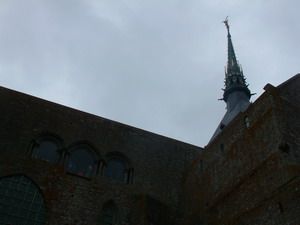
In the 15th century, the collapsed Romanesque altar was replaced with a Flamboyant Gothic altar, forming its current appearance. By the 16th century, it was an essential religious destination for French people, but declined after the Reformation in the 17th century. In 1780, the nave columns were destroyed by fire, giving the Romanesque facade a classical look. Before the French Revolution, parts of the abbey served as an infamous prison, known as the "Bastille of the Provinces." After the Revolution, the church was dissolved, and in 1811, it became a general prison for criminals and political prisoners like Barbes and Blanqui. Today, the museum displays torture instruments, reminiscent of Alcatraz. The prison operated until 1863; ten years later, it was planned as a historical monument and underwent large-scale restoration. In 1897, a gilded bronze statue of Saint Michael holding a sword and scales (10 meters high) was erected atop the new bell tower, making it a unique and charming tourist destination visited by millions annually.
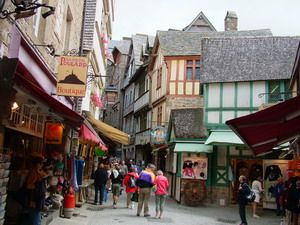
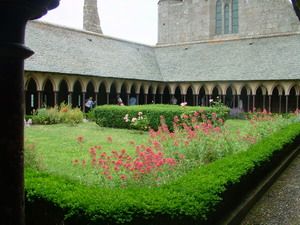
The entire Mont Saint-Michel is a fortified mountain city with high defensive walls and only one entrance through the fortress gate. Entering through the solid Royal Gate (15th century), visitors walk down narrow, long streets unchanged for five centuries, lined with Norman black-and-white arched houses housing shops, hotels, restaurants, and souvenir stores. Climbing further leads to the church fortress gate, which isolates the site when closed. Sloping stairs through arches enter the fortified courtyard, leading to a beautiful gate that opens the journey into the abbey: passing the defense hall, climbing 90 steps to the Saut-Gaultier platform, where the church is on the right and the cloister residence on the left, connected by aerial corridors. Continuing forward to the west platform and church square offers a panoramic view of the sea. The magnificent church sits on rocks nearly 80 meters high. The nave features arcades, galleries, tall windows, and barrel vaults, creating a spacious, bright Romanesque example. Ahead lies a mesmerizing Flamboyant Gothic altar (900 steps from the entrance to the church). Entering the captivating cloister, the central courtyard is an open medieval garden surrounded by intricately carved double colonnades, facing the sea to the west—a place for monks’ walks, meditation, or singing. The cloister connects to the Miracles Building, two three-story Gothic structures surrounding the cloister, guest rooms, and refectory, where monks once ate. Descending leads to the guest rooms, featuring a 35-meter-long Flamboyant Gothic vaulted ceiling, where kings such as Louis IX, Louis XI, and Francis I stayed. Next are the crypts beneath giant columns supporting the upper monastery. Entering the Saint Martin crypt, then the huge wheel built in 1820 for transporting food during the prison era. The chapel is accessed via north-south stairs under the west platform, leading to a long hall used by monks for walking. Further ahead is the spacious Knights' Hall (26m x 18m), where monks studied. Finally, the Almonry, located below the Knights' Hall, was where the monastery distributed aid to the poor and various pilgrims.