Manet - Luncheon on the Grass
Luncheon on the Grass, 208×264.5 cm, 1863. Collection of the Musée d'Orsay, Paris.

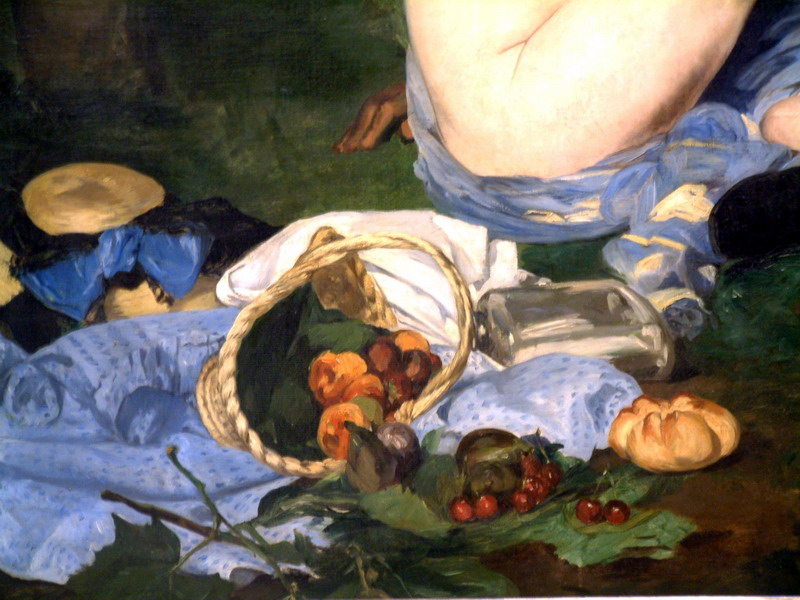
Detail of Luncheon on the Grass. The bold depiction of still life reveals modernist expression methods. Manet (1832–1883) was a pivotal French painter bridging past and future. His early works drew inspiration from classical masters, particularly those of the Spanish Golden Age. In his extraordinary bold and concise works, vigorous brushstrokes and sensual colors showcased a unique modern style. In Luncheon on the Grass and Olympia (1863), Manet continued to innovate, uniquely transforming natural objects into an autonomous world of plastic art, becoming a forerunner of Impressionism and sowing the seeds of modern painting. From Gauguin to Matisse, from Fauvism to abstract art, all were deeply influenced by him.
When Manet completed Luncheon on the Grass and Olympia in 1863, Daumier had finished Women Washing, Cabane The Birth of Venus, and Rodin the sculpture The Man with the Broken Nose. These two masterpieces by Manet sparked public outrage, not only due to moral concerns but also because of their painting technique. Regarding the theme, it is purely artistic form; Manet interpreted a print by Raphael and transformed Titian’s Concert Champêtre. The subject matter itself was challenging. He depicted a picnic in a clearing, with two well-dressed men accompanying a very relaxed nude woman. As contemporary critics mocked: "Manet intends to astonish the bourgeoisie, especially through his strange and decadent taste." They failed to see how effectively Manet transformed modern life. However, the bright light, air, and strong color contrasts on the canvas had already opened the door to modernist painting.