Mark Rothko – Untitled (Black on Brown)
Untitled (Black on Brown), 1964, Centre Pompidou, Paris
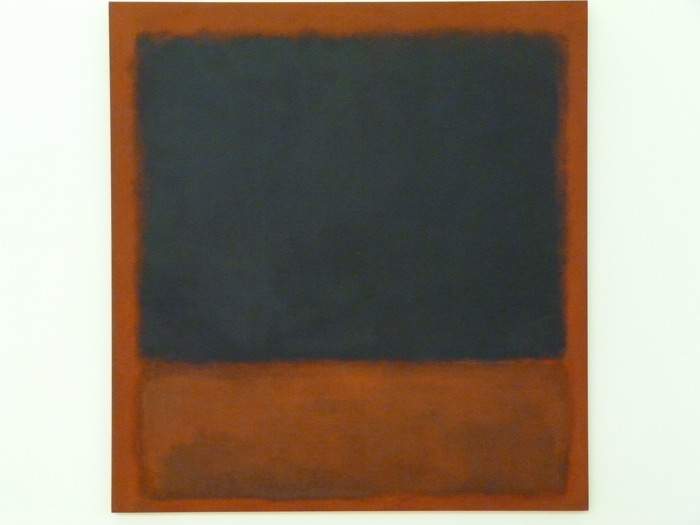
Mark Rothko (1903–1970) is one of the most representative painters of the American Abstract Expressionist movement in the 1950s. He is famous for his serene and composed large color-field paintings, which permeate an extraordinary spiritual sensitivity. His early work oscillated between Expressionism and Surrealism. From 1947, he shifted toward a lyrical and calm abstract painting style, attempting to reveal subtle light through the combination of uncertain rectangular geometric forms on contrasting or adjacent hues, color fields, and flat planes without visible brushstrokes, all built upon the trembling of keen colors to convey inner perception and awaken spiritual consciousness. The artist stated: "Simple expression of complex thought."
Between 1950 and 1970, he continued to explore mysterious color rhythms and subtle variations, gradually shifting from bright tones to somber and dark hues. Untitled (Black on Brown) demonstrates this process: two rectangles (one black, one brown) surround a saturated brown area, highlighting the subtle changes in immaterial color light. Rothko’s color-field painting thus became another starting point for abstract art after "painterly abstraction."