Miquel Barceló "Skulls and Shells" Solo Exhibition
(Top) One of the poetic "Skulls and Shells" series works from 2006. (Middle left) The quite abstract "Shells" work from 2006. (Middle right) One of the bewitching "Skulls and Shells" series works from 2006. (Bottom) A distinctive 2007 sculpture mixing Ku Klux Klan imagery with animals. Miquel Barcel


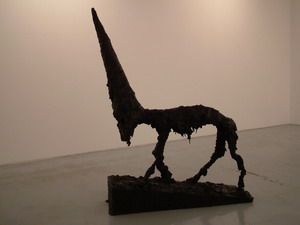
(Top) One of the poetic "Skulls and Shells" series works from 2006. (Middle left) The quite abstract "Shells" work from 2006. (Middle right) One of the bewitching "Skulls and Shells" series works from 2006. (Bottom) A distinctive 2007 sculpture mixing Ku Klux Klan imagery with animals. The Miquel Barceló "Skulls and Shells" solo exhibition is on display at Y Lambert Gallery from April 14 to May 26.
Born in 1957, Miquel Barceló is one of the most representative artists of Spain's new generation. Since the 1980s, his work has revolved around the unique material energy of Spanish painting, expressive tension in form, and emotional color, intertwined with a consciousness of existence within the grand tradition of Spanish humanism. This particularly echoes the strong will to life and tragic depiction of death found in Goya's Black Paintings, exploring the essential nature of human existence.
He chose expressionist forms early on to express his consciousness. Through emotional brushstrokes, expressive figurative forms, and distinctive emotional colors, combined with Barcelona's traditional, unique, and rich material textures, he operates between figurative and abstract forms. His purified language strongly reveals inner emotions, presenting a state of consciousness. In his fluid, nomadic creative process, Barceló maintains keen sensitivity; this nomadic lifestyle and its tensions guide him to construct the essential reality of pictorial forms through environmental spatial differences.
Having traveled extensively between major cities in Europe and America and Africa (Senegal), the "Skulls and Shells" series exhibited in this solo show seems to originate from his time in Africa. There, he could truly face the primitive state of nature and the tragic nature of life. On the African continent, natural death and the death of nature become one; skulls symbolizing life become natural objects like shells. These elements are mixed into Barceló's inner mental images in the "Skulls and Shells" series. Against powerful black-and-white visuals and bewitching material textures, they present a vast natural scene. Under bright light, figurative shell forms and prominent skulls are purified (with only simple pencil outlines). Overall, they are quite abstract (concise forms, enhanced materiality, and accentuating black spots), yet upon closer inspection, the meaning becomes clear. They generally surround giant shells (which are actually skulls when viewed carefully), with various bewitching shells scattered across the surface. Under these elusive and ambiguous forms, a space of virtuality and reality emerges, filled with deep poetry and mystery under an unnamed perception.
Barceló says, "In my paintings, I like dual expression. Often there is an ambiguous feeling. I like to look closely at my paintings; you can see something, or else it cannot be perceived. Only up close can you. I like that surface, which connects to that appearance. Thus, I create that final rough surface, giving a necessary clarity to seeing this natural phenomenon, within the dual expression of tension and rigorous structure in the painting. Besides, these things were almost elusive before me, representing an unclear expression and anti-tradition."