Nathaniel Rackowe "Pathfinding" Solo Exhibition
"Black Shed" detail 240x230x300cm 2008


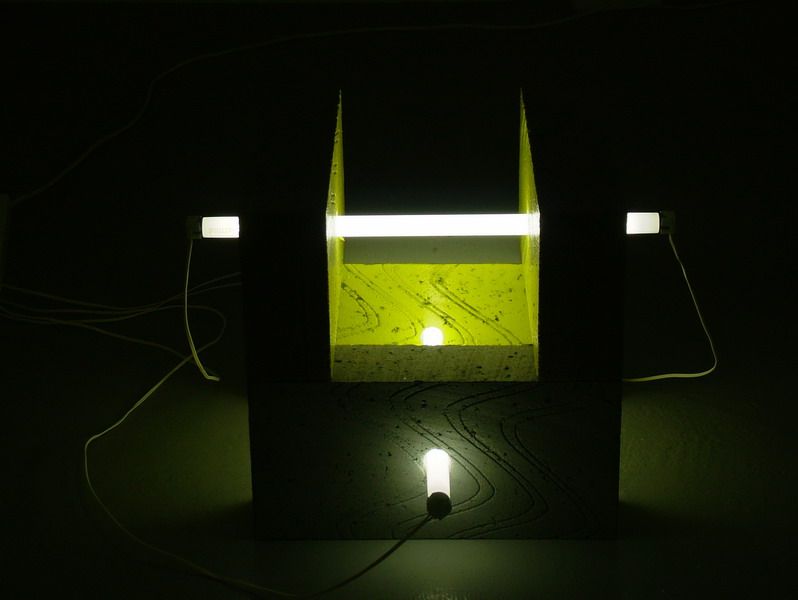
Aereted Blocks -2 44x44x44cm 2008
Nathaniel Rackowe's "Pathfinding" solo exhibition was held at Almine Rech Gallery from June 14th to July 19th. Nathaniel Rackowe (born 1975) is a British artist of the younger generation, who narrates the grandeur of modernism through dramatic object-sculpture-installations. Utilizing everyday objects and light within construction and restoration, he builds his extraordinary sculptures. In the theatrical forms of light and shadow, structure and architecture, site and imagination, under an atmosphere of unease and fear, he synthesizes the worlds of Constructivism's Tatlin and Minimalism's Flavin.
The theme "Pathfinding" draws inspiration from video games, built upon the encoding of computer information, which allows for the creation of convenient access to system pathways, equally establishing the concept of location, all hinted at in the artistic presentation and its outcome. The exhibition centers around the monumentally-scaled work "Black Shed," an object-installation of a gardener's wooden shed with yellow neon and a moving light bulb. Geometric, regular lines of light emanate through the gaps between the horizontal wooden planks. The artist masters the surface characteristics of materials, considering a narrative approach and constructing an extraordinary atmosphere.
"SP-For V Tatlin" appropriates Flavin's 1964 neon composition "Monument for V. Tatlin-1," elucidating modernist forms within a postmodern perfect simulacrum. "Pathfinding" is constructed from a series of standard concrete blocks, with a white neon light emanating from a groove in the center, residing within the characteristics of Minimalism. "Sliced Door 5," within a modernist geometric construction, evokes a Minimalist structure, rhythmically composing a series of wood and light. The light animates the physical environment, space, and imagination.
The geometrically furniture-like "WLP7" is constructed from two wooden panels on a wall, concealing a lighting device within. The light reflects the geometric form, revealing form and lines, creating an atmosphere and becoming the soul of the work. Evidently, Rackowe provides a temporal orientation; through these mechanical technical constructions, within the structural regulations of modernism, he develops and displays his dreams.