Odilon Redon "With Closed Eyes"
With Closed Eyes 38.1×30.2 cm, 1890, held in the Musée d'Orsay, Paris.

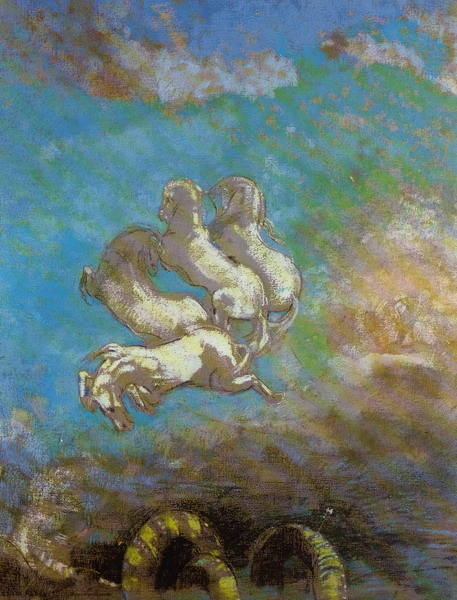
The Chariot of Apollo 91×77 cm, 19051914 (pastel) Held in the Musée d'Orsay, Paris. Artist: Odilon Redon (18401916). Redon was a uniquely individual French Symbolist painter. His works are full of literary quality, adept at interpreting his profound, dreamlike inner world from the external world of appearances. His inspiration came from religion, mythology, and the depths of his subconscious.
"With Closed Eyes" is another captivating and substantial work by Redon. It is like an immaterial image of a dream, radiant and dreamlike, interpreting the artist's extraordinary state of mind and imaginative world. The portrait of a young man with closed eyes lies horizontally, suggesting a state of deep sleep, dream, and death. In this dreamlike vision, it symbolizes an unreality close to the subconscious. The painter explained his concept of painting thus: "I practice an art according to myself; I open my eyes to see this beautiful visible world, what people can say, and a tenacious submission to the laws of nature and life (...). I believe that submission to this secret law guides me in a laborious way, as best I can and according to my dreams, where I deploy all that I have (...) because nature also instructs us to submit to what she gives. But my things are led into dreams: I suffer the entanglements of imagination and am surprised by what comes from the pencil: it guides and leads me to these extraordinary accidents, according to the rules I understand and feel, the only result the viewer can obtain, through a substantial power of fascination, the whole manifestation, all the uncertain temptations onto this unusual territory of thought."
After 1890, Redon found the medium of pastel to interpret his inner world. "Bodhisattva" is the most famous work in his pastel series. The piece displays a mysterious, dreamlike, serene, and meditative world, elegant like poetry. The Bodhisattva strolls in a forest of illusions, emanating a transcendent religious atmosphere.
In "The Chariot of Apollo," we do not see the chariot, only four powerful horses galloping through the blue sky among clouds. This is a manifestation where the idea surpasses the form; it constitutes a fragment of a mythological narrative. On one hand, it takes shape in the viewer's imagination, and on the other, it presents the artist's spiritual world.