Cézanne (P. Cézanne) - House and Jas de Bouffan Farm
House and Jas de Bouffan Farm, 60×73 cm, 1885-1887, National Gallery Prague. This innovative work is Cézanne’s most stylistic exploration...
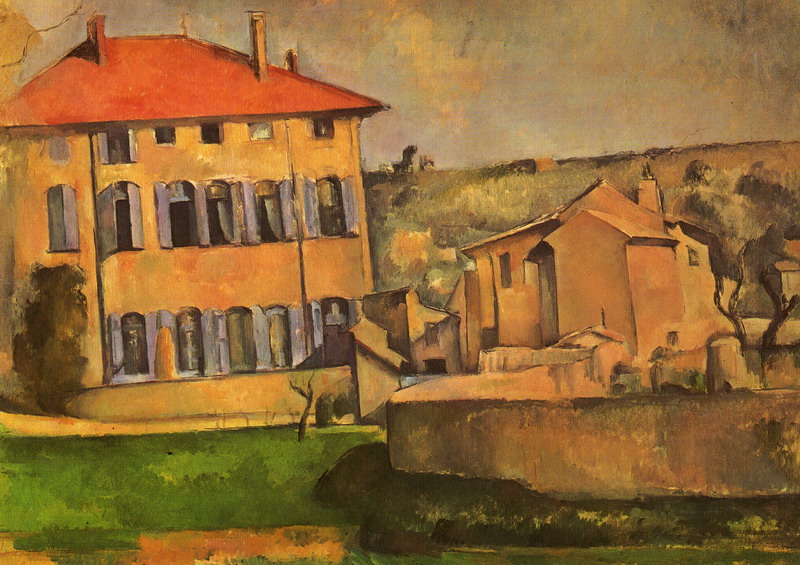
House and Jas de Bouffan Farm, 60×73 cm, 1885-1887, National Gallery Prague. The innovative House and Jas de Bouffan Farm is Cézanne’s most stylistically exploratory work. After his painting "Landscape with House on a Hill" was ignored and criticized, he endured humiliation and worked hard for years; after ten years of exploration, he finally developed here the unique style that defines Cézanne. Natural elements are streamlined to achieve a precise value as formal elements, with natural landscape serving merely as an excuse for painting.
The bright painting of the House and Jas de Bouffan Farm appears quite flat. The house and farm buildings are presented in geometric facade forms using multiple viewpoints. Under this geometric structural framework, the house on the left and the group of buildings on the right become facades (precursors to Cubism). The vertical structure of the buildings is balanced by parallel lines of the walls and ground. The left house tilts slightly, intersecting with the distant perspective lines, forming an organic geometric rhythm (the clever part of the painting).
Here, a regular brushstroke pattern clearly appears, with semi-transparent colors applied like watercolor. Within the overall warm color tone and rigorous formal structure, this landscape painting becomes extraordinary. (Similar intent to the contemporary "Blue Vase")