Mondrian (P. Mondrian) - New York City
Mondrian (P. Mondrian) - New York City (I) 119.3 × 114.2 cm, 1942, Collection of Centre Pompidou Museum of Modern Art
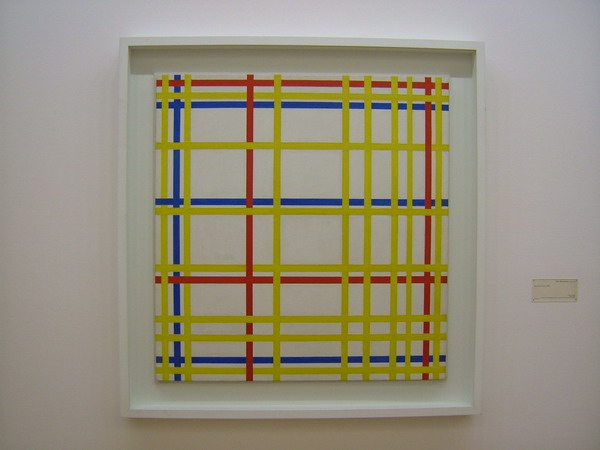
Mondrian (P. Mondrian, 1872–1944), a Dutch painter, was one of the founders of 20th-century geometric abstraction and a theorist of Neoplasticism. His geometric abstraction evolved from the derivation of Cubism.
Mondrian said: "The appearance of things brings joy, the essence of things reveals life." This painting is a masterpiece from his later New York period. Concluding the Neoplasticism of his Paris period, the colors within the black lines and square forms disappeared, replaced by lines of yellow, red, and blue.
Here, Mondrian explored color and space with a new appearance, endowing the canvas's construction with a painterly space. Through the weaving of geometric color lines and alternating overlaps, white areas were left on the picture plane (implying its most effective time). Greenberg said: "Now it involves the most rigorous vision of three-dimensional space, the most rigorous painting."
Mondrian said: "Now I understand that my black lines and small color patches were only sketches for oil paintings. In sketches, lines are the primary means of expression, because in painting, lines are absorbed by the color planes themselves, while retaining the full value of the lines within them."