Paolo Uccello (1397-1475) - The Battle of San Romano (c. 1456)
The Battle of San Romano (c. 1456), 180×316 cm, tempera on panel, Louvre Museum collection. He was one of the most representative painters of the Florentine School; his art, continuing Massaccio's legacy, was also deeply influenced by Brunelleschi and Donatello.
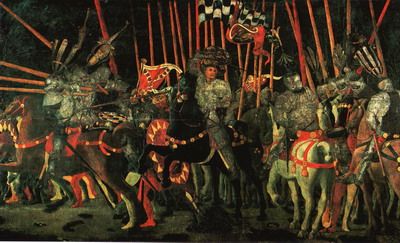
The Battle of San Romano (c. 1456), 180×316 cm, tempera on panel, Louvre Museum collection. He was one of the most representative painters of the Florentine School; his art, continuing Massaccio's legacy, was also deeply influenced by Brunelleschi and Donatello. He devoted his life to the study of perspective, seeking to grasp the three-dimensionality of objects through bold lines, rich colors, and complex forms within a self-realistic style. In his rigorous organization, he perfectly rendered acute perspectival space. His paintings often achieved perfection amidst verticality and horizontality, chaos and order, sensibility and rationality, and reality and imagination. His greatest contribution to art history lies in perspective, particularly in his masterpiece series "The Battle of San Romano."
The Battle of San Romano is a triptych and Uccello's magnum opus. The left panel is housed in the National Gallery, London; the central panel in the Louvre, Paris; and the right panel in the Uffizi Gallery, Florence. This series depicts the fierce battle between the Florentine army and the Sienese army in the wilderness. Careful appreciation reveals its dramatic quality, like toy knight puppets. Within the naturalistic realism of the early Renaissance, it demonstrates accomplished perspective through rich colors, complex forms, attempts to grasp object volume, especially in overlapping images, extending lines, and the size and position of objects. These works achieve perfection in verticality and horizontality, chaos and order, sensibility and rationality, and reality and imagination. Uccello's rigorous and perfect perspective studies became the paradigm for perspective painting at the time. Clearly, his inspiration for figures resembling puppet knights and horses came from ancient Roman stone carvings, not from real-world objects.