"Play Back" Special Exhibition
Exhibition signage on the wall of the Paris Municipal Museum
Exhibition signage on the wall of the Paris Municipal Museum
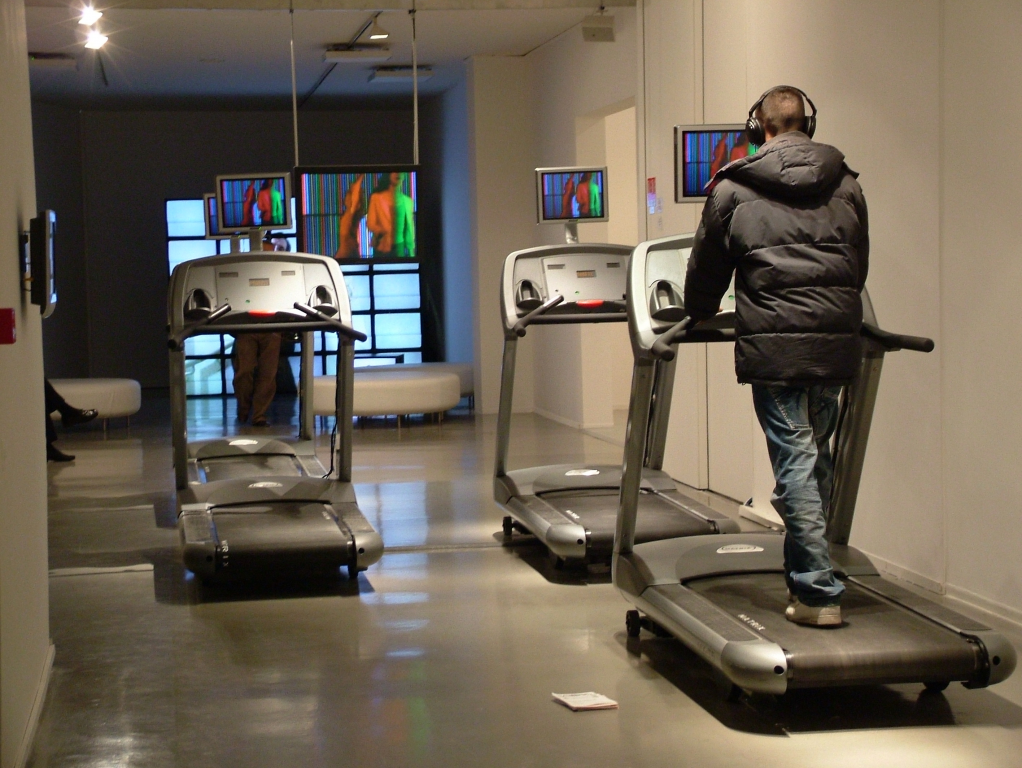
Young artist Melik Ohanian's Hit, combining bodily movement and video, 1999.

Karaoke exhibition space scene by artist Mario Garcia Torres, 2004.
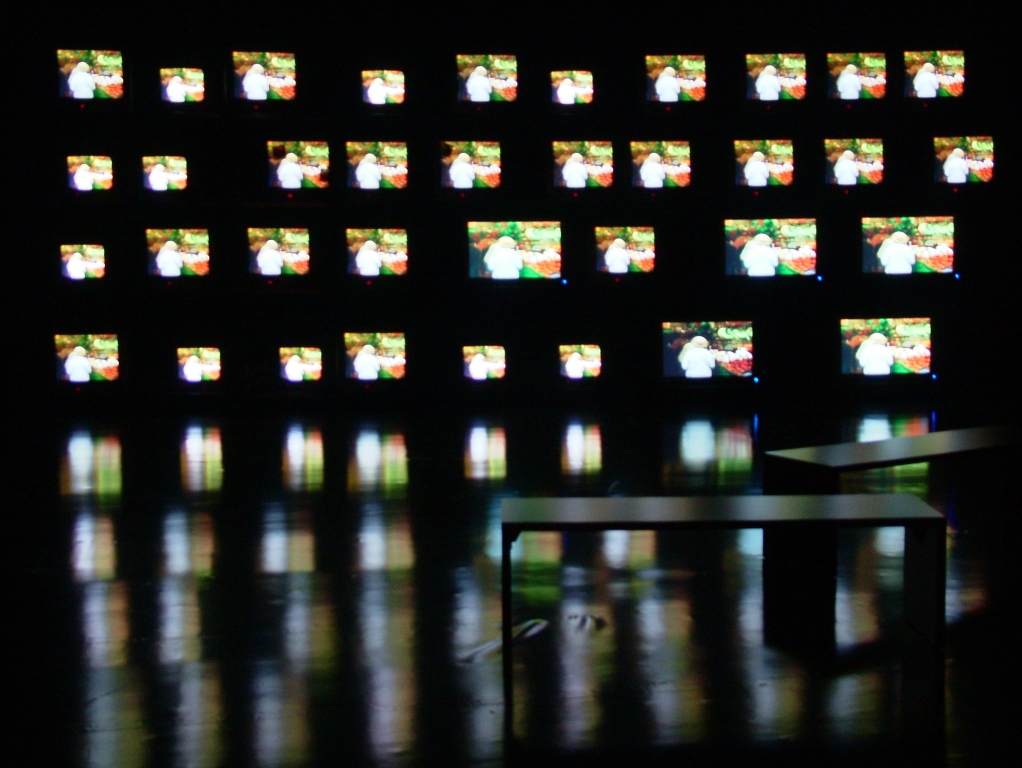
Audio-visual art combining television recording and film—Seen on TV exhibition space. The "Play Back" special exhibition was held at the ARC (Art et Recherche Centre) of the Musée d'Art Moderne de la Ville de Paris from October 20 to January 6, 2008. This exhibition is the result of developments in video art, exploring composite arts under contemporary digital images and new technologies, specifically Karaoke, KTV, and MTV audio-visual art. Through free borrowing forms from original music star videos or artists' performances and experimental recordings, this exhibition begins with a groundbreaking practice between Nam June Paik's electronic brushwork Dripping Television and current (or famous) video artists' Name Dropping works.
The overall exhibition features works that oscillate between humility and arrogance across sound, music, experimental film, language, performance, advertising, cinema, and more. All possess experimental characteristics and raise inappropriate political content, indirectly posing questions of personal identity and relational display: social, political, gender, ethnic, etc. Audio-visual media has become a widespread tool for contemporary artists to transmit information and influence the public.
"Play Back" proposes three areas of exploration: First, music, text, and film are edited into various themes as continuously flowing television programs. Two attitudes face music: the Best of Danse exhibition aspect, simultaneously enjoying change and contrasting with the pseudo-static Best cf Posture. Second, language and life writings appear in Karaoke. Third, the game-like Bootleg / Covers et Alike series cycles short films through broad sensory references. Finally, Seen on TV gathers all commissioned works from artists, broadcasting colorful short clips of famous movie and singing stars on television (KTV and MTV from the 1980s to present), collectively presenting a non-linear video history. Particularly through these diverse revitalized styles and some heterogeneous elements, it creates a Zapping effect: mixing certain parody and humor with video introspection, narrativity and abstraction, film and cartoon animation, groundbreaking products and amateur silhouettes.
The "Play Back" exhibition features a groundbreaking decorative scene layout: Upon entering Bonus, an indoor sports exhibition room allows audience participation; each exercise machine has a flat-screen TV where viewers can watch short clips while exercising: Melik Ohanian's "Hit" (1997), Paul McCarthy and Damon McCarthy's "Newport Caroler Mimic" (2005). In the same room, Best cf Posture features a large screen continuously playing experimental video art since the 1970s: Laurie Anderson's "O Superman" (1981), Joseph Beuys's "Sonne Statt Reagan" (1982), Thomas Hirschhorn's "Prince and Me" (1995), Eri Duyckaerts's "Kant" (2000), Young-Hae Chang's "Heavy Industries" (2006), etc. Then, inside a Karaoke studio with a large screen and microphone, audiences can sing along enthusiastically to the videos and subtitles appearing on screen: Les Malas Amistade's "Bolitas Canicas" (2000), Roberto Cuoghi's "Foolish Things" (2002), Kati Rule's "I am a lover. Not a Dancer" (2002), etc. Following this, the Bootleg / Covers et Alike series offers a comfortable sofa-chair cinema, continuously screening short clips of today's most dramatic and representative TV singing stars and experimental works by many young artists: Devo's "Whip it" (1980), Dara Birnbaum's "Fire /Hendrix" (1982), Christelle Lheureux's "Vague /E la rave Va" (2006), etc. Finally, the Seen on TV exhibition room resembles a department store display of series of televisions of various sizes, projecting experimental short clips by famous and young artists under a highly dramatic audio-visual theater setting: Andy Warhol and Dan Munroe/The Cars's "Hello again" (1984), Robert Breer and William Wagman with New Order's "Blue Monday" (1988), Tony Oursler and Sonic Youth's "Tunic (Song for Karen)" (1990), Damien Hirst and Blur's "Country House" (1995), Cao Fei's "Hip-Hop Guangzhou" (2003), Antoine Catala's "Winnie le peyote" (2005), etc., all showcased under extraordinary audio-visual and ambiguous lighting, opposing traditional long-form uninterrupted video, expressing originality within exploratory so-called non-paradigms.