Viewing the Centre Pompidou Collection – “Arte Povera” Special Exhibition
Exhibition space for artists Alberto Burri, Lucio Fontana, and Piero Manzoni who influenced Arte Povera.
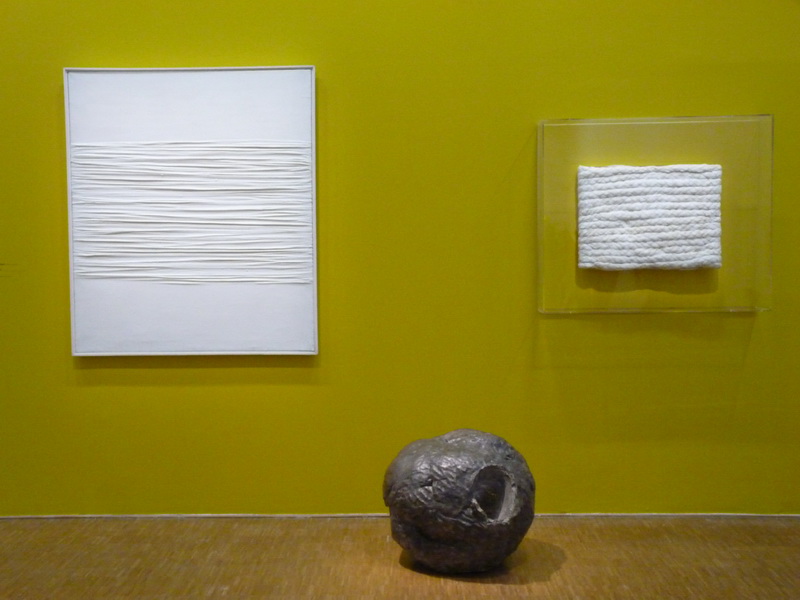
Text/Photos by Chen Chi-Hsiang | Dates: June 8 to August 29 | Location: Pompidou South Gallery
Arte Povera is Italy’s most significant modernist art movement after Futurism and post-WWII Europe, representing a grand artistic trend in post-war Europe capable of rivaling American art on equal footing. It emerged as a negative outcome of American Minimalism; explicitly, it was a complete rejection of Minimalism or the internationalized art promoted by the United States.
In the fifth issue of Flash Art magazine in 1967, critic Germano Celant declared: “It intends to establish an anti-authoritarian stance against American hegemony, giving Europe new momentum as opposition to the international culture driven by the US, which monopolizes industrialized Minimalism.” From this cultural awakening arose an exploration of artistic identity rooted in origins, excavating and developing ancient European civilizations and expanding unprecedented fields of modern art. Regarding Arte Povera’s reflection of ancient Italian cultural traditions, Celant stated: “Symbols, magic, obscurity, alchemy—these are very European elements. Under this magic, Arte Povera is combined.”
Featured artists include Mario Merz, Jannis Kouneillis, Michelangelo Pistoletto, Giovanni Anselmo, Luciano Fabro, Gilberto Zorio, Giuseppe Penone, Giulio Paolini, Alighiero Boetti, Pino Pascali, Piero Gilardi, and Emilio Prini.