July Notes – Painting, Heatwave, World Cup
Painting is the most enjoyable moment of life.
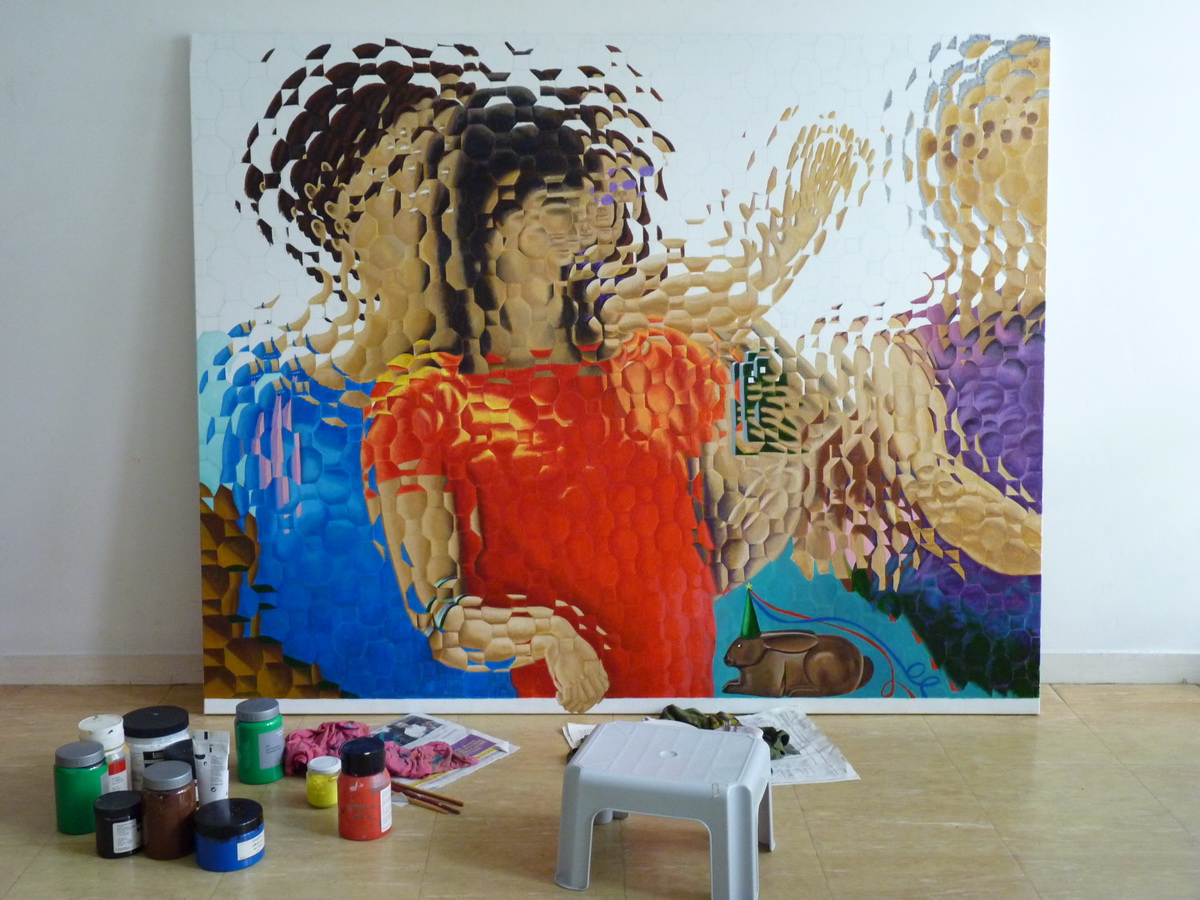
Text and images by Chen Chi-Hsiang. The July notes have three keywords: painting, World Cup, and heatwave. Every summer I have more time to tend my backyard and engage in painting creation, continuing to explore the existential consciousness of contemporary life. Especially under technological communication and the virtual internet, there is a hidden worry that one almost forgets who they are. I feel that people today are oppressed by their life tools and media, chased by time and compressed into flat space, with fragmented mental states. People spend all day staring at their phones, endlessly swiping; the "phubbing" habit has become a daily ritual, indulging in the virtual world, invisibly hijacked by the tools they use without being able to extricate themselves. Information is now readily available, enriching people's lives but also manipulating them. Drunk on illusory fluid values, an era of foam-like intellectual weakness is taking shape, moving toward a scenario where artificial intelligence replaces human existence. Entering the big data era means entering an era of complete control. I often think it wouldn't be difficult to completely pause contemporary life: interrupt the global communication system, go to an ATM to withdraw cash, but no money comes out, and people panic, not knowing what to do. We shouldn't continue to indulge; it is time to rethink life.
Entering this year's creation from June's gentle breeze and sunny skies, July was even more attacked by a heatwave. Hiding in the shade to paint is the best way to escape the heat; indeed, a calm mind naturally feels cool. Painting helps me find myself again, stimulating my imagination and creativity. Especially in recent years, I chose the most difficult method of creating fine-grid paintings, challenging my own carefulness, patience, concentration, and willpower. I gather my heart, return my mind to its proper place, leisurely enter meditative creation, and soar within painting.
In 2018, the World Cup finals began in July. This year I didn't watch many matches (only France's semi-final and final), and I wasn't very concerned about the games. This time, the French team fought bravely, overcoming obstacles. All of France and Paris went crazy (supporting their own team); flags were hung everywhere to cheer for the national team, full of confidence in their own squad. Interestingly, even though I didn't watch the match, I knew who won because every time France played, whenever they scored, the whole city would erupt in cheers or boos, allowing one to understand the game situation. The president promised the team that if they really advanced to the final, he would personally attend to support them.
Unexpectedly, the French team really had good luck. When they advanced to the final, all of France and Paris were extremely excited. Streets and alleys were filled with the sound of car horns honking and crowds waving flags and cheering "On va gagner!" (We will win!). It was a crazy celebration. On the day after Bastille Day, double joy arrived as France faced Croatia in the final. The two teams were evenly matched. In the exciting final, the Croatian team made mistakes, conceding two goals (scoring two own goals). The brave and fighting French team had high morale and finally won 4:2, making a long-desired perfect dream come true. The World Cup winner was France. All of France and Paris went crazy, and the people collectively intoxicated in the atmosphere of triumph. Just look at the crazy celebration scene on the Champs-Élysées in Paris that night to know. There hasn't been such spontaneous madness for a long time, making the French proud, writing a new record in French football history 20 years later.
The biggest feeling in July was the deadly heat. The scorching temperature broke the high temperatures since the last century. It is hard to imagine Paris reaching 41 degrees (it is said that in a certain countryside in central France, the sun reached 52 degrees at noon, and 38 degrees in the shade, oh my god!). This is the hottest summer I have lived in Paris for thirty years. Recently, the average has been around 35 degrees or above. Every heatwave causes air pollution in Paris. Although public transportation in the city is free, except for necessary outings, I hide in public spaces (with air conditioning) to escape the heat or stay in the cool shade at home, avoiding the fierce sun tiger. I thought it would pass in a few days, but unexpectedly, heatwaves came one after another. According to weather reports, this was caused by strong hot air pressing in from the African continent, covering all of France. Actually, the heatwave swept across the entire Northern Hemisphere. Rising hot temperatures meant Central Europe, Eastern Europe, and Southern Europe were all in ovens with steaming hot temperatures (refer to chart: Southern Europe Italy and Spain around 47, Greece 48.8, France 44.1, Germany 40.3, Eastern Europe 41-44, Northern Europe 35-38, Siberia 45.4). All of Europe was under high-temperature red alerts. The high temperatures in July this year set a historical record for Europe, and the scorching heat continues to August today. The extreme heat has caused droughts and disasters across the European continent. Rainfall is scarce. Under the greenhouse effect, wildfires rage, with forest fires in many places in Europe. A rarer phenomenon is that during this deadly heat, Paris experienced a storm with hail one evening. Is this a natural disaster or a man-made one?