Paris French National Day (2007)
(Fig. 1 left) A formation of Mirage fighter jets flying low over the crowd during the 2007 Bastille Day parade, trailing blue, white, and red smoke. (Fig. 1 right) EU military representative teams at the 2007 Bastille Day. (Fig. 2 & 3) Spectacular fireworks over the Seine on Bastille Day. The annual
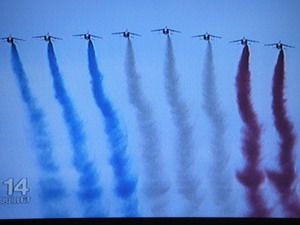
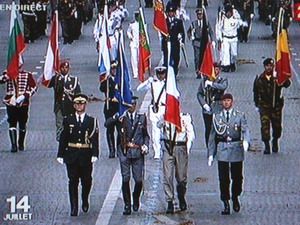
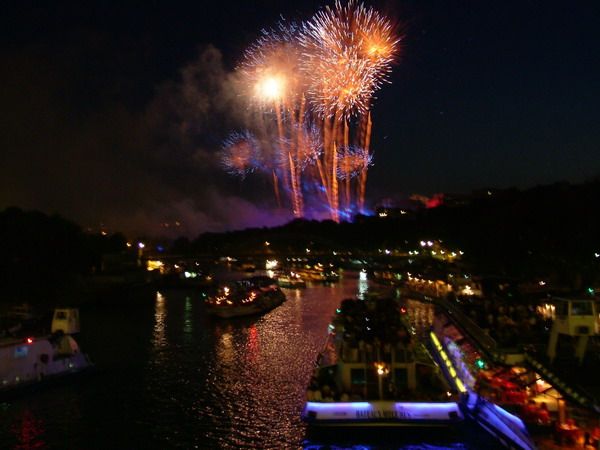
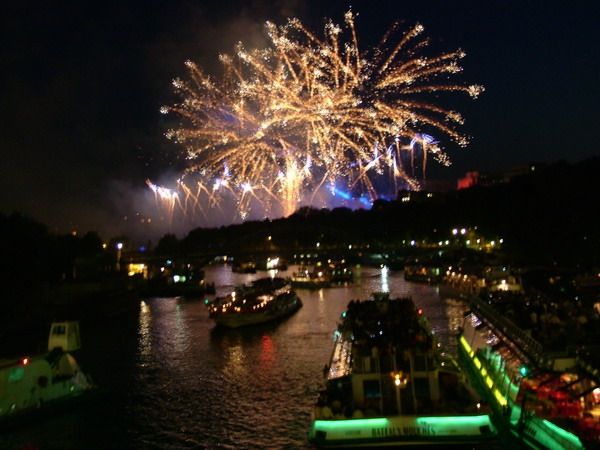
(Fig. 1 left) A formation of Mirage fighter jets flying low over the crowd during the 2007 Bastille Day parade, trailing blue, white, and red smoke. (Fig. 1 right) EU military representative teams at the 2007 Bastille Day. (Fig. 2 & 3) Spectacular fireworks over the Seine on Bastille Day. The annual French National Day (July 14) is Paris’s largest carnival during the summer vacation. This year was worlds apart from the past; amidst a new political atmosphere driven by an energetic new president and government, the public became the measure of this new politics. Public support and applause were needed, becoming the driving force for innovation. Especially with the new president expressing his completely different new political philosophy through "rupture," every action and gesture in his "president-celebrity" administrative style became media fodder. There were frequent unexpected moves, as the new government attempted to project a close-to-the-people image and charm.
This year’s unique National Day drove all of Paris into a frenzy. On the evening of the 13th, an extraordinary, grand, and lively folk concert and ball took place at Place de la Bastille, featuring passionate African music as the main theme. That night, Place de la Bastille became Paris’s largest nightclub and dance floor. The public joyfully danced to the music, attracting nearly 200,000 Parisians and tourists, bringing the National Day to a peak of folk entertainment. Especially during this summer holiday, many young people rejoiced wildly until dawn.
The next day, on this joyous National Day, rare clear sunshine had prevailed since June. The traditional ceremony was held grandly on the Champs-Élysées. Early in the morning, the avenue was already packed with spectators. Many French people hoped to see the new president, Nicolas Sarkozy, at his first military review. Like usual military carnivals, this year’s live TV coverage focused entirely on the president. Leading the National Gendarmerie on horseback, he descended from the Arc de Triomphe with vigor. Unexpectedly, as the presidential car approached the reviewing stand near Place de la Concorde, he stepped out to greet cheering citizens lining the street, accepting their applause before proceeding to the stand.
This year’s striking National Day review mainly highlighted the various political, economic, and military relations within the EU. In addition to inviting numerous EU guests to the stands, the heroic troops from the 27 European allied nations passed the reviewing stand in neat formation to thunderous applause. A formation of Mirage fighter jets flew low over the crowd, trailing blue, white, and red smoke. Then came wave after wave of magnificent naval, army, air force, marine combat units, and Alpine special forces, resembling machines. Next, heavy motorcycle-mounted special police units rumbled by, followed by light machine gun jeep combat units, amphibious tank special units, and light and heavy tank units. Finally, the Paris Fire Brigade closed the show, ending this extraordinary review amidst audience cheers.
Afterward, President Sarkozy, accompanied by the EU President, shook hands one by one with representatives holding EU military flags. The president and his wife proactively visited the disabled veterans’ delegation area to show care for their disabled compatriots. This unusual move raised questions: was it a show or a genuine act of closeness to the people? Everyone knows the president-celebrity likes to stage shows, but it also signaled a new politics and style that stood out. Finally, under live TV cameras, a shot of the president’s family appeared, suggesting profound meanings and political messages.
In the past, the president would deliver a speech on public television at noon after the review. Under the new president’s new style, this ritual of addressing the nation was canceled, representing a rupture with the past political system and a stance of new politics. Instead, he hosted a banquet for 5,000 civilians and officials in the gardens of the Élysée Palace, including invitations to 2,000 social activists. The new president signaled praise for social morality; these actions and styles were unprecedented.
Besides the grand military review on the world-famous Champs-Élysées during the day, folk dances were held on streets in various urban areas at dusk (organized by local fire departments). Most attractive was the grand European superstar concert held on the Champ de Mars lawn below the Eiffel Tower in the evening (e.g., French veteran rock singer Michel Polnareff, who lives in seclusion in California, organized by the government). The president himself led new cabinet ministers and senior officials to attend. It attracted almost all Parisians and tourists, especially the youth. Over 500,000 viewers gathered to listen to this unprecedented concert, illustrating the immense political implication contained within this collective entertainment.
Following the concert, the National Day fireworks display began at Trocadéro in front of the tower. The area around the tower was already packed to capacity, and all nearby metro stations were blocked. Arriving at Invalides station at 8:00 PM, I got off in the crush and moved with the crowd toward the tower. Everywhere was jammed, making further progress impossible, so I found a spot on the Alma Bridge. After waiting nearly three hours and watching boats on the Seine, when the Eiffel Tower finally shone alone against the twilight, the bridge was filled with people. Suddenly, the tower’s mesmerizing single light went out. In the darkness, one by one, dazzling floral fireworks exploded with booming sounds. Poetic, colorful sparks bloomed brilliantly in the night sky.
Finally, beneath a sea of vibrant, extraordinary, and dazzling multi-colored fireworks, the Parisian summer reached its climax, beautifully concluding this unique French National Day. Only the next day, through news reports, did I learn that this unique concert and spectacular fireworks display involved over 600,000 participants in Paris’s National Day entertainment feast. This was an unprecedented French National Day. The new president and government intended to gain public favor through these mass popular programs, hoping to win more public appreciation and affirmation.