Parisian Horticultural History: Italian Renaissance Gardens
(Top) Parisian imitation of Renaissance gardens - the Square Rene le Gall's terrace floor inlay pattern resembles the magical imaginative paintings of Renaissance painter Arcimboldo. (Bottom) The Square Rene le Gall, located in the 13th arrondissement, is sufficient to reveal the perfection of Renai

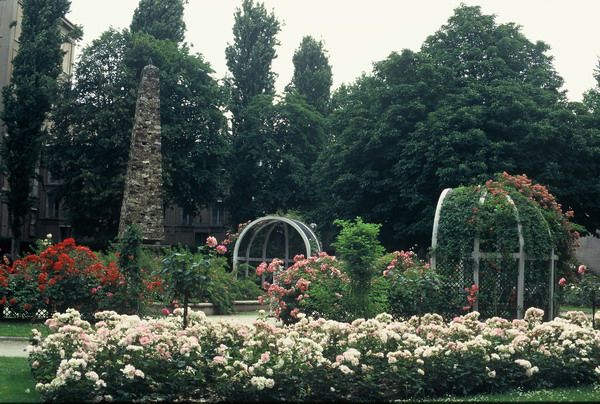
(Top) Parisian imitation of Renaissance gardens—the Square René le Gall’s terrace floor inlay pattern resembles the magical imaginative paintings of Renaissance painter Arcimboldo. (Bottom) The Square René le Gall, located in the 13th arrondissement, is sufficient to reveal the perfection of Renaissance gardens.
The Italian Renaissance movement of the fifteenth century was the most notable and abundant era in Western civilization history. It was a period of flourishing humanism and plastic arts, simultaneously ushering in this new form of Western garden art. This exquisite and perfect Italian Renaissance garden, brimming with humanistic spirit, was introduced to France by King Charles VIII after his expedition to Italy in 1496. He opened a Pacello-style Italian Renaissance garden on the terrace of his Château d'Amboise along the Loire River, thereby creating France’s first garden of living aesthetics. Later, through Louis XII and up to Francis I, it reached its peak. The Château de Fontainebleau, especially in the suburbs, was particularly famous, having specially invited Italian artists to participate in its construction. Exquisite and perfect Italian Renaissance gardens became the model for all royal gardens in France from the sixteenth to early seventeenth centuries; famous examples include the gardens of the Château de Fontainebleau, the Tuileries Garden, the Saint-Germain-en-Laye Garden, the Villandry Castle Garden along the Loire River, and finally the Luxembourg Garden, all belonging to this type.
Sixteenth-century French gardens were subordinate to castles, arranged in simple geometric patterns resembling chessboards, decorated with neatly trimmed short boxwood, yew, and green lawns in geometric and curved shapes, pleasing to the eye and full of visual beauty (this is the origin of the lush evergreen floral patterns in French gardens). At that time, gardens were still surrounded by city walls or verdant hedges, and water features and statues had not yet displayed their proper functions and roles. However, leisurely strolling had become a fashionable ritual for royalty and nobility, further expanding into a distinctively French excellence in humanistic living aesthetics. (Among the series of gardens established in Paris during the 1930s, an imitation Renaissance garden was completed—the Square René le Gall.)