France's Black Thursday
(Image) French President Sarkozy, the enigmatic woman, and First Lady Cecilia. Image from yahoo.com.tw Chinese news. On Thursday, October 18, a nationwide transport strike paralyzed France...
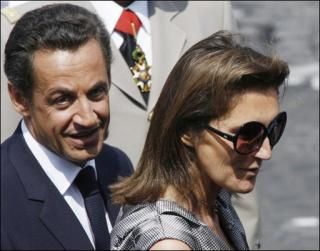
(Image) French President Sarkozy, the enigmatic woman, and First Lady Cecilia. Image from yahoo.com.tw Chinese news. On Thursday, October 18, a nationwide transport strike paralyzed France. Approximately sixty towns across the country staged protests, with unions pressuring the President to abandon his "special retirement scheme" reform plan (which previously allowed retirement after 37.5 years of service, but now requires meeting the 40-year threshold for other civil servants or private sector employees). Black Thursday not only crippled domestic and international transport throughout France but also disrupted normal social operations; it was the largest national strike since 1995. Unions, usually divided, united in this unprecedented social battle against special retirement reforms. Participants included not only railway workers and provincial metro staff but also EDF (Electricité de France), telecom operators, and primary and secondary schools. This was the most severe labor unrest in twelve years under President Sarkozy, representing an unprecedented, though not necessarily final, challenge to his social reforms. The French public acknowledges that societal progress and trend reforms are inevitable, yet unions ultimately seek to defend their historically significant retirement benefits. The weight of this resistance will become leverage for future negotiations with the government. Laurent Fabius, a veteran of the Socialist Party and former Prime Minister, stated on Monday morning: "Working is hard, and early retirement is deserved. If that is not the case, colleagues must have equal retirement conditions to be fair." Jean Grosset, leader of the UNSA union, declared: "This strike is larger and more powerful than in 1995. We agree to correct the special retirement system, but not as proposed by the government. We do not oppose increasing years of service, but we disagree with working more while earning less." However, President Sarkozy adopted a tough stance, refusing to be threatened by the strikes. He said, "The current labor measures burden the government's finances, are outdated and unfair. If no reform is made, the people should worry!" Thus began the battle over the special retirement system between unions and the government, suggesting the drama was just beginning.
During the nationwide strike on Black Thursday, the Élysée Palace spokesperson dramatically announced in fifteen words: "Sarkozy and First Couple Cecilia officially divorced," ending weeks of rumors about the President's separation from his wife. This enigmatic couple appeared emotionally estranged, their tabloid story unfolding like a thrilling romance novel, far more dramatic than fiction. The story began when young, handsome Mayor Sarkozy met his future wife in 1984 during a televised wedding hosted by TV presenter Jacque Martin. Unexpectedly, the host became infatuated with the young, beautiful woman (Cecilia). The smitten young mayor launched an intense romantic campaign, and under Sarkozy’s relentless pursuit over four years, they fell in love, leading to Cecilia’s divorce from Jacque Martin. Sarkozy separated from his own wife the following year. With a smooth political career, he served as Minister of Economy under Édouard Balladur’s government from 1993 to 1995, gradually emerging as a rising political star due to his decisive nature. He finally finalized his divorce from his ex-wife in 1996 and immediately married Cecilia in October of that year, becoming the most prominent blended family at the time (Cecilia brought two daughters, Sarkozy two sons), living a loving life. In 2003, the ambitious Sarkozy became Minister of the Interior under Chirac, with Cecilia serving as his closest and most important assistant. His career soared, and they became the brightest couple in Parisian politics and society. A year later, they had a son. No one expected that in 2005, the enigmatic Mrs. Sarkozy would suddenly disappear, leaving her beloved Nicolas to roam Paris and New York with her lover. Tabloids like Paris Match revealed her secret affair, causing a scandal akin to a tragic opera of joy and sorrow. Since becoming Minister of the Interior in 2003, Sarkozy had openly displayed ambitions to be France’s next president, framing all actions as steps toward candidacy. By early 2006, as the presidential race heated up and Sarkozy emerged as the right-wing candidate, Cecilia returned to his side to support his crucial campaign. Her motives remained opaque to outsiders. Sarkozy publicly declared, "He and his beloved wife will never be separated again" (seemingly a strategic image management tactic for the election). Yet Cecilia remained elusive. Although she reluctantly accompanied her husband to vote in the first round, she disappeared again, even vanishing during the second round. Media confirmed Cecilia did not vote (Sarkozy was accompanied by his two daughters born to Cecilia), highlighting the mysterious nature of this independent woman who evoked both love and frustration in Sarkozy.
The theatrical illusion peaked at the celebration party after Sarkozy’s election as President. Only his two elegant daughters accompanied him in the presidential car; the future First Lady remained invisible. Late into the night, escorted by numerous presidential confidants, Cecilia appeared at the Place de la Concorde victory rally. Former Defense Minister (and current Interior Minister) Michèle Alliot-Marie held Cecilia’s hand and placed it in Nicolas’s in a seemingly intimate gesture. Before the inauguration, Cecilia repeatedly expressed reluctance to become First Lady. Yet at the ceremony, she performed the role of harmonious family matriarch, dazzling in glamorous attire as she led the entire family into the Élysée Palace. During the solemn inauguration, the President frequently thanked his wife Cecilia and his family. In this perfect, joyful image of the presidential family, President Sarkozy kissed his beloved wife to conclude the event.
It seems becoming First Lady of France did not capture Cecilia’s heart, revealing her superior charm and independent attitude. In June, during the G8 Summit, she accompanied the President with great dignity but returned to Paris alone beforehand, confusing the French public. To repair her image, in July, Cecilia traveled to Libya as a presidential envoy to resolve the issue of Bulgarian nurses, only to face harsh criticism from the French opposition. Feeling wronged and unable to compromise, she rarely appeared in public thereafter. During the summer vacation, the presidential family went to the United States for a holiday. President Bush and his wife hosted a banquet, but Cecilia missed it citing ill health. A few weeks prior, when President Sarkozy visited Bulgaria, the First Lady did not accompany him, leaving Bulgarian authorities disappointed in their planned recognition. Two years earlier, she had shared her personal feelings: "Public life no longer suits me; it does not align with my inner self." Cecilia emphasized that she prefers darkness, tranquility, and stability. She has always known she had a public figure as a husband and accompanied him for twenty years. "When you marry a politician, private and public lives merge, and that is where the problem begins." Rumors and discussions about the President and Mrs. Sarkozy’s separation continued until the Élysée Palace spokesperson on Black Thursday confirmed the fact of their split. As the Chinese saying goes, "Cultivate oneself, regulate the family, then govern the state and bring peace to the world." The French President’s current situation can be described as: "The realm remains, but the beauty has left; regulating the family and governing the state cannot be achieved simultaneously."