"Stardust or the Last Frontier" Thematic Exhibition
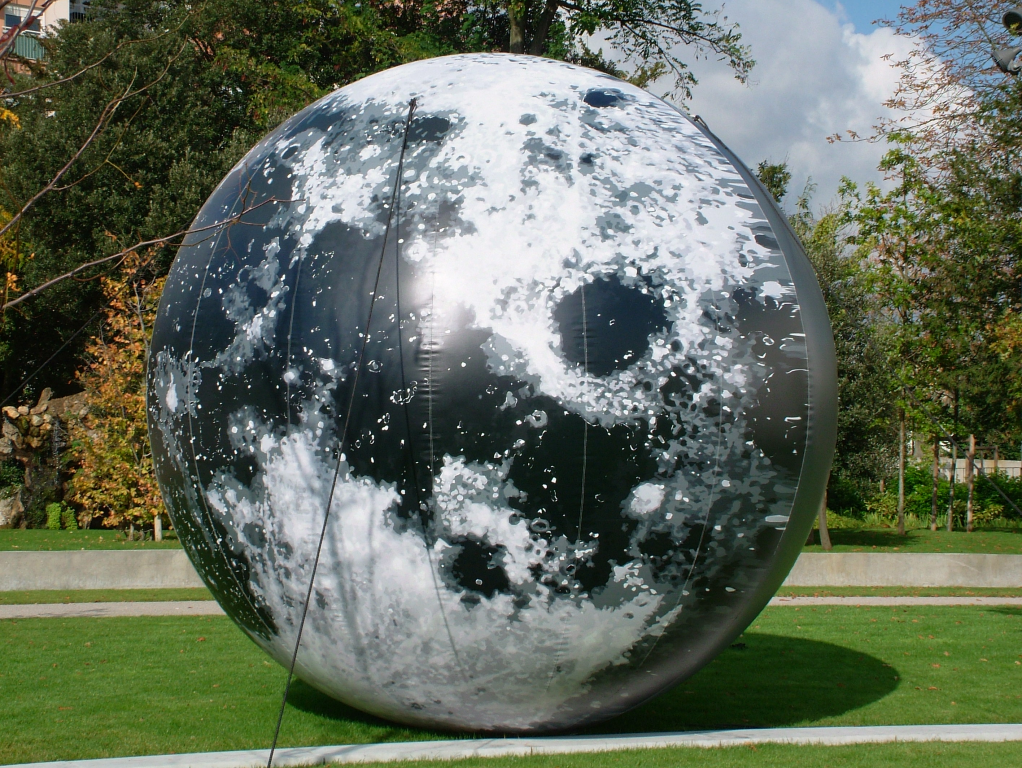
Bruno Peinado's Earth outdoor installation, 4m, 2006. {{0007%20%20Yink%20Shonibare%20-MBE%202002%20sPACE%20WALK.png}} Yink Shonibare, Spacecraft-Object Installation, 2002.


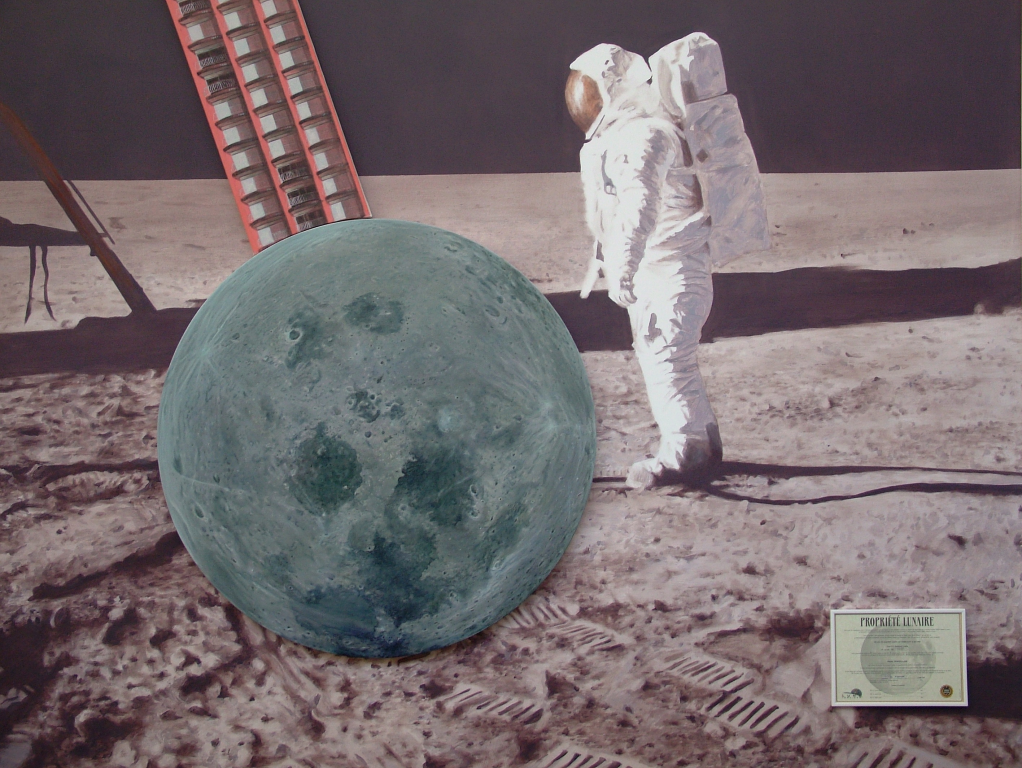
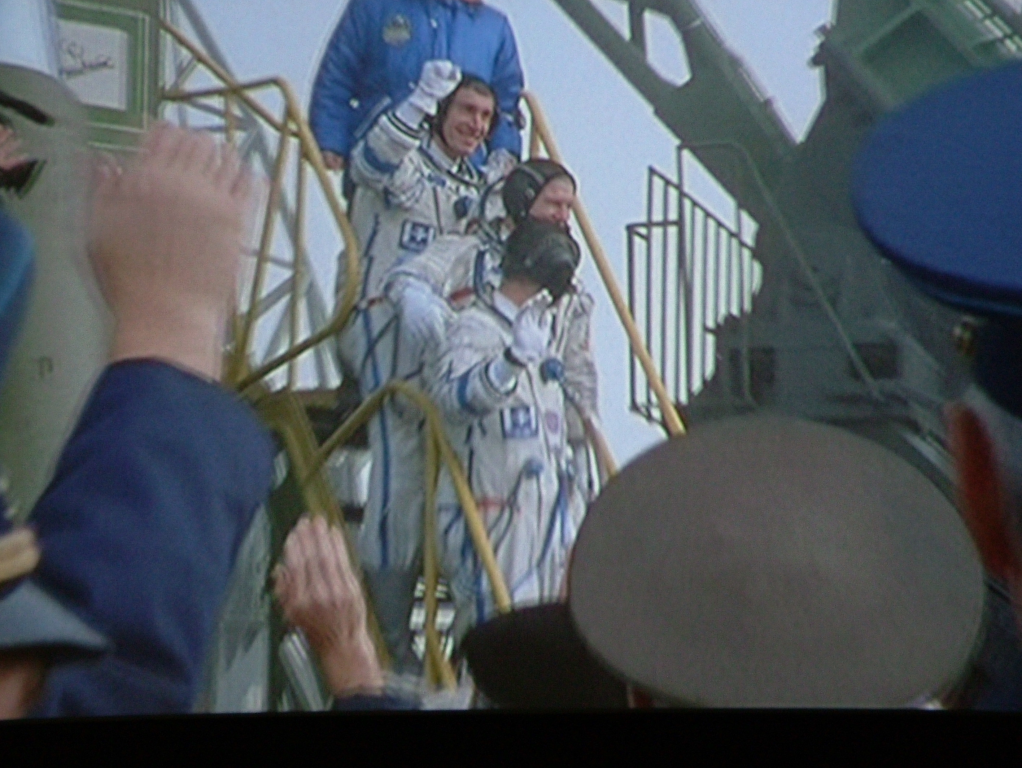
Left: Gwen Rouvillois, Lunar Property Painting, 2007. Right: Jeanet Louise Wilson, Video Art of Launching a Space Rocket, 2001. Preface: "Stardust ou la derniere frontiere" (Stardust or the Last Frontier) was exhibited from October 5 to February 2, 2008, at the Musée d’Art Contemporain du Val-de-Marne in the suburbs south of Paris. This exhibition commemorates the 50th anniversary of humanity’s first artificial satellite, Sputnik-1, launched by the Soviet Union on October 4, 1957, from the Baikonour Cosmodrome. It ignited the space race between East and West during the Cold War. Today, landing on the moon is history, while efforts to explore Mars are underway. Broader understanding of the solar system, comprehension of the penetrating nature of mysterious black holes, and discoveries of cosmic systems beyond the solar system and galaxies have gradually unveiled the mysteries of the universe. Yet, today’s astronomical discoveries have not diminished our curiosity, bewilderment, and imagination regarding the mystery of the cosmos.
The eternal imagination: skies, sun, moon, galaxy, universe, celestial bodies, black holes, comets, meteors, planets, time-space, satellites, rockets, astronauts, spacecraft, celestial movements, and all extraordinary phenomena continue to fascinate humanity. The illusions and projected imaginations of the magnificent cosmic spectacle are extraordinary. Indeed, the cosmic frontier has long been an object and domain for human ambition to conquer. Exploring vast astronomical phenomena and contemplating constant cosmic concepts have become echoes in the evolutionary history of human civilization. Although modern science and technology are so advanced, yielding significant discoveries through observation and exploration, the universe remains shrouded in mystery, continuing to irresistibly captivate people. Especially under the extraordinary imagination of artists, writers, and poets; their romantic fictions, utopian constructions, and poetic ingenuity, attempts are made to depict this extraordinary realm. The "Stardust or the Last Frontier" thematic exhibition gathers over forty international artists exploring this magical cosmic sky through painting, video (photography), objects, installations, sound, and other media, attempting to explore, question, conquer, colonize, and verify this distant, visible, and invisible world.
French people say "artists are often in their clouds," a metaphor clearly pointing to the creative facts of artists seeking inspiration, fantasy, and fiction. It seems that artists wandering the vast world, entering the cosmic realm, and landing on the moon are somewhat easier than others. This romantic sentiment and dreaminess, though impractical, poetically lead people to the mysterious or find truth in illusion, galloping with extraordinary imagination and guiding people into a dazzling dreamy world and cosmic context. This "Stardust or the Last Frontier" exhibition invites audiences to roam this extraordinary sky.
Diverse explorations: Poetic Celestial Bodies: Tony Cragg transforms decay into magic, poetically assembling plastic objects into a large "moon." Claude Closky presents a series of fictional photos of ghosts floating in the Paris metropolis, revealing unease about foreign invasion and questioning what we see. Guy Allott displays humorous and witty "space landscape" paintings, poetically presenting an extraordinary dream world. Jacques Monory’s brilliant galaxy emphasizes painterliness between reality and imagination, disillusionment and rebirth, and figuration and abstraction. Didier Rittener’s starry sky shines as it moves in the unreachable sky; Nicolas Baier’s magical and illusory black holes draw people into infinite imaginative spaces. Olivier Mosset’s full-of-metaphor blue stars, Bridget Smit’s observatory under the starry moon, Bruno Peinado’s poetic Earth planet, Davide Bertocchi’s extraordinary celestial bodies—all cosmic planets series, etc.
Ideological Works: Yinka Shonibare names his spacecraft "Martin Luther" and depicts two sky figures wearing African patterned clothes floating in mid-air, exposing ideological wars of conquering space and emphasizing the social consciousness of minorities, criticizing racial discrimination. Gwen Rouvillois lands on the moon, plants a flag, and claims lunar territory as her own, absurdly marking property rights on the painting like land deeds, exposing hegemonic infringement and strong occupation.
Beautiful Utopian Constructions: Jean-Luc Vilmouth constructs "Mars Project Object Installation" using electric fans and video combinations, exploring new worlds of the future in extraordinary imagination. Etienne Chambaud ingeniously assembles antennas and radios into "First Space Living Flight Antenna," hoping to establish contact with humans on Earth and aliens in the galaxy. Sylvie Fleury’s poetic "Heel Stepping on the Moon" shows a rocket lying on the ground, flanked by two bizarre eye-shaped trees, indicating the imagined world of landing on the moon. Mark Wallinger’s "Comparison of Spacetime Volume" uses a square enclosed copper-walled cabin, alluding to various anecdotes in spacecraft, resembling a monument from outer space. Bruno Peinado’s "Stardust" fills a bucket with sparkling metallic dust, highly poetic and profoundly metaphorical.
Extraordinary Sound Installations: Julien Discrit’s object original sound installation of the Golden Record of the extraterrestrial traveler broadcasts Earth music sent to the unreachable universe via spacecraft in 1977, attempting to contact aliens through music, allowing us to listen to our own beautiful songs. Most striking is Pascal Broccolichi’s sound installation, a series of unique cosmic sounds such as extraordinary solar storms, explosions and surges of the galaxy, crisp sounds of meteor showers, or musical pieces of meteors crossing the sky, available on CD for listeners to choose from, leading audiences into the sky context.
Video Art: Jeanet Louise Wilson narratively depicts the entire recording process of launching a space rocket from the Russian Baikonour Cosmodrome in 2001, from rocket placement on the launch pad, press conferences for space crew members, control rooms, boarding ceremonies, to liftoff. Nicolas Moulin reveals his construction and exploration of the magnificent scenery of Martian deserts, excellently playing the role of an astronomer.
Conclusion: The "Stardust or the Last Frontier" exhibition reminds people not only of artistic, astronomical, scientific, political, social, historical issues, but also deeper philosophical and life-related ones. These two aspects seem not fully touched upon in this exhibition, because the boundless universe: systems outside the solar system, galaxies outside galaxies—where is the last boundary? The magic of black holes and the disillusionment and rebirth of galaxies construct eternal celestial bodies under the cycle of birth and death, akin to reincarnation and indestructibility in Buddhism. Stardust is nothing else but all living beings and humanity itself. Humans become passersby of time and space in this insignificant cosmic body. How should one cherish life itself? Only sages or every friend can answer.