French Society in the Slump
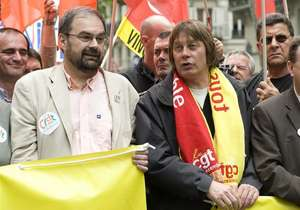
François Chérèque of CFDT and Bernard Thibault of CGT, union leaders, at the May 21 protest against the 35-hour workweek. Image from Reuters via www.liberation.fr
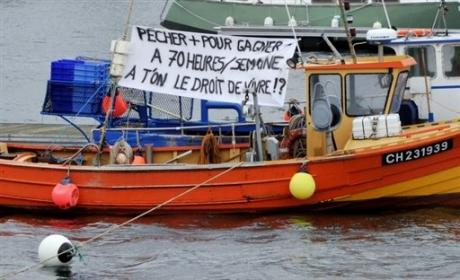
Fishermen block ports to protest. Mychele Daniau AFP | Protest banner on a fishing boat in the port of Cherbourg, May 19, 2008. Image from www.20minutes.fr
In the context of globalized economics, the world financial crisis continues to ferment. International oil prices have surged unprecedentedly, breaking through $135 per barrel, with prices appearing poised for uncontrolled escalation. Another dilemma is the global food crisis; now even staple foods like rice and wheat are subject to speculation by multinational corporations. Under this dual pressure of energy and food costs, the entire world has entered an era of unusually high prices. Poor nations are pushed to the brink of starvation, and social conflict is on the verge of erupting. Wealthy countries are no exception, facing numerous extraordinary social problems. Inflation continues to soar while wages fail to keep pace, leading to declining purchasing power and reduced consumption. Production lines are directly affected, and it seems everyone is poorer. The social structure is beginning to transform, and the era of high prices will open new perspectives on environmental consumption and economic life.
Under these global high-price conditions, reform is inevitable for French society. Changes in political and economic conditions are shaping a new culture and consumer perspective centered on sustainable global development. Social reforms in flux are not just ideals but practical necessities. Streamlining government finances and social resource allocation is the current prospect for innovation. Under tight budgets, all public agencies and schools must be reorganized and planned. With streamlined reform plans (preparing to lay off tens of thousands of civil servants and teachers), nationwide protests and marches by civil servants and primary/secondary school staff began in April. This has sparked a social battle for "livelihoods," featuring intermittent strikes and school closures lasting two months, along with repeated large-scale national marches by staff and students seeking favorable negotiation terms. Despite multiple talks with Labor Minister Xavier Bertrand, no agreement has been reached.
On the anniversary of the 1968 student uprisings, low-pressure societal unrest permeates unease and difficulty. Facing the current era of high prices, stagnant economic growth, and persistently high unemployment, the government's pension reform (extending contributions from 39 to 41 years) and the 35-hour workweek face dual pressures, sparking widespread opposition from all unions. In today's globalized era, uncertainty about the future prevails; no one can guarantee employment until retirement. To protect personal interests and the social system, no one wishes to be infringed upon. These demonstrations and strikes have continued uninterrupted since late last year, with negotiations oscillating back and forth. France appears to be a country accustomed to demonstrations, strikes, and school closures, making them a daily routine and traditional virtue in French society. Social struggle has always been the grassroots channel for the French to fight for welfare and construct the social system. Amidst high prices, social problems emerge endlessly. Daily consumer goods, oil, and gas prices rise almost daily, bewildering consumers. Every industry is affected, including basic utilities like water, electricity, and gas at home. Energy conservation is difficult because comfortable living has become habitual; change is hard to achieve. However, given the soaring energy costs, non-compliance is impossible. For middle- and lower-class families, failure to conserve will lead to monthly bankruptcy. An era of sustainable environmentalism and minimal energy consumption has arrived.
Soaring oil prices also affect overall social balance. Economic growth has become the standard for measuring industry performance, and various energy-dependent sectors suffer severe consequences. Recently, industries across the board have voiced demands to the government, hoping for appropriate subsidies, or some may collapse. Fishermen were the first to rise up, protesting that high oil prices make survival impossible. Over recent weeks, they have blocked ports in protest, marched to Paris, and occupied regional fuel storage facilities. The Minister of Agriculture and Fisheries met and negotiated with them, securing subsidies that failed to satisfy many fishermen, who continue their struggle. Following the fishermen, farmer groups, truck transport unions, and taxi associations have also stood out to protest oil prices and seek government subsidies. Consumer groups hope the government will also subsidize energy issues for middle- and lower-class families. Clearly, this is not just a French problem but a concern for everyone in the global village. A new food and oil crisis driven by high prices and energy costs seems imminent. All of this has deeply entered our daily lives. Conserving energy, developing new energy sources, promoting environmental sustainability, and changing uncontrolled consumption patterns have become essential for preserving the Earth and human survival.