France Assumes the EU Presidency
France assumes the EU presidency on July 1—the Eiffel Tower shines with EU glory. Image from www.20minutes.fr, credit Reuters. Starting July 1, France takes over as EU president; the Eiffel Tower is adorned with the EU stars, and at dusk it becomes a striking blue pillar of light (symbolizing the EU
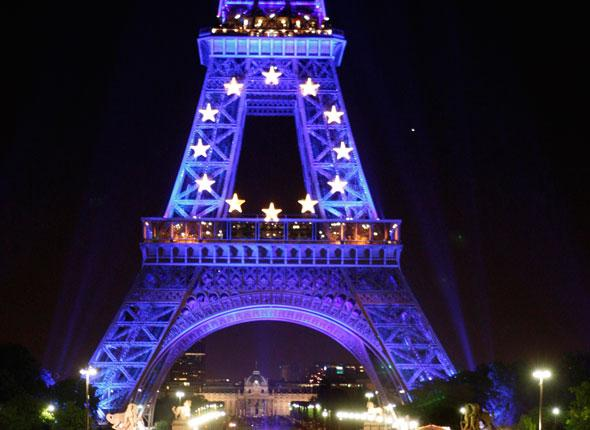
France assumes the EU presidency on July 1—the Eiffel Tower shines with EU glory. Image from www.20minutes.fr, credit Reuters. Starting July 1, France takes over as EU president; the Eiffel Tower is adorned with the EU stars, and at dusk it becomes a striking blue pillar of light (symbolizing the EU flag). French President Nicolas Sarkozy fulfills his dream of EU presidency, imagining the colorful dreams of Napoleon’s rule over Europe, but in this era of freedom, democracy, and peace, that dream is different. Yet under the power of desire and imagination, it at least satisfies the French President’s aspirations.
Just as Ireland says “no” to the EU’s Lisbon Treaty, and the Polish Prime Minister challenges the rotating presidency by saying “not signing the treaty,” coupled with the current energy and financial crises, declining purchasing power, and inflation issues across countries, the EU faces heavy difficulties. France’s assumption of the EU presidency confronts an extraordinary prospect of restructuring and innovation.
In this integrated construction and extraordinary situation, the most important goal for France as EU president is to ensure all 27 member states successfully sign the Lisbon Treaty (currently nearly half have signed), and to propose urgent reform plans for Europe. First, sustainable environment and current energy: this has become the greatest challenge of globalization. The EU hopes to make contributions to environmental protection worldwide or become a global model, aiming to achieve a global climate agreement through the United Nations. Regarding energy: developing new energy sources and improving biofuels to cope with skyrocketing gasoline prices.
European defense: strengthening the EU’s defense system and establishing new friendly relations with neighboring countries. Immigration issues: this has become one of the most pressing problems for the EU. According to EU estimates, there are nearly 8 million illegal immigrants within its borders, plus countless smugglers risking their lives daily, making it the most thorny issue for EU human rights nations. The EU has become the desired paradise for illegal immigrants worldwide; France proposes establishing an “EU Immigration and Asylum Treaty.”
Regarding EU agricultural and fisheries policies: in the current food and energy crisis, EU agriculture and fisheries are deeply affected. Farmers and fishermen repeatedly demonstrate, demanding effective subsidies or new proposals from the EU. The French presidency intends to comprehensively reform the EU’s Common Agricultural Policy, proposing subsidies to aid vulnerable sectors to resolve the major problem of soaring food prices.