Picasso (Pablo Picasso) - Eclecticism
Portrait of Dora Maar 92x65cm 1937 Collection of the Musée Picasso, Paris. The expressionism of violent forms was soon softened by innocent, romantic love. In 1927, Picasso met his fourth young and beautiful wife, Marie-Thérèse...
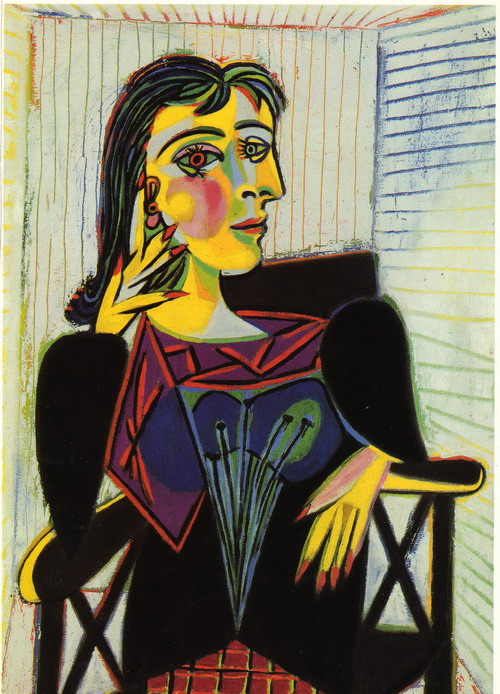
Portrait of Dora Maar 92x65cm 1937 Collection of the Musée Picasso, Paris. The expressionism of violent forms was soon softened by innocent, romantic love. In 1927, Picasso met his fourth young and beautiful wife, Marie-Thérèse (she was only 17 at the time, while Picasso was 46), seemingly reaching a new life realm of "a village hidden behind dark willows and blooming flowers" under spiritual fulfillment—eclecticism. At this time, form and color seemed to gain a soul, active in a metaphysical world. The careless Picasso thus traveled far with the young and beautiful Walter to the Côte d'Azur, abandoning the ill Cocteau. A series of works featuring light surrealistic deformations, such as Bathers (1931) and figures on the beach, are manifestations of this period. It was also during this period that Picasso boldly began experimenting with developing three-dimensional Cubist sculptures in his Bosjoli studio, including Woman Standing or Sitting (1930), Bathers (1931), and Head of a Woman (1931), all incarnations of Marie.
In the 1930s, Picasso's three most prominent painting themes were the Crucifixion (Crucifixion), Bullfighting (Corrida), and the Minotaur (Minotaure). In 1932, Picasso held his first retrospective; the following year he began a series of prints. In 1935, he completely cut off contact with Cocteau, stating, "This is the most destitute period of my life." At the end of the year, Marie gave birth to a daughter, Maya, and his affair with Marie came to an end.