The End of Picasso's Art - Baroque
Portrait of a Seated Woman 100x81cm 1971 Saint-Etienne Museum Collection
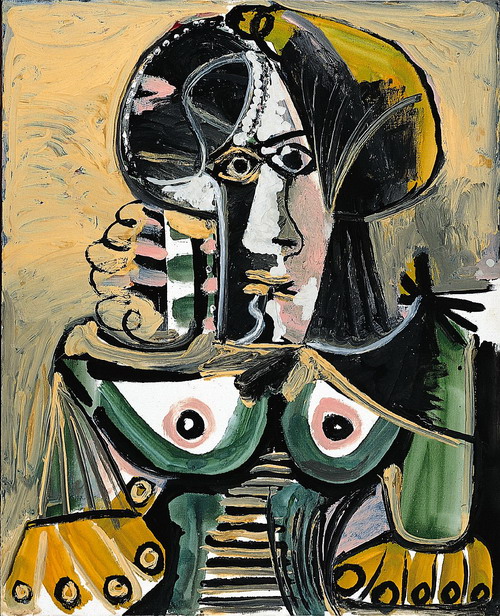
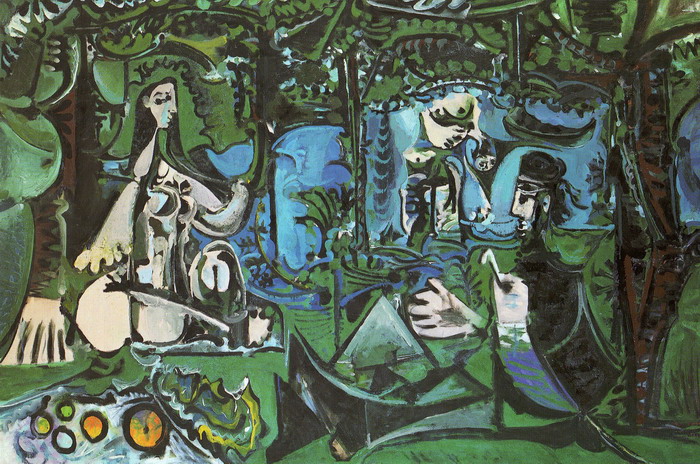
Manet’s Luncheon on the Grass 129x195 cm 1960-61 Musée Picasso Paris Collection. The vigorous Picasso found a new love. As Gilot exited through the front door, Picasso’s last wife, Jacqueline Roque (a typical Mediterranean beauty with bright eyes), appeared in his studio from the rear hall. At this moment, Picasso’s artistic life ended within the Baroque painting style. In his later years, Picasso consecutively interpreted famous paintings, starting in 1955 with his series on Delacroix’s Women of Algiers, followed by Manet’s Luncheon on the Grass. Simultaneously, he created series based on the prints Bullfight and Idyll. In 1966, for Picasso’s 85th birthday, the French government held a grand retrospective at the Grand and Petit Palais in Paris, attracting 800,000 visitors in a short period, allowing us to imagine the brilliance of his lifelong artistic creation. In 1973, Picasso passed away, leaving behind a colorful legacy of anecdotes and works.
Luncheon on the Grass: This is one of Picasso’s late works immersed in interpreting historical masterpieces. Is such imitation of famous paintings not an artistic characteristic of the 1980s (postmodernism)? (For example, New York’s mimists). By this logic, was Picasso not the ancestor of postmodernism? These interpretations of famous paintings were merely using them as a pretext, just as he borrowed nature to recreate it. If we compare them with Manet’s original Luncheon on the Grass, they cannot be equated; naturally, Picasso recreated Luncheon on the Grass with his unique Baroque style.