Saint-Cloud Park I
(Top left) The magnificent garden centers on the verdant, sculpted yew terrace (castle ruins). (Top right) The terrace serves as the best vantage point for panoramic views of Paris.
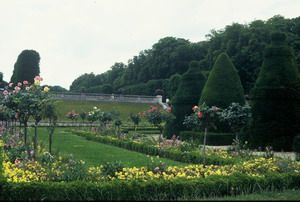
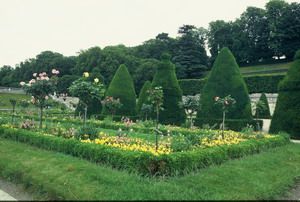
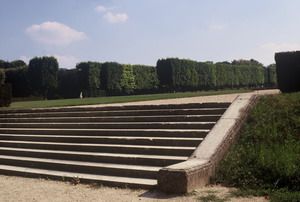
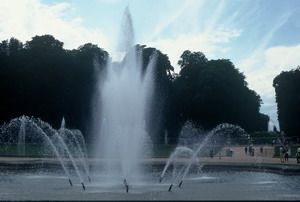
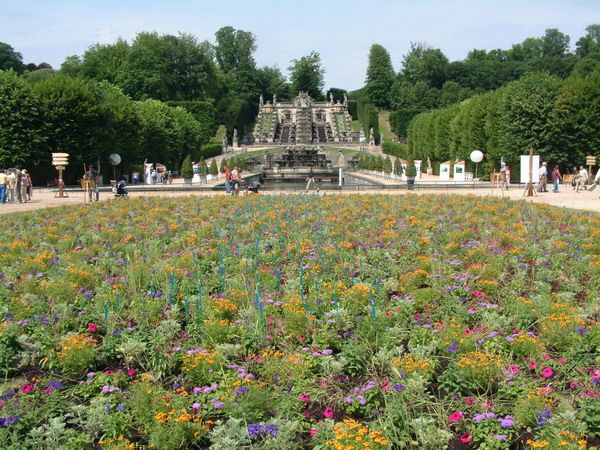
(Top left) The magnificent garden centers on the verdant, sculpted yew terrace (castle ruins). (Top right) The terrace serves as the best vantage point for panoramic views of Paris. (Middle left) The verdant, sculpted yew terrace features rhythmic grand staircases and orderly geometric tree-lined paths. (Middle right) A mesmerizing water theater on the terrace leads from majestic water-curtain fountains to an octagonal fountain in the distance. (Bottom image) The park’s most spectacular and dramatic water theater—the Grand Cascade—rivals the gardens of Versailles.
The imposing royal gardens of Saint-Cloud Park are among the most representative French gardens in the Paris suburbs, second only in scale to Versailles. This delightful large garden is Le Nôtre’s masterpiece following the grandeur of Versailles. The vibrant garden is surrounded by the lush Saint-Cloud Forest, situated on the rolling hills of the left bank of the winding Seine, overlooking the Paris basin with its vast, breathtaking panorama. It remains the only French garden today without a castle.
The serene, verdant Saint-Cloud Royal Castle and gardens were once favored residences of French royalty. Built in 1658 by Philippe d’Orléans, brother of Louis XIV, it became Queen Marie Antoinette’s rural retreat away from court in 1785. After the French Revolution, it became public property. In late 1799, upon Napoleon’s return from Egypt, he moved the committee to Saint-Cloud. It became Napoleon’s imperial residence in 1802, where he held his grand wedding to Marie Louise (his second wife) in 1810. Four years later, after Napoleon was exiled, Charles X and Louis Philippe stayed there during the Restoration. Notably, in July 1930, Charles X signed his abdication decree at Saint-Cloud, leading to the collapse of royal power. Later, the most grand event occurred in 1867 during the Paris World Fair, when Napoleon III hosted sixty-two heads of state at the magnificent Saint-Cloud Castle. On July 5, 1870, Napoleon III also declared war on Prussia (Germany) from this castle. Three months later, as Prussian troops advanced toward Paris, the magnificent Saint-Cloud Castle was destroyed during the Franco-Prussian War. The dream of the French Empire vanished accordingly. Thus, what we see today at Saint-Cloud is only the garden; the castle is no longer visible.