Park of the Château de Champs-sur-Marne
(Top) The stately castle serves as the garden's centerpiece, with two intricately carved floral patterns in front. (Bottom left) On a high platform, flanking symmetrical seasonal flower beds are Egyptian busts. (Bottom right) Grand patterned flower beds frame double perfect avenues leading to infini
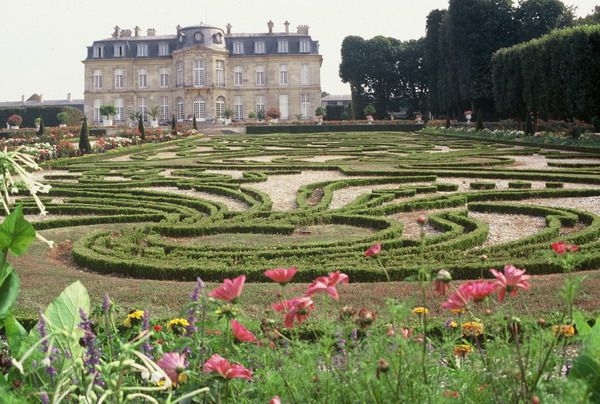
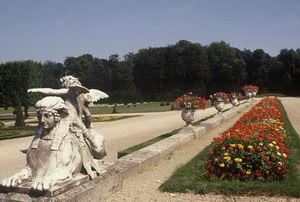
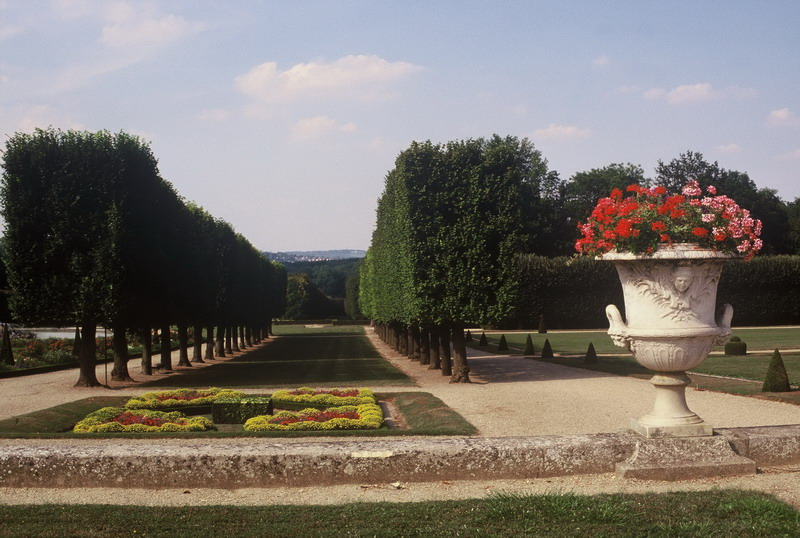
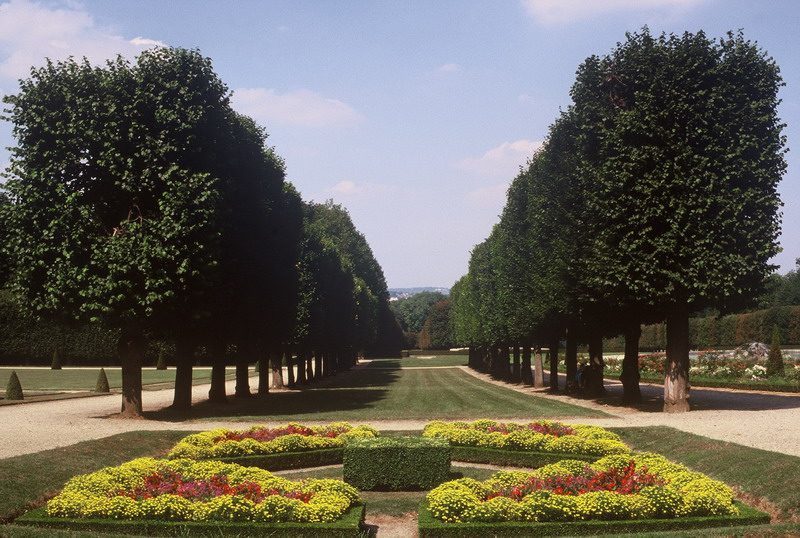
(Top) The stately castle serves as the garden's centerpiece, with two intricately carved floral patterns in front. (Bottom left) On a high platform, flanking symmetrical seasonal flower beds are Egyptian busts. (Bottom right) Grand patterned flower beds frame double perfect avenues leading to infinity. (Bottom) Colorful seasonal square flower beds dot the foreground of the grand avenue.
Poetic Chantilly Castle Park is one of France’s finest gardens from the early 18th century, located in the lush countryside just east of Paris. Its castle is unassuming, but its jewel-box-like garden is striking, making it one of the quietest estates near the capital. This rigorous and perfect courtyard is the masterpiece of Claude Desgots, grandson of Le Nôtre. Though Chantilly itself is obscure, the entire garden was constructed with perfect geometric symmetry, showcasing magnificent landscapes. Within its rhythmic spaces, amidst bright light, gorgeous flower beds, fountains reflecting water and shadows, and dense forests, one rediscoveres the romantic sentiment and superior humanistic spirit of 17th-century French gardens.
The elegant Chantilly Castle belongs to the architectural style of Louis XIV. Aside from having been a place where Louis XVI hid his mistresses, there seem to be few other historical traces linking it to royalty or nobility. Thus, the castle feels unfamiliar and unobtrusive, yet it has not lost its charm. The exquisite and elegant castle was built by Charles Renouard, Louis XIV’s military finance minister. In 1701, Renouard was imprisoned for corruption; the castle was then acquired by the arms dealer Poisson, as it was the hometown of his beloved wife. From then on, Chantilly became the venue for lavish banquets hosted by the arms dealer. In 1716, during the regency of the Duke of Orléans, Poussin was arrested for financial matters, released the following year, but his property was confiscated. It was later acquired by Princess Conti and gifted to her cousin, the Duke of Vallière. After obtaining Chantilly, the Duke of Vallière undertook major construction, rebuilding the castle and changing the classical French garden into an English landscape garden. In 1757, it was rented to Madame de Pompadour, mistress of Louis XVI. After the French Revolution, renowned horticulturists Henri and Achille Duchêne restored the garden to its former perfection as a classical French garden. At the end of the 19th century, Count Cahen d’Anvers and his wife acquired Chantilly Castle, undergoing extensive renovations and furnishing it. In 1935, the descendants of Cahen d’Anvers donated this luxurious castle to the local government, thus becoming the museum and poetic garden seen today.