Visit to the Prado Museum in Madrid
(Top) Prado Museum. (Middle-left) Greco, 1577-1579, The Trinity, 300x170 cm. (Middle-center) Velasquez, c. 1632, The Crucifixion, 248x169 cm. (Middle-right) Goya's famous Black Paintings series, one of them, 1808-1810, The Colossus, 116x105 cm. (Bottom) Velas…
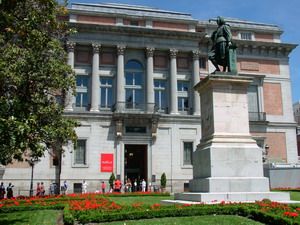


(Top) Prado Museum. (Middle-left) Greco, 1577-1579, The Trinity, 300x170 cm. (Middle-center) Velasquez, c. 1632, The Crucifixion, 248x169 cm. (Middle-right) One of Goya’s famous Black Paintings, 1808-1810, The Colossus, 116x105 cm. (Bottom) Velasquez’s most representative work, Las Meninas (The Spanish Royal Family and Attendants), 318x276 cm, 1656.
Visiting the Spanish capital, Madrid, again, I joyfully returned to the Prado Museum, feeling as if embraced by a lover’s warm arms. The Prado is one of Europe’s most bewitching museums, with a rich collection comparable to the Louvre in Paris, the Uffizi in Florence, and the National Gallery in London. Its dazzling array of world masterpieces includes Italian painting from Fra Angelico, Mantegna, Botticelli, Raphael, and Titian of the Renaissance, through the tragic Caravaggio to Tiepolo of the 18th-century Venetian school. Northern European painting spans the Flemish Renaissance, featuring Bosch’s The Hay Wagon and The Ecstatic Dream, via Van Eyck, Bouts, Memling, and the enigmatic folk allegories of Brueghel, up to the sensual Rembrandt, Rubens, and Van Dyck of the 17th century. German Renaissance works include Dürer, Lucas Cranach, and Baldung Grien. French painting ranges from Poussin and Lorrain in the 17th century to Watteau in the 18th.
Naturally, the Prado is the sanctuary of famous Spanish painters, encompassing art from the Middle Ages to the 19th century, especially renowned masters: El Greco, through the Golden Age of Spanish painting with Velasquez, Zurbarán, Ribera, and Murillo, to the passionate and heroic Goya. Due to time constraints, we did not tour the entire museum; instead, we focused on Spanish painters. We began on the second floor, in the gallery covering 1550–1850, strolling through this artistic paradise of paintings. Passing Poussin, glancing at Caravaggio, and viewing Rembrandt’s noble portraits with their delicate forms and mysterious atmosphere, we were led deep into our hearts. In silence, we felt the radiance of religious art, expressed beyond words.
Before us stood Rubens’ sensuous Three Graces and the portrait of Empress Medici, welcoming us into the coveted Golden Age of Spanish painting. We entered Velasquez’s exquisite exhibition room, seeing the heroic equestrian portrait of Prince Carlos, the dignified portrait of Queen Marianne, and notably, The Crucifixion, which is profoundly tragic and heroic. Under his precise realistic technique and bewitching light, extraordinary brilliance and humanistic spirit are displayed. Then came the most famous masterpiece, Las Meninas. Surrounding the blonde, kind-hearted young prince are attendants in luxurious attire playing with him. On the left, Velasquez himself is depicted holding a brush in his left hand and a palette in his right, painting. On the right, a dwarf attendant and a young girl step on a large mastiff. Through an open door in the background stands a gentleman, and a painting of the King and Queen (resembling a mirror reflection) dramatically implies their presence, constructing a perfect spatial structure and noble imagery, more real than imagined. Two other dramatic large-scale works, The Surrender of Breda and the mesmerizing domestic scene of The Spinners, deeply influenced French painters Delacroix and Manet.
Crossing Zurbarán’s splendid still lifes, we entered Goya’s exhibition room, the peak of Spanish painting. Here, The Nude Maja and The Clothed Maja are exhibited side by side, making it hard to imagine the nearly identical poses lying on the bed. Passing numerous portraits of queens and national treasures, we turned a corner to see the May 3, 1814 execution of Spanish civilians by Napoleon’s French army. Under ruthless war, the tragic massacre is depicted with realistic fidelity and emotional tone, becoming the best historical record. Next, we entered Goya’s artistic pinnacle, the Black Paintings, depicting humanity’s disasters and unrest most profoundly. In The Colossus, crowds flee in panic while a gigantic figure looms in the sky, expressing human fear and anxiety. In Saturn Devouring His Son, the horrified state deeply portrays human disaster and fate, moving the heart and provoking deep thought.
Immersed once again in the embrace of art, enjoying a feast of eternal beauty, I will never forget the true meaning of "beauty." For those interested in the Prado Museum, please visit the website: www.museoprado.es