Seville's Most Grand Spanish Royal Palace and Plaza
The most striking architectural complex in Seville is the Royal Palace, with a panoramic view of its side.
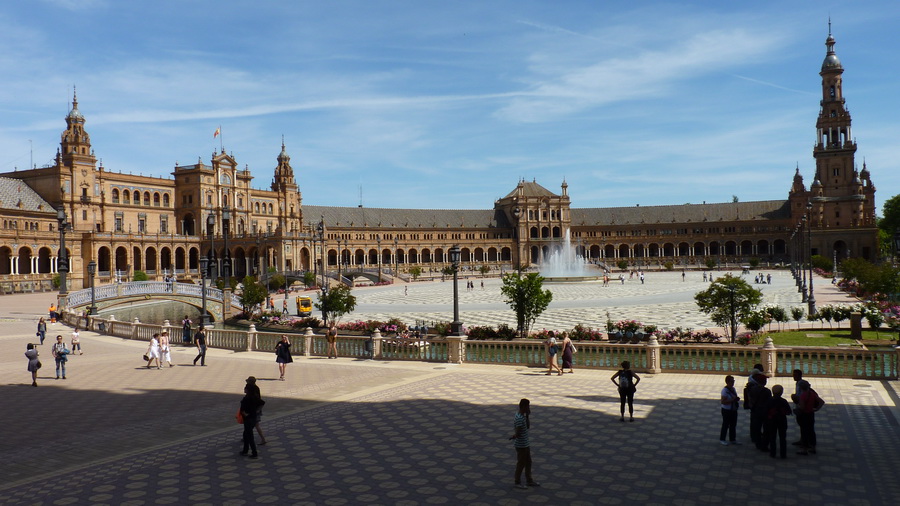
Text and photos by Chen Chi-Hsiang. The most striking architectural complex in Seville is the Royal Palace, the grandest monument in Andalucia. This structure combines marble and brick, featuring a central castle-like building flanked by two eighty-meter-high towers, symbolizing supreme authority. Built for the 1929 Ibero-American Exposition, it is a masterpiece by renowned architect Aníbal González. The entire building is surrounded by arches lined with a series of marble columns, each inner arch inlaid with the name of a Spanish province, creating a magnificent visual aesthetic. Along the walls of the two wings are fifty-eight colorful ceramic decorations, representing the various provinces of Spain.
The palace surrounds a vast semicircular plaza, divided from the main building by a semicircular canal. Four symmetrical ceramic bridges span the canal, metaphorically representing Spain's four major historical dynasties. A circular fountain stands at the center, while the floor is paved with black and white pebbles arranged in geometric patterns. This theater-like plaza stages countless human dramas daily, making it a must-visit space for tourists to browse and photograph. Every weekend or holiday, people can enjoy boating on the canal plaza. Many young, beautiful women dressed as Carmen and handsome horsemen stroll here, taking wedding photos. The scene of tourist carriages and men riding out with Carmen figures is captivating. It feels as though time has reversed, with the drama of Carmen continuing to be performed, astonishing visitors.
In front of the Plaza de España lies the María Luisa Park, a space for tourists and locals to escape the heat and relax. This was the site of the 1929 Ibero-American Exposition; after the exhibition, it became a lush, dense park. Designed in the Andalusian style, the park features diverse flora, including bougainvillea, cycads, agave, lemons, roses, palms, and coconuts, many imported from South America. These exotic plants have integrated over centuries into a vibrant local landscape. The park houses two museums with rich collections: the Museum of Folk Costumes and the Archaeological Museum. There is also an enchanting monument dedicated to the local poet Bécquer.