Titian: Venus of Urbino (1538)
Venus of Urbino (1538), 119×165 cm, oil on canvas, Uffizi Gallery, Florence. Compared to Botticelli's Venus, which derives from ancient Greek statues, this work is closer to reality, drawn from a living model.
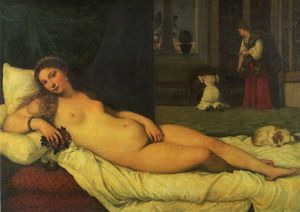
Venus of Urbino (1538), 119×165 cm, oil on canvas, Uffizi Gallery, Florence. Comparing Titian’s Venus of Urbino with Botticelli’s Venus, it is evident that Botticelli’s Venus derives from ancient Greek statues, whereas this one is closer to reality, drawn from a living model. Contrasting Giorgione’s Venus with Titian’s, the former is more poetic and full of symbols and imaginative space, while the latter is quite sensual and sexy, manifesting the aesthetic beauty of the female body (carnality). The inspiration for this painting seems to come from Giorgione’s Sleeping Venus; in almost the same posture, she lies diagonally across a comfortable bed in a boudoir. Her sensual body occupies half the picture diagonally, her figure fuller and sexier than the Sleeping Venus. Her hair is held by a clip and falls long over her shoulders. Her round face, tender skin, and full breasts gaze at the viewer with an alluring look. Her right hand rests on a large white pillow, adorned with jewelry and holding red roses (symbolizing eternal love); her left hand, like the Sleeping Venus, covers her private parts, quite sensually. Her crossed legs lie on white sheets, showing very sensual and intimate characteristics. At the foot of the bed, a small dog sleeps, metaphorically representing a woman’s docility and loyalty. The background is divided into two halves: the left side shows a dark bedroom behind a red bedspread, contrasting with the bright interior on the right. The entire space extends through the window to a landscape of blue sky and white clouds. In the corner of the room stands a maid in a red long dress, watching a little girl in a white skirt kneeling on the floor, rummaging through boxes. It is clear that every matter in this palace is attended to; Venus lives the life of a noble lady. Notably, the natural and serene Venus looks out at the viewers, while the little girl rummaging inside turns her back to the viewers, both indicating another extraordinary imaginative space in painting. Through naturalistic realism, unified lighting, chiaroscuro, soft colors, and rigorous geometric composition, Titian materially presents his idealized supreme aesthetic of femininity.