Toulouse-Lautrec — Toulouse-LLautrec
Bal at the Moulin Rouge 88.5×101.3 cm, 1889, Collection of the Art Institute of Chicago


Arabian Burlesque 285×307.5 cm, 1895, Collection of the Musée d'Orsay, Paris. Toulouse-Lautrec (1864–1901) was a representative painter and poster artist of French Post-Impressionism. He produced many brilliant posters throughout his life, profoundly influencing the development of modern poster art, earning him the title "Father of Modern Poster." Born into an aristocratic family in southern France, he showed artistic talent from childhood and seemed to have a promising future. However, due to a congenital bone disease, two consecutive falls halted his growth, leaving him a dwarf and altering his life; he turned to alcohol to compensate for this deficiency.
Driven by his passion for art, he went to Paris in 1882 to study under the famous teacher Princeteau, then entered Bonnat's studio, and later studied under Carmon. It was during this time that Lautrec met Vincent van Gogh and Émile Bernard, who had just arrived in Paris. His true mentor, however, was Degas, particularly in works featuring indoor figures such as dancers, bathers, and portraits. He began carefully observing the lives of people in Montmartre. In 1885, he settled in Montmartre, which was Paris's red-light and entertainment district, featuring circuses, music halls, coffee houses, hotels, and brothels.
In 1889, he gained prominence at the Salon des Indépendants. That same year, the world-famous Moulin Rouge opened, and Lautrec immersed himself in its atmosphere, indulging in wine and beautiful women, all of which became his subjects. In 1891, invited by Jules Chéret, he produced lithographic posters, achieving instant fame and updating traditional posters with highly modern forms. For the next few years, he frequented the dance halls and taverns of Montmartre's Moulin Rouge, seeking creative inspiration and solace. These ten years became the peak of his creativity (almost all his important paintings were completed during this period). A decadent lifestyle combined with frenzied creation, along with alcoholism and sexually transmitted diseases, led to a mental breakdown in 1899, resulting in his admission to a psychiatric hospital. He died prematurely in 1901 at the age of 36, leaving a brilliant page in art history.
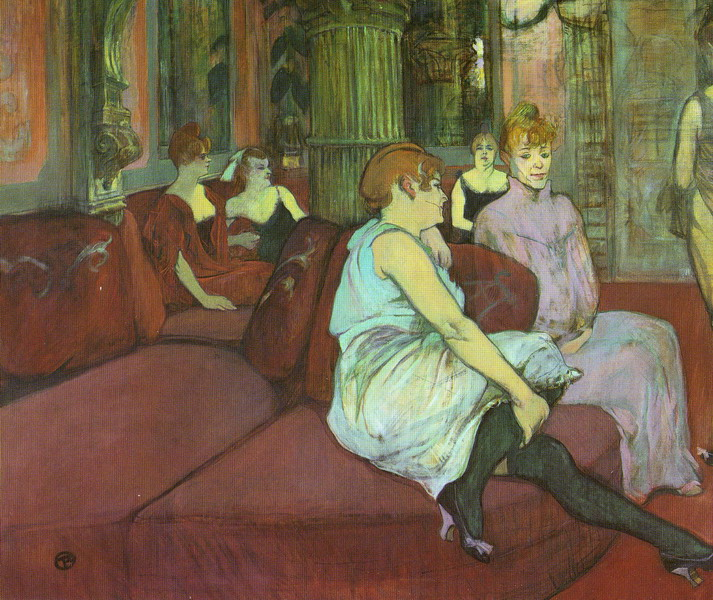
His works specifically depicted the Moulin Rouge, nightclubs, and brothels beneath Montmartre hill in Paris. Deeply influenced by both Degas and Japanese ukiyo-e prints, he used vibrant colors, fluid imagery, and painted color planes to portray various aspects of human life, excelling at capturing fleeting expressions and situations.