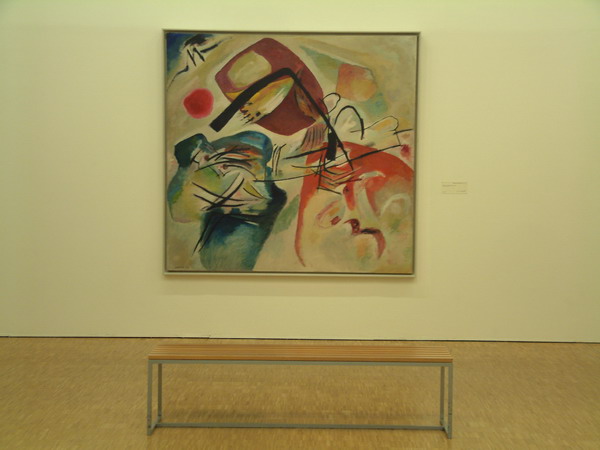
Kandinsky (V. Kandinsky) - Black Arc
Kandinsky (V. Kandinsky) - Black Arc 188x198 cm, 1912. Collection of the Centre Pompidou, Musée national d'art moderne.
Wassily Kandinsky (V. Kandinsky, 1866–1944), a Russian painter, was a founder of Der Blaue Reiter and one of the pioneers of abstract painting. Influenced early on by Expressionism, he gradually developed into abstract painting (1910). Around 1922, he began to organize these geometric forms and colors, revealing the essence of abstract painting through their inherent autonomy, thereby creating an entirely new art form.
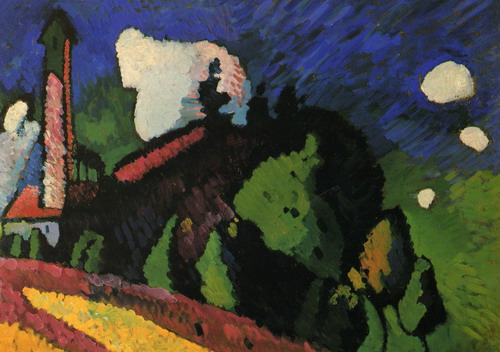
Kandinsky’s abstract paintings slowly took shape from natural imagery (gradually moving toward abstract forms and color compositions from landscapes). From the strong contrast of color planes in the landscape rhythm of Tower Landscape (1908) to Improvisation (1909)—a simplified landscape of imagination—and then to Impression (II) (1910), where dual themes were gradually liberated from landscapes, symbolic forms and colors metaphorically represented nature through sign-like shapes.
Kandinsky wrote: “Abstract form—who knows if it is natural form?” Shortly after, he wrote: “Modern art is born only when the sign becomes symbolic.” By 1912, with the disappearance of natural elements in this Black Arc, the entire spatial composition of the painting was constructed by the movement and tension of these color stripes and lines; as they collided, it was like the emergence of a new world. Kandinsky wrote: “To create a work is equivalent to creating a world,” and thus, abstract painting was born.