Van Gogh "Self-Portrait with Hat"
Self-Portrait with Hat, 44×37.5 cm, 1887, held in the Van Gogh Museum, Amsterdam, Netherlands. Van Gogh (1853–1890) was a Dutch painter and arguably France's most representative and legendary Post-Impressionist artist. In his brief, tortuous life, repeated setbacks (dropping out of school, failing t
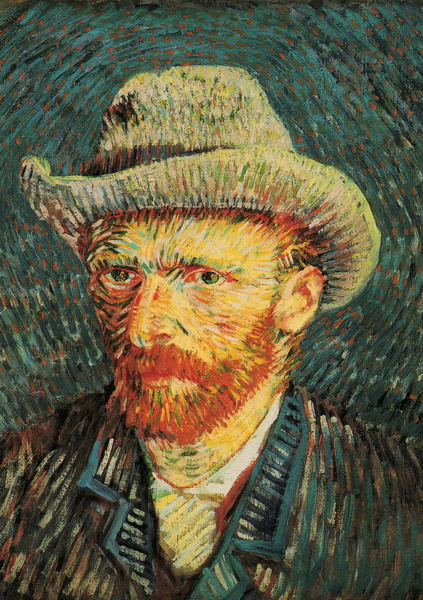
Self-Portrait with Hat, 44×37.5 cm, 1887, held in the Van Gogh Museum, Amsterdam, Netherlands. Van Gogh (1853–1890) was a Dutch painter and arguably France's most representative and legendary Post-Impressionist artist. In his brief, tortuous life, he faced repeated setbacks: dropping out of school, failing to become a pastor, desperate desire for marriage, multiple rejections, disputes with Gauguin, mental instability leading to institutionalization, remaining single throughout his life, and finally finding solace in artistic creation as his sole means of existence.
In 1886, he moved to Paris to stay with his brother Theo. At that time, during the post-Impressionist renewal, the works of Gauguin and Toulouse-Lautrec immediately caught Van Gogh's attention, along with his curiosity about Seurat's Neo-Impressionism. He actively engaged in passionate creation. Through his brother's introduction to the Impressionist painter Pissarro, he broke away from the gloomy tones of his Dutch period, writing: "The atmosphere of France opened my skylight, making me cheerful."
After enduring a harsh winter in Paris in 1887, he went south to France the following year to seek bright sunlight, arriving in Arles in Provence. There, he finally found light without shadows; dazzling yellow became sacred sunlight. Driven by madness, he entered a peak period of creation. With rough brushstrokes, passionately burning colors, and fiery imagery, his heart boiled, expressing high-spirited emotions and state of mind. He invited his friend Gauguin south to create together, but they eventually fell out due to conflicts in artistic concepts. "Self-Portrait with Bandaged Ear" is clear evidence of this extraordinary relationship.
Driven mad, he was sent to the Saint-Rémy asylum for psychiatric treatment, yet continued to create wild and brilliant paintings amidst emotional agitation. In 1890, arranged by his brother, he came to the small town of Auvers-sur-Oise near Paris to heal. He spent only 70 days there before shooting himself, ending the life of a 37-year-old "man never understood by anyone."
He left behind still lifes, landscapes, and portraits. In his most nervous rough brushstrokes, strongest and most trembling colors, and flattened color planes, he subjectively expressed his frank and true inner world. Thus, he became a pioneer of Fauvism and Expressionism.
Van Gogh painted numerous self-portraits throughout his life. In each period, based on his emotions and internal conflicts, he presented his immediate will and state of mind under intense spiritual expression. Each painting has touching and tortuous stories, such as the 1888 "Self-Portrait with Bandaged Ear" or "Self-Portrait Before Suicide," where one can see his extraordinary internal conflict and compassion. Each work has its own exploratory style and symptoms.
This 1887 "Self-Portrait with Hat" is a confident portrait from his Paris period. It features bright eyes, a glowing face, unkempt red beard, a sun hat, and a tailored suit. The rhythmic brushstrokes clearly show the influence of Seurat's Pointillism. Here, Van Gogh personally created using divisionism, emphasizing the intensity and tension of extraordinary yellow, blue, and red colors, displaying remarkable light and atmosphere.
In 1886, introduced by his brother, he met Pissarro, the first Impressionist painter in Paris. The perceptive Pissarro then predicted: "Van Gogh will become either a madman or someone far surpassing the Impressionists." Van Gogh's artistic achievements proved Pissarro's extraordinary vision.