Wang Du "Photography" Solo Exhibition
(Image) A partial view of the wall installation, 2007.
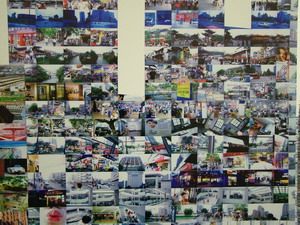
(Image) A partial view of the wall installation, 2007.
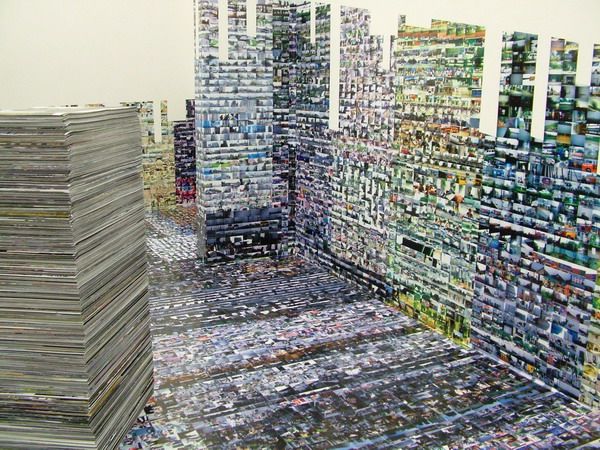
(Image) Installation scene on the wall and floor, 2007.
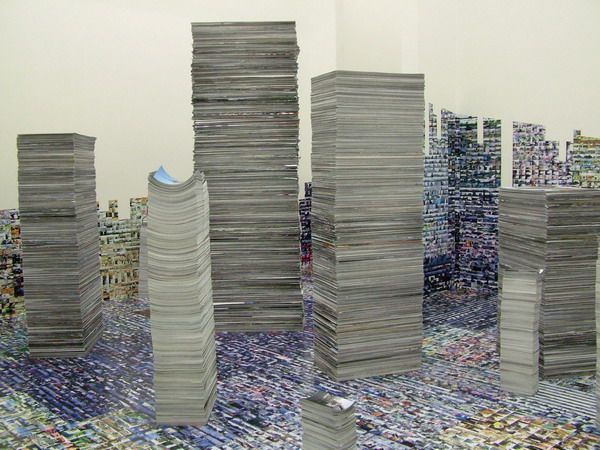
(Image) Partial view of the accumulation forming skyscrapers, 2007.
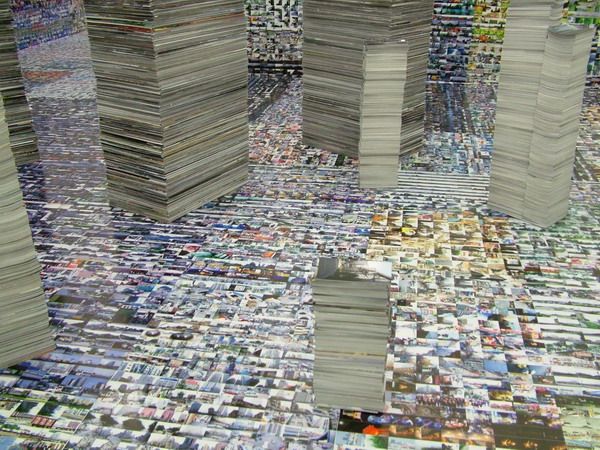
(Image) Installation scene on the floor, 2007. Wang Du's "Photography" solo exhibition was on display at Laurent Godin Gallery from September 22 to November 3. Wang Du is currently one of the most representative Chinese contemporary artists living in Paris, and also one of the most active artists in the European art world. His work as a whole is built upon today's mass media information, especially eye-catching images. In an era where "the world" is equivalent to "mass media," no one can avoid its influence; it has become a medium for widespread global cognition and a conductor for everything in the world. Obviously, today's mass media are widely and largely based on images and short articles (people today are too lazy to read, so direct images have become the core). Images of myriad phenomena have thus become the most popular and universal "culture" today. Looking at the entire history of plastic arts, it was built on images until Pop Art widely adopted mass media images to transform them into artworks, praising the image world for conveying trends, popularizing social values and aesthetics, making media images the core of painting and art. Then, in today's crazy globalization of mass media, it became even more diverse and universal. Besides traditional mass media (news newspapers and magazines): satellite TV, digital TV, digital images, virtual images, and the internet world, etc., there are various rich and universal images that dazzle people, deeply changing people's lives and their perspective on observing the vast world. In this era of diversified global media and multi-functional digital technology, infinite impact and new prospects have been brought to contemporary artistic creation. Obviously, many contemporary artists' creations are built upon this trend, and Wang Du occupies an important position in this exploration.
Images have always been the core of Wang Du's exploration. Early on, he questioned the overly flat form of images from mass media, molding and converting them into three-dimensional painted sculptures. The artist said, "An idea struck me: everything is already there, why look elsewhere? My realistic target subject (is right here in these mass media images). I molded and sculpted like this, borrowing directly from reality... It is a type of social scrutiny, and even more so, a holistic observation." In this photography solo exhibition, Wang Du once again questions images. An image is a small part of reality; an image is a record not present at the scene; an image is a memory of life; an image is provided for viewing; an image is for the sake of the image; an image is to build another image; an image constructs the world into an image.
These photographic images were taken during this summer vacation by inviting 30 students and friends/relatives in various cities and towns in China, without specific themes or categories, whether related or unrelated, surrounding daily life, environment, street encounters, travel, news reports, life, etc. Everything visible was photographed, totaling over 50,000 photos. Subsequently, Wang Du developed these images into various sizes, approximately 10,000 square feet of photos, nearly four tons of photo paper and paint. In this photography exhibition, the artist arranged these photos in a comprehensive spatial layout (floor and walls), with a series of same-sized photos constructed into skyscrapers (one pile after another, varying in height and size) in the center of the dazzling space, whimsically resembling a metropolis. In this art project, the artist inverted the core of photographic images. Such a quantity is definitely not for people to view and read photos, nor is it about the quality of images or their inherent meaning, but rather clearly stacking spatial installations. Images become non-images; images become conductive media. Massive amounts of images blind people's eyes. No wonder people in today's mass media can watch with their eyes closed; everything reveals the truth silently (because truth has no form, yet contains all forms).