Football – Zhuangzi – Painting
This is the fourth in a series of paintings created while watching the World Cup, following the match schedule—completed in mid-July.
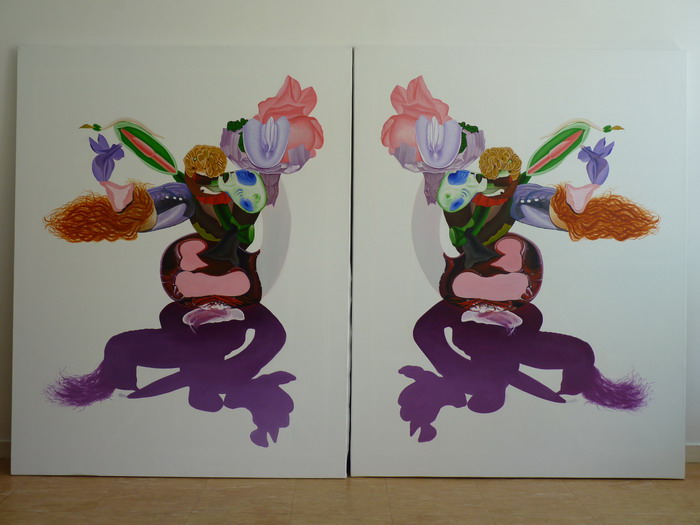
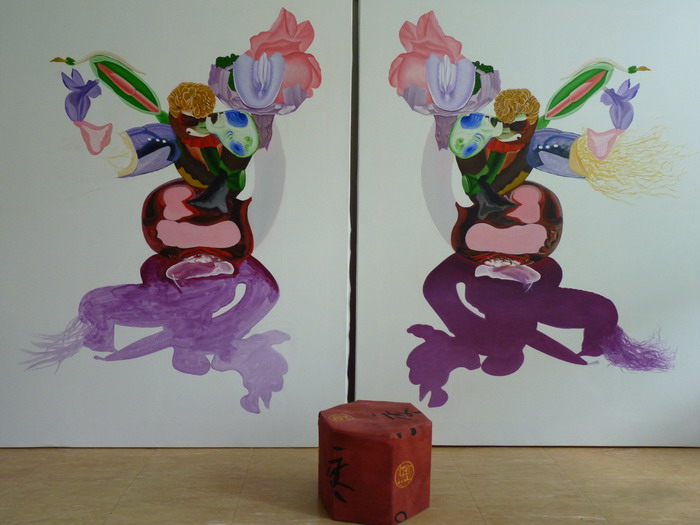
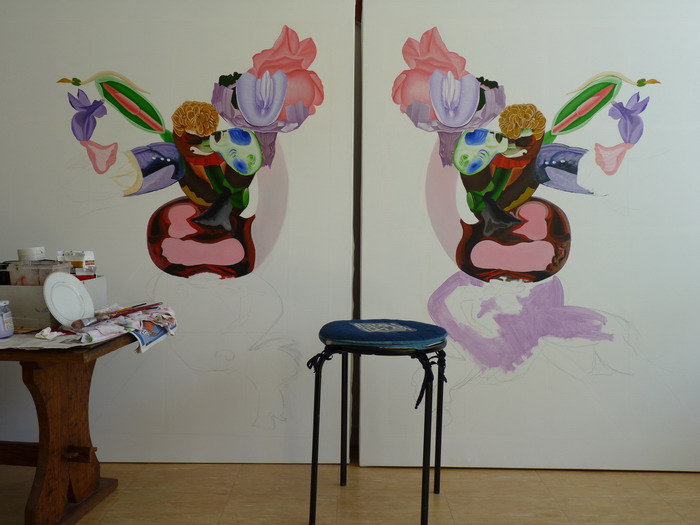
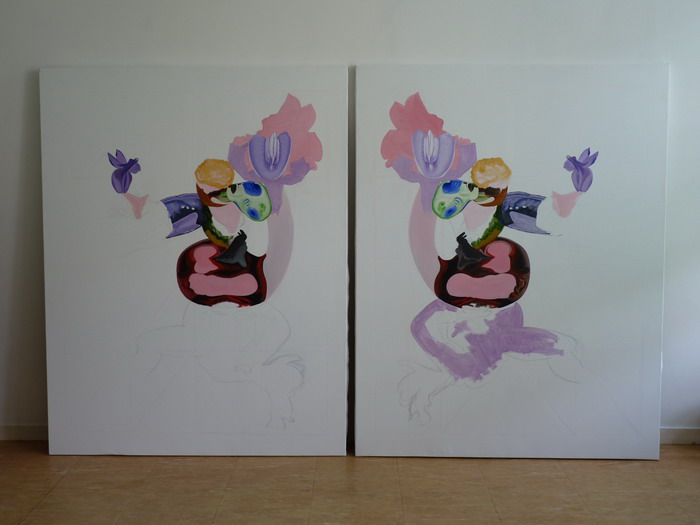
This is the first in a series of paintings created while watching the World Cup. In early June, the FIFA World Cup kicked off in South Africa with unprecedented grandeur. It was the first time ever that the tournament was held on the African continent, making South Africa the focus of global attention. As one of the world’s emerging nations, South Africa has left racial segregation behind as history and established democracy as its system of government. Although the distinction between black and white is no longer so sharp, the gap between rich and poor has become more pronounced, and social issues are increasingly evident. In the future, this wealth disparity will form a clear wall, representing a priority issue for the South African government to address. Like in many parts of Africa, this has become a factor of social unrest and political instability.
It is difficult not to be a football fan in Paris. Among the sports programs I enjoy most there, football is undoubtedly the most popular, along with tennis, Formula 1 racing, and the Tour de France. However, I do not watch everything; I choose the most dramatic and exciting matches, such as finals or clashes between star teams, or high-level tournaments like the World Cup, which are certainly worth watching. Enjoying such delightful sporting events is indeed a form of leisure and entertainment.
During the World Cup from June to July, I watched live broadcasts while painting, which was truly satisfying and brought me physical and mental pleasure. Initially, I picked some teams I favored, but unexpectedly, the French team was eliminated in the group stage, suffering a dramatic public humiliation on the international stage. The previous champions, Italy, also fared poorly; relying on past glory often leads to such lessons. The teams that were most impressive were Argentina, Uruguay, Brazil, and Germany. Asian teams like South Korea and Japan drew increasing attention with their improving standards, leaving viewers amazed. North Korea also attracted significant curiosity, especially when facing Brazil. Spain, Portugal, England, and the Netherlands performed averagely. Surprisingly, the semi-finalists were Germany, Uruguay, Spain, and the Netherlands. The final featured two nations that had never won the championship before: Spain versus the Netherlands. Both teams dreamed of victory and gave their all, yet played conservatively. Spain managed to prevail through sheer determination and finally won the World Cup. However, I considered the most exciting match to be Germany versus Uruguay, full of climactic moments and drama, leaving me with the best memories. This is sport.
Football and Zhuangzi have nothing in common. However, before the World Cup started, I read every night Osho’s brilliant interpretation of “Zhuangzi – The Empty Boat.” The story of Zhuangzi dreaming he was a butterfly is quite perplexing and inspiring, blurring the lines between truth and illusion, filled with imaginative space. The thoughts of Laozi and Zhuangzi accompanied my university life, and this sentiment and philosophy became an attitude toward my current creation and life. Even today, whenever I have free time, I occasionally flip through books by Laozi and Zhuangzi, savoring Zhuangzi’s concept of “the use of the useless,” similar to Laozi’s “non-action” (wu-wei). Whether it is Zhuangzi’s thought or Osho’s brilliant interpretation, they are too fascinating to read repeatedly, like vitamins in my life, continuing to accompany me.
Starting from late May, I immersed myself back into painting, returning to my “back garden” to continue cultivating the artistic realm. I delved deeper into the “Mirror Flower, Water Moon” and “Like Mirror – Like Realm” series, centered around Zhuangzi’s perspective of the butterfly dream. Truth and falsehood are not empty; everything fluctuates and vanishes between reality and imagination. Art is no exception.
After the World Cup began, I temporarily set aside Zhuangzi because there were exciting matches almost every night. During the day, apart from writing about arts and culture, I immersed myself in painting. Coincidentally, I sketched this work on the opening day of the World Cup, progressing through the creation like the match schedule (as shown in the attached images), and finally completed it two days after the final. I found my Zhuangzi again. He has nothing to do with football, but all connections lie within me. Existence encompasses all relationships, both connected and unconnected. Art exists between Zhuangzi’s “use of the useless” and Laozi’s “non-action,” continuing to deepen and simplify, transforming into the essence of life.