Simon Staling "Thereherethenthere" Solo Exhibition
A scene from Simon Staling's "Thereherethenthere" exhibition.


Simon Staling’s solo exhibition “Thereherethenthere” is on display at MAC/VAL, the contemporary art museum in the Paris suburbs, from September 18 to December 27. Born in 1967, Simon Staling is one of Britain’s most representative contemporary artists and a winner of the 2005 Turner Prize for Contemporary Art. Staling specializes in appropriating and transforming the substance of everyday objects. Within the tradition of updating Duchamp’s readymades, he creates object installations that establish specific spatial contexts. Observing this process is like witnessing traces, building conceptual series through nature, technology, economy, and geography. Staling describes his creation as “a concrete manifestation of a thinking process,” highlighting hidden stories and complex relationships between reality and imagination, time and space, action and context, construction and deconstruction.
The “Thereherethenthere” exhibition unfolds as two independent yet interconnected shows: “Works 1997-2009” at MAC/VAL in the Paris suburbs, and “Source” at Parc Saint-Leger Art Center. Together, they offer a comprehensive view of Staling’s extraordinary creative output. The rhyming theme “Thereherethenthere” (Here/There-Then There/Here) carries philosophical and metaphorical weight, particularly regarding time, space, meaning, situation, and displacement. Staling’s work is built on behavioral awareness through composition, transformation, procedure, story, change, exchange, cycle, unexpected convergence, and mixing of different types, temporality, and technology. He develops a slightly realistic and poetic cartography, linking form, history, object-sculpture, poetic narrative, and procedure to the reality of fine arts, politics, society, economy, history, and geography.
Analysis of “Works 1997-2009”:
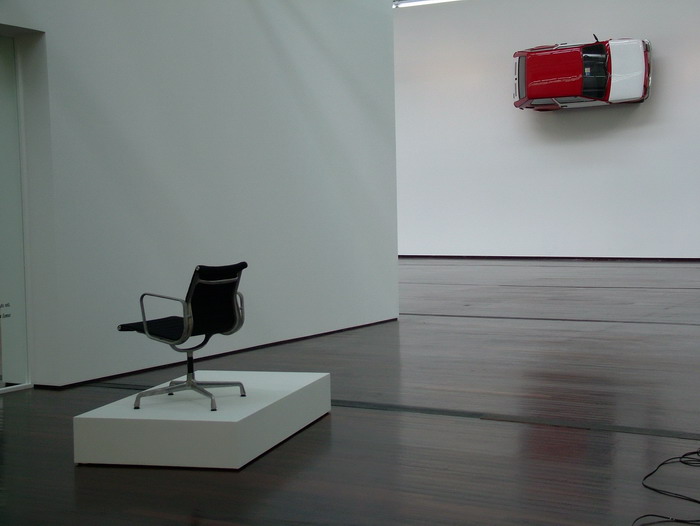
“Work .Readymade. Bern Centre of Contemporary Art” (1997) is an early work by Staling, demonstrating the transformation and appropriation of daily readymades under behavior and consciousness. A Charles Eames aluminum office chair with black leather upholstery, constructed from Marin Ausalito bicycle metal, sits on a white pedestal like a displayed object. Across a white wall and transparent floor-to-ceiling window, another Charles Eames aluminum Marin Ausalito bicycle leans against a white pedestal. Here, the artist subverts the concept of the readymade through simple behavioral metamorphosis. These two aluminum objects, constructed from each other’s industrial elements, carry their own genetic transformation signs, presenting an industrial world process within an extraordinary sculpture and object charter, connecting qualitative change, conversion, technology, reality, and imagination.
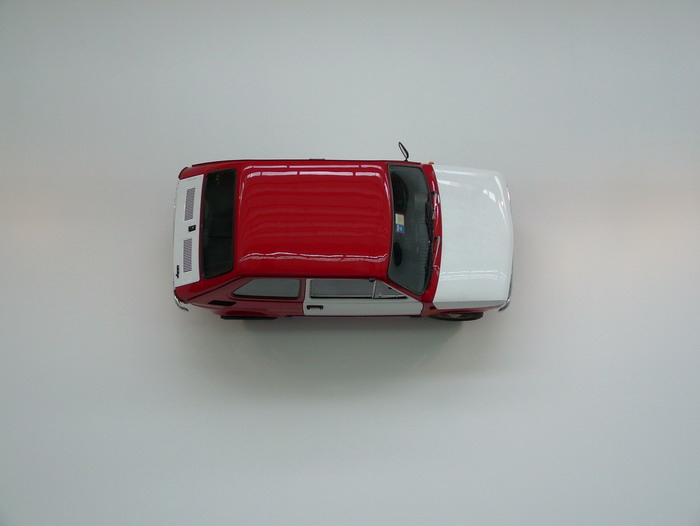
“Flag (1972-2000)” (2000) places a red-and-white Fiat 126 car produced in Turin, Italy, in 1970 directly onto a wall, resembling a three-dimensional flag within the charter of painting and object-sculpture. This mini-car factory moved to Poland in 1972 and operated for 36 years until closing in 2000. This living object not only references painting and sculpture but also highlights capitalist operational modes, from industrial to post-industrial situations, consumption and production, transformation and time-space, industry and capital, and other temporal realities.
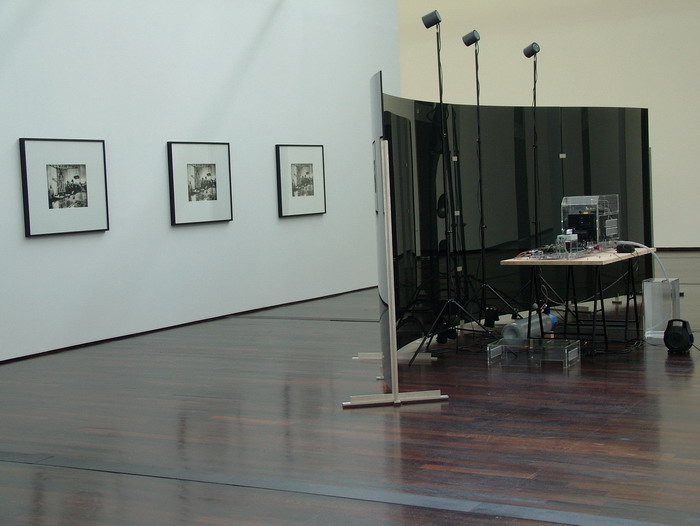
“Exhibition” (2004) is grounded in a highly significant architectural and design site installation. The unusual work was inspired by images of the German Pavilion participating in the Technical Innovation Exhibition annex of the 1929 Barcelona International Exposition. This modernist new energy exhibition annex was designed and constructed by outstanding architects Lilly Reich and Mies van der Rohe. The venue’s lighting used the most advanced combustible battery energy of the time, developed through hydrogenation/oxidation reactions and alloy catalysts.
This work was constructed during the 2004 exhibition at the Joan Miró Museum in Barcelona. It juxtaposes multiple historical events, seemingly reversing time and positively reflecting modernist progress and contemporary technological contexts. Based on images of the German Pavilion at the 1929 Barcelona International Exposition, it was replicated at original size, presenting a series of semi-circular dark glass partition walls like mirrors. A central table holds a series of alloy electronic instruments and three lighting lamps, referencing the constructive implications of contemporary advanced energy. It reflects three images of the 1929 German participation in the Spanish Barcelona International Exposition Technical Innovation Exhibition annex. Emphasizing historical connectivity in location, it focuses on cultural, technological, and energy innovations occurring during the modernist process, reminding people to reconsider the possibilities of current energy technology.
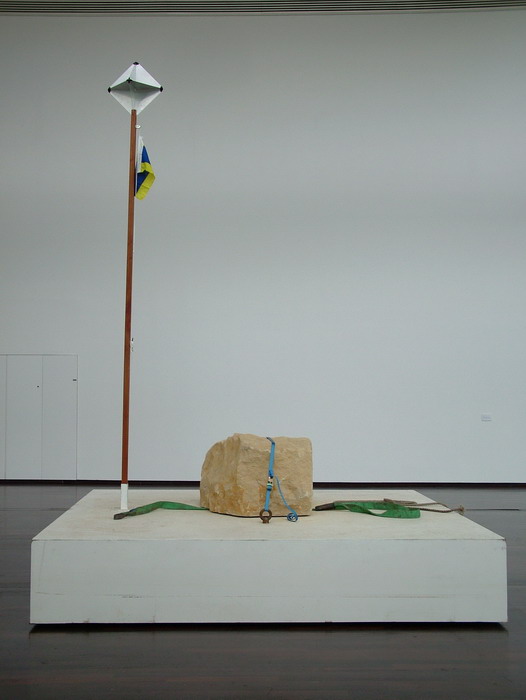
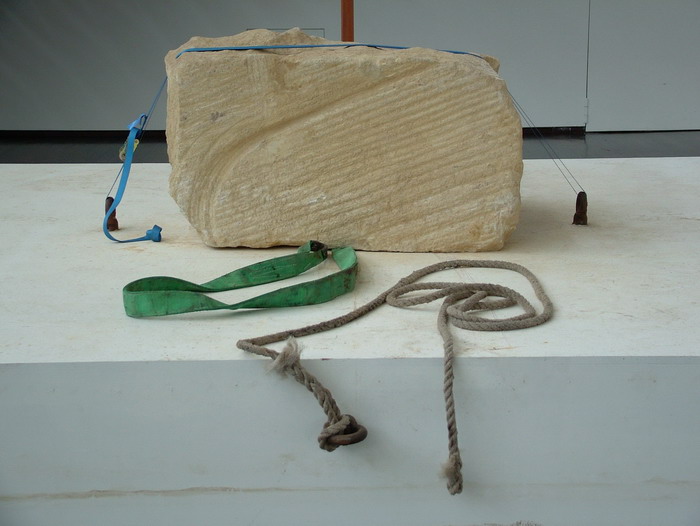
“Rockraft Pedestal Row” (2008) displays a square stone block tied with a seatbelt on a large white square wooden pedestal, with a buoy inserted nearby, carrying location, displacement, and behavioral consciousness within the charter of sculpture-object. A square limestone block collected from Avommouth, UK, was transported via a simple wooden raft (like a sculpture pedestal) during high tide on a journey of 19 kilometers to Bristol port. After entering the port, the stone enters another layer of virtual journey: scanned and digitized, conceptually converted and transferred to a new (same-size) pedestal, magically entering the museum as an artwork. The work clearly carries the object’s location, change, procedure, displacement, virtual context, and the storyline and conceptual operations attached by the artist.
“Mirrored Wall Head” (2008) is a series of stone blocks six meters long and one meter high. Orderly in form and color, like a windbreak or isolation wall, the striking stone wall is constructed based on eight cut stones at both ends. Stone forms and colors are symmetrical left and right, extending inward from both ends, focusing on the center. It reflects not only today’s computer-digitized high-tech world but also an extraordinary mirror effect in its vertical and horizontal symmetry.
“Silver particle-bronze -after H Moore” (2008) is an amorphous organic bronze sculpture presented on a white pedestal. Inspired by a photograph of Henry Moore’s British sculptor work “Reclining Figure,” its image was modeled in 3D and enlarged 300,000 times to form the sculpture, cast simultaneously in Moore’s frequent copper-casting studio. It obviously simulates the sculptural creation method of master Henry Moore, converting time, space, and meaning between behavior and procedure, reality and imagination, concept and sculpture.
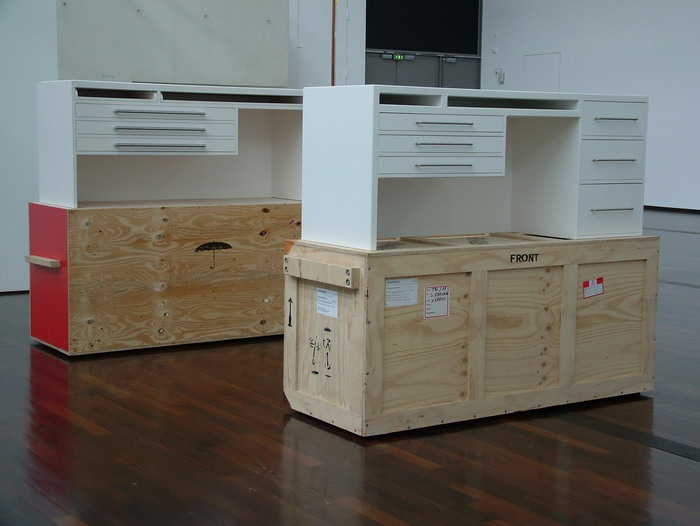
“Three white desks” (2008-09) consists of three copies of copies of early 20th-century modernist office desks, presented on wooden crates used for transporting desks, like object-sculptures. Clearly, the objects carry historical memory and craftsmanship, as these three are replicas of modernist furniture masters like Le Corbusier, Eileen Grey, and Marcel Breuer, copied by London furniture maker and interior decorator Francis Bacon in the 1930s. However, these three are not direct copies of Bacon’s works but were replicated from digital data files. The clever relationship of objects involves creative sources and procedures; this relationship and fate become the value and meaning of the work, clearly carried on Staling’s object works. For example, one piece was inspired by scanning Francis Bacon’s data files from the National Library of Australia in Canberra, realized by Berlin furniture maker Uwe Kutter. Another involved Uwe Kutter transmitting data files to the artist, who then asked Charmian Watts in Sydney to construct it. The final piece was sent by Charmian Watts in Sydney to the artist and realized by George Gold in London. In this network of copy after copy, flowing, displacement, conversion, and time-space plots construct object value and additional meaning.
“D1-Z1(22.686.575-1) 35mm Black and White Film” (2009) can be seen as a video art work, projected by a simplified German Dresden D1 film projector from the early last century. Z1 refers to the story of the first computer believed by people. The 30-second audio-visual film endlessly repeats fragments of the mechanical process of manufacturing small electronics in early factories. This computer was created by German artist and engineer Konrad Zuse (1910-1995) in 1936, a memory machine capable of addition, subtraction, multiplication, and division, reading via punched tape programs. Here, this 35mm black-and-white film is played for the first time through such a program, allowing people to dramatically see the film continuously flowing through the projector. The ingenious construction of D1-Z1 fills imaginative space, reassembling things and history appearing in era changes into a symphony of the new era.
“White Model” (2009) neatly displays the artist’s published catalogs and exhibition (images and invitation cards) materials from the past 14 years inside a white glass cabinet, allowing viewers to clearly see the overall progress of creative work, formal comparison, and conceptual conversion. Works like “Hanging Garden” (1998), “Saving Azaleas” (1999), “Flag” (2002), “Failed Wheels” (2003-04), “Boat Cabin Boat Cabin (Mobile Architecture No. 2)” (2005), “William Noack Factory” (2006), “Under the Bodhi Tree” (2009), etc., are viewed conceptually as a single work display, like a milestone in the journey of recent creative evolution. Between information and concept, behavior and attitude, imagination and interpretation.