19th-Century French Academic Painting
J-L Gerome, Cockfight, 1846 painting, exhibited at the 1847 Salon, 143x204 cm, held at the Musée d'Orsay, Paris.


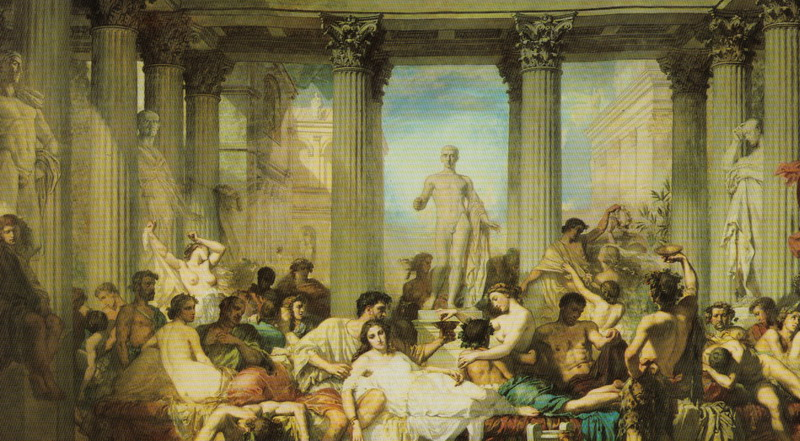
Thomas Couture, Fallen Roman, 472x772, painted in 1847, held at the Musée d'Orsay, Paris. "Pompier" (firefighter) is synonymous with French Academicism. The term originated in the mid-19th century to mock paintings that revived historical and mythological themes; figures often wore Greek or Roman helmets, resembling firefighters. This style became the trend of conservative academies, a remnant of Neoclassicism that eventually represented official art. The Paris Salon became the domain of the Academics.
Jules-Léon Gérôme (1824–1904), influenced by Ingres’s Neoclassicism (he was Ingres’s outstanding student and successor), created this highly dramatic Cockfight. He completed this masterpiece at age 22. The work depicts a handsome man and beautiful woman leaning forward, intently watching the cockfight, set against ancient ruins featuring heavy columns and an Egyptian sphinx statue. Through object arrangement and contrasting colors, Gérôme expressed spatial composition, ending the Neoclassical tradition established by David and Ingres.
Alexandre Cabanel (1823–1889) and William-Adolphe Bouguereau (1825–1905) were representative painters of mid-19th-century French Academicism. Inheriting remnants of Neoclassicism, they emphasized aesthetic, sensual, mannered, and unreal beauty; perfect bodies with marble-like pale skin. (Compare Bouguereau’s The Birth of Venus with Ingres’s The Source: aside from posture, the depiction of the two goddesses is identical.) Their works became aesthetic ornaments for the conservative bourgeoisie of the 19th century.
Thomas Couture (1815–1879). Fallen Roman is one of the large-scale works in the Musée d'Orsay and a representative piece of 19th-century Academicism. It reflects Romans escaping reality amidst the radical Industrial Revolution by retreating into history. Influenced by the dramatic grand scenes of 16th-century Venetian painter Veronese, it fully displays the decadent, hedonistic mood of the fallen Romans, serving as testimony to 19th-century official historical narratives.