The 2007 French Presidential Election, Part I: Tensions Rising
(Top center) Ségolène Royal, the Socialist Party’s presidential candidate, at her first Paris press conference, held at the Carpentier indoor sports arena in Paris’s 13th arrondissement. (Left) Nicolas Sarkozy, UNP’s right-wing presidential candidate (image from his campaign website). (Right) Jean-M
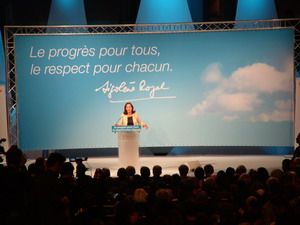
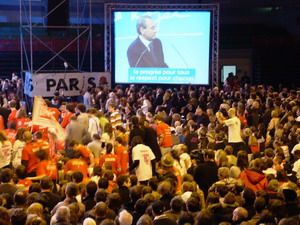
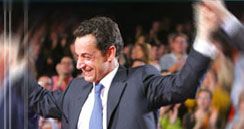

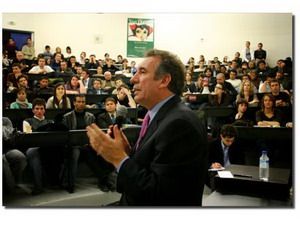
(Top center) Ségolène Royal, the Socialist Party’s presidential candidate, at her first Paris press conference, held at the Carpentier indoor sports arena in Paris’s 13th arrondissement. (Left) Nicolas Sarkozy, UNP’s right-wing presidential candidate (image from his campaign website; see online feature). (Right) Jean-Marie Le Pen, presidential candidate for the well-known National Front (Front National) (image from the FN party website). (Bottom) François Bayrou, the UDF’s centrist presidential candidate (image from his website; see online feature).
This year’s French presidential election has reached its climax. The candidates for both the left and right have been clearly established, and all intending candidates have begun presenting their platforms, entering a Warring States era of rumbling artillery fire and mutual attacks. This year, the number of intending candidates is particularly high, totaling over forty. According to the French Constitution, each candidate must obtain formal endorsement signatures from five hundred local officials—prefects, mayors, town mayors, and village mayors across France—to become an official presidential candidate. This naturally favors major parties, while smaller parties and independent candidates often fail to meet this condition and are automatically eliminated. The period for seeking these endorsements ends in late February. Under pressure from major parties, many intending candidates faced difficulties this year; even Jean-Marie Le Pen of the famous National Front complained about being unable to realize his dream. Nevertheless, today, candidates from all parties, large and small, have fully launched their campaigns with swords drawn and bows bent. The first round of the presidential election will be held on Saturday, April 21.
Here are some introductions to the more important candidates: First, undoubtedly, is the most imposing and media-savvy ruling party leader, Nicolas Sarkozy of the UNP (French right-wing party). Next comes Ségolène Royal, the attractive female president of the Poitou-Charentes regional council for the French left-wing PS (Socialist Party). The centrist UDF party is led by its chairman, François Bayrou. Also running are Jean-Marie Le Pen of the French National Front (Front National), the most famous far-right party, and Philippe de Villiers, another far-right candidate. After the failure of the anti-liberal alliance, Communist Party leader Marie-George Buffet ran alone. Meanwhile, José Bové, the hero of the anti-globalization movement, lived up to expectations by entering the race. There are also two far-left candidates from the Workers' Party: the experienced Arlette Laguiller, who has represented the Workers' Party in multiple presidential elections, and Olivier Besancenot, another far-left figure who became a dark horse for social revolution after running in 2002. The Green Party is led by former Ecology Minister Dominique Voynet, among others.
Among the candidates in this year’s French presidential election, Jean-Marie Le Pen of the far right is the oldest and has been in politics the longest; he was once the youngest member of parliament in the French National Assembly in 1956. On the left, postman Olivier Besancenot is the youngest (with no political experience); everyone else belongs to the middle generation, around fifty years old. Currently, Interior Minister Nicolas Sarkozy has the highest international profile. He visited US President Bush last year specifically to strengthen his international standing, clearly signaling his pro-American stance and advocacy for liberalized economics. French left-wing presidential candidate Ségolène Royal has relatively low international recognition and no international political experience. Last year, she visited Lebanon and Israel specifically as a presidential candidate. Earlier this year, she visited China, personally climbing the Great Wall of Beijing like the late French President Mitterrand. Her eloquence caused a stir in Paris’s political circles. Through these international visits and contacts, she has built international prestige and has now become the candidate most watched by international media for the French presidency. Apart from these two, almost all other candidates lack international recognition.
The most attention-grabbing issues in this year’s election, besides unemployment, are the rise of natural ecology and environmental awareness. Under the manifesto of Nicolas Hulo, the famous host of the "Ushuaia" program on France’s first television channel regarding the geographical environment (who intended to enter the race but ultimately dropped out), almost every major party signed his environmental treaty. In the Fifth Republic’s presidential elections, it is usually a showdown between the left and right. Unexpectedly, in 2002, the left was struck out, surprising everyone. This opened up all possibilities for the future, especially under current French social trends where the far right has become a third political force, casting a significant variable into the election. No wonder the traditional right-wing UMP’s platforms and positions often inch closer to appease the far-right voters.
Of course, the biggest feature of this year’s French presidential election is a glamorous hot mom, Ségolène Royal (mother of four children), who was selected by international media last year as one of the ten sexiest women in the world. One can imagine her boundless charm; she has almost become the public figure closest to the media. Leading the trend in today’s international wave of female governance, she is a topic of endless discussion. In this male-dominated French political arena, she casts a possible variable for the future, likely competing with the vigorous Interior Minister Nicolas Sarkozy for power.
All strategic operations in this year’s French presidential election largely defy convention, deploying various tactics to win public opinion and expand their respective left or right political territories. In Nicolas Sarkozy’s speeches, he leans slightly left, showing goodwill and insights to the labor sector, and occasionally moves toward the far right to soothe National Front voters. Socialist candidate Ségolène Royal proposes a strategy of "participatory democracy," meaning listening to the people. This leaves most people confused and somewhat mysterious. Her platform presentations often use "we" as the central axis, starting from maternal patience and love. Naturally, many people are not accustomed to this feminized political ideal. Her discourse often wanders within the realms of left and right, neither fully left nor fully right, leaving traditional leftists unsure of how to react and giving the right a headache. Starting from family-centered perspectives, there is hardly any clear dividing line between left and right. It is too subtle. It has attracted criticism from both sides, with accusations of being "a bit left, a bit right." With time yet to run out, everything remains a variable. Who will win? No one can predict the outcome of this election so easily.
In short, according to polls on February 13, when Nicolas Sarkozy had not yet officially become a candidate, she was always leading by a wide margin. Current polls show a slight cooling off. For the first round, Nicolas Sarkozy is at 31%, Ségolène Royal at 27%, François Bayrou at 13%, and Jean-Marie Le Pen around 12%. For the second round, Nicolas Sarkozy is at 53% and Ségolène Royal at 47%. We shall wait and see who wins.
2007-2-13