The 2007 French Presidential Election, Part 7: The Theater of the Campaign
Humorous and satirical images from debat2007.fr are the work of cartoonist Michaelski. (Top) The omnipotent Nicolas Sarkozy. (Bottom) The 2007 campaign theater.
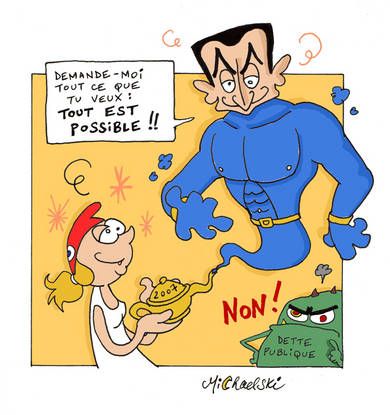
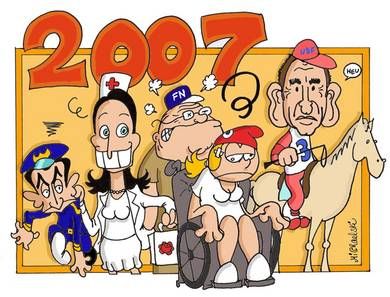
Humorous and satirical images from debat2007.fr are the work of cartoonist Michaelski. (Top) The omnipotent Nicolas Sarkozy. (Bottom) The 2007 campaign theater. As the French presidential election approaches the first round, the situation grows increasingly heated. Jacques Chirac, who has dominated French politics for over forty years, announced in mid-March his withdrawal from the political arena and declared he would vote for the UMP candidate affiliated with his party. This was the result Nicolas Sarkozy had long desired; finally, the time had come to strike freely.
Nicolas Sarkozy, a candidate who enjoys being the center of attention or employing strategies that overshadow others, brought up the topic of "French identity" on March 8 during the political talk show À vous de juger ("It's Up to You"). He proposed establishing a "National Identity and Immigration Office" if elected. Unexpectedly (or perhaps not so unexpectedly), he revived a platform traditionally associated with the far-right National Front of Jean-Marie Le Pen. In this election, Le Pen had actually moderated his stance and did not particularly emphasize this narrative, though everyone knew where he stood. This immediately sparked widespread social debate.
Clearly, many right-wing voters favored the centrist discourse of François Bayrou of the UDF. Polls showed Bayrou threatening the traditional right-wing UMP candidate. By introducing this novel discourse, the strong candidate (incumbent Minister of the Interior) Nicolas Sarkozy was clearly aiming to appease far-right voters. All left-wing candidates strongly condemned the danger of this National Front-style rhetoric, accusing Sarkozy of colluding shamelessly with Jean-Marie Le Pen. Centrist François Bayrou stated that this National Front discourse was spreading through the election. Far-right Jean-Marie Le Pen claimed Sarkozy was a plagiarist, arguing that society prefers originality, yet it is he (Le Pen) who reaps what he sows. One can imagine this as a tragicomedy where anything goes in the electoral arena.
Shortly after, Socialist candidate Ségolène Royal responded to the discourse regarding "every household should own a French flag." She argued that hanging flags on balconies or windows on Bastille Day or other major commemorations is common in France. Discussing "the nation" or "the flag" seems to be trivialized in this peaceful era. Talking about "the nation" appears to reflect the French people's anxiety regarding globalization and the European Union, or perhaps serves another strategic purpose in the campaign.
In such an intense campaign, any social event or international issue can influence the outcome, especially when involving partisan candidates. Thus, the suburbs of Paris (particularly areas affected by riots) drew significant attention during the presidential race. Any incident there would cast a shadow over the incumbent Minister of the Interior and presidential candidate. During this period, a document issued by police stations in the northern suburbs of Paris, which instructed officers not to provoke, coerce, or conduct special raids in specific areas, caused public controversy. No wonder hidden beneath this calmness was the abuse of administrative power by public authorities.
Under this strong-handed internal policy, on Tuesday evening (March 20), in front of Rampal Elementary School in Belleville, Paris, an undocumented Chinese grandfather was caught by police while waiting to pick up children. He was stopped for inspection at a café across the street. When forcibly placed into a police car, he clashed with parents coming to greet their children. Amidst the chaos, police used tear gas and violence to disperse the crowd. Reports by mass media caused public uproar. The next day, the elementary school principal was arrested and interrogated by police for endangering public authority. She defended herself, stating she was only protecting her school's children. Parents and teachers' union representatives went to the police station to rescue her, demanding her immediate unconditional release. After seven hours, she was released, drawing the attention of all presidential candidates.
The incident expanded, and parents and union members demonstrated at the inspectorate the following day, demanding that the government stop arresting undocumented children and parents in schools and their surroundings. Under government pressure, the problem of undocumented illegal residents suddenly became a topic of discussion among presidential candidates. The matter did not end there. On Friday, all elementary schools in Paris held a strike in response to this event. Which future president will have the courage to handle these complex social issues?
A week earlier, the French President had announced the resignation of his Minister of the Interior, Nicolas Sarkozy, replaced by the young minister for overseas territories, François Baroin. Sarkozy threw himself wholeheartedly into the presidential campaign. On Monday, March 26, during a brief ceremony, Sarkozy humorously remarked that he was changing lanes. The next morning, police unions in Marseille, southern France, held demonstrations, sighing with relief and celebrating the departure of the strong-willed interior minister.
That evening, a riot broke out under the metro at Paris's Gare du Nord due to ticket checks. Over two hundred youths battled police in the urban underground, destroying shops in the underground mall. The underground battle lasted from 5:30 PM until 2:00 AM. This free violence has become a commonplace phenomenon in contemporary society, accumulating among the populace, especially the youth, ready to explode at any moment; it is merely a question of scale. The recently resigned interior minister claimed his glorious record in maintaining public order was now being heard. That riots occurred again was hardly accidental. Shocked throughout France, everyone knows whether the red light has been flashed on public safety.
Almost all presidential candidates pointed to the recent failures of the former interior minister's strong-handed security policies as bearing considerable responsibility. The major issue of public safety once again became a discourse topic for presidential candidates. Reflecting on the 2002 presidential election, one recalls how Jean-Marie Le Pen of the far-right National Front unexpectedly won French votes from similar violent events. The spectacular theater of the French presidential election continues to unfold, scene after scene.