The Sixteenth of the "2007 French Presidential Election": A Battle of Wits
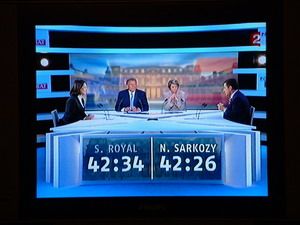
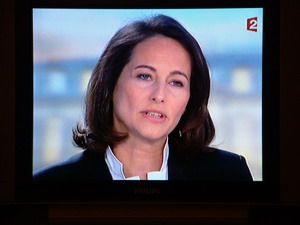
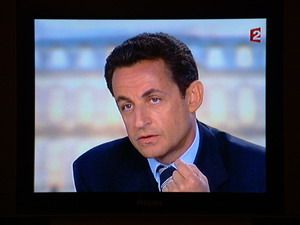
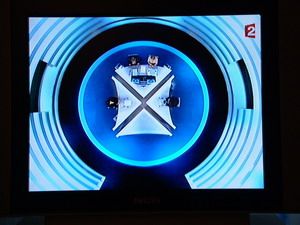
(Top) Photo from TV debate. (Mid-left) Leftist Ségolène Royal. (Mid-right) Rightist Nicolas Sarkozy. (Bottom) Photo from TV debate. In three days, France's next president will be revealed as the race reaches its climax and finale.
In three days, who will be France’s next president will be revealed. The presidential showdown is entering its peak and finale, with firecrackers going off everywhere, as both candidates fight to the end with all their might. Three days ago, Francois Bayrou, leader of the Union for French Democracy (UDF), became a key figure in this election campaign. He publicly declared that he supports neither the right nor the left, continuing his neutral stance and allowing his voters and party members to freely choose France’s future. He proposed a televised dialogue with Nicolas Sarkozy and Ségolène Royal. Naturally, Nicolas Sarkozy immediately refused, while Ségolène Royal agreed at once, creating an unprecedented episode in the Fifth Republic’s presidential campaign. The televised dialogue between Francois Bayrou and Ségolène Royal, which attracted the attention of all France, had no positive effect; it was clearly a gesture by the Socialist Party to curry favor with centrists, attempting to win over votes from the middle ground.
The battle lines between the left and right continued to heat up, both hoping to win over the floating votes of centrists. They used direct appeals or covert maneuvers, employing every trick in the book. Of course, the alliance between centrists and the right has become a tradition in French politics, so it was quite normal that the UDF’s National Assembly members (29 in total, 21 of whom) quickly shifted to the right. This involved their personal interests, as the subsequent legislative elections would follow the presidential vote. Francois Bayrou and his supporters continued to reject the Socialist Party’s goodwill (such as including centrists in their government if Royal were elected). Meanwhile, Jean-Marie Le Pen of the far-right National Front held his traditional May 1st march around the Joan of Arc statue to defend France. Party leader Le Pen announced, “I hope voters show trust in me, do not vote for Nicolas Sarkozy or Ségolène Royal, I hope voters collectively refuse to vote.” Another far-right figure, Philippe de Villiers of the Movement for France, declared his support for Nicolas Sarkozy, both calculating carefully for their legislative elections. The exciting and dramatic showdown was about to unfold.
All of France waited for the 9 p.m. presidential debate on the evening of May 2nd, where the left and right candidates debated openly, facing each other head-on in a political comparison of two blueprints for France’s future. French presidential televised debates began during the global oil crisis of 1974 and have since become a tradition. The most memorable was the wonderful debate between Mitterrand and Chirac in 1988. In 2002, President-elect Chirac refused to debate Le Pen of the National Front. This year attracted even more national attention because, unlike previous times when incumbent presidents or prime ministerial candidates participated, this time featured completely new faces, the youngest candidate, and a new female candidate. This presidential televised debate was like the World Cup final between France and Italy; all of France held its breath. Regardless of left or right, almost everyone stopped to watch on the small screen. Streets and cinemas suddenly grew quiet, attracting nearly 20 million viewers. The heated campaign reached an unprecedented peak.
In the rigorous and elegant geometric debate hall, the two candidates faced each other across a symmetrical table (on TV, Nicolas Sarkozy was on the right, Ségolène Royal on the left), with two moderators in front. Starting at 9 p.m., the debate lasted over two hours, filled with climaxes. Topics included France’s economy: unemployment, the 35-hour workweek, industrial relocation under globalization, national debt, nuclear energy, natural energy, and environmental protection. Domestic issues focused on public security, immigration, pension systems, education, housing, and scientific research. Questions regarding France, the EU, and Turkey’s accession were also raised. Notably absent from this televised debate was discussion of France’s future international affairs; only Iran’s nuclear issue was briefly mentioned, with no word on Iraq or Afghanistan.
In this head-to-head debate, Nicolas Sarkozy responded calmly but was not entirely comfortable facing his elegant female opponent, often turning his gaze toward the moderators. However, on many issues, he presented concrete plans, frequently using smooth, indefinable words to provoke the other side. Ségolène Royal maintained a firm attitude, smiling as she fought back with an aggressive stance, fully demonstrating her keen wit. Her fierce attacks clearly aimed to use the televised debate to win over floating voters. The battle of wits started with economic issues, especially labor working hours. Nicolas Sarkozy criticized the “35-hour workweek” constructed by the Socialist Party as the cause of France’s economic decline, stating, “No country in Europe, nor even other socialist-governed countries, allocates working time like France. I suggest another strategy: create jobs through work.” This meant loosening the 35-hour rule, allowing those who want to work more to do overtime and earn more. Ségolène Royal questioned Nicolas Sarkozy, “If you are so dissatisfied with the 35-hour workweek, why didn’t you improve it when you were in power? Do you really want to abolish it?” Nicolas Sarkozy ambiguously replied, “Not abolish it.” Ségolène Royal argued, “I support workers who wish to increase their working hours; overtime is feasible.” When asked, “What about the 35-hour limit? Will it be kept?” Ségolène Royal answered, “I believe the second regulation, keeping the 35-hour limit is too strict. I hope to loosen it and negotiate conditions with unions and employers to solve the problem.”
Regarding public security, Ségolène Royal strongly criticized, “Former Interior Minister Nicolas Sarkozy’s security measures were a complete failure. In 2002, he claimed ‘zero tolerance,’ yet violent incidents have increased. Recently, two female police officers were raped, shocking society. If I am elected, I will protect civil servants, especially women.” Nicolas Sarkozy retorted sarcastically, “I don’t need to debate Mrs. Royal. Social security wasn’t much better when the Socialist Party was in power. Unfortunately, the Socialist Party did not approve the creation of new police personnel the year before last, so we couldn’t assign bodyguards to every female civil servant.”
The presidential televised debate reached its climax halfway through. When Nicolas Sarkozy discussed the schooling of children with disabilities, he angered Ségolène Royal, who angrily accused his policy of “political moral corruption.” The special education plan to help disabled children attend school was an institution established when she served as Deputy Minister of Education, but it was canceled after the right-wing took power. Nicolas Sarkozy coldly told her not to get excited. She confidently said, “I am not uncalm; I oppose injustice in a rage.” Facing Ségolène Royal’s relentless sharp criticism as the Socialist candidate, Nicolas Sarkozy fired back, “I did not question your integrity, so you need not question my morality. You are too quick to lose your temper.”
Regarding the pension system, Ségolène Royal proposed supplementing pensions through economic growth and stock taxes, and abolishing the Fillon Treaty (equal retirement age). Nicolas Sarkozy proposed abolishing special pension systems, as pension funds would lose balance by 2020. On nuclear energy, Ségolène Royal hoped to continue extending nuclear power policies while simultaneously developing natural energy. Nicolas Sarkozy stated nuclear energy is the cleanest energy and advocated developing next-generation (third-generation) nuclear power plants. On housing, Nicolas Sarkozy advocated that everyone should be a homeowner, encouraging the public to buy houses through tax deductions. Ségolène Royal proposed that municipalities build more social housing systems. On EU issues, Nicolas Sarkozy hoped to directly sign the EU Constitutional Treaty and opposed Turkey’s accession. Ségolène Royal advocated resolving these two issues concerning French citizens through referendums. On education, Nicolas Sarkozy wanted teachers to observe children’s progress in learning to read and write. Ségolène Royal hoped that those with weaker abilities would receive individual tutoring.
The day after the televised debate, on the 3rd, poll results showed that 53% of people believed in Nicolas Sarkozy’s clear political arguments, while only 31% affirmed Ségolène Royal, and 16% were completely dissatisfied. When Francois Bayrou, leader of the centrist UDF, was interviewed by reporters, he explicitly stated, “Sarkozy’s arguments are too liberal; I already know I won’t vote for Nicolas Sarkozy.” But no one knew who he would vote for—was it the Socialist Party’s Ségolène Royal? Would this reverse the disadvantage of the Socialist candidate? Who knows? Will Nicolas Sarkozy, who holds the advantage in polls, be the next president?