The Fifteenth of the "2007 French Presidential Election": Portrait of Nicolas Sarkozy
The demeanor of political strongman Nicolas Sarkozy during his first-round victory, image from sarkozy2007.forumactif.com. Another strongman in the French presidential runoff was Nicolas Sarkozy of the Union for a Popular Movement (Union pour un Mouvement Populaire), born…
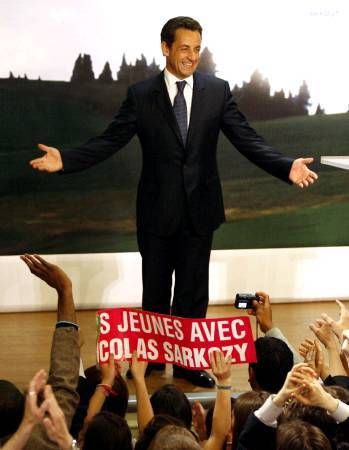
The demeanor of political strongman Nicolas Sarkozy during his first-round victory, image from sarkozy2007.forumactif.com. Another strongman in the French presidential runoff was Nicolas Sarkozy of the Union for a Popular Movement (Union pour un Mouvement Populaire). Born on January 28, 1955, in Paris's 17th arrondissement, he is currently 52 years old; if elected President and serving until the term ends in 2012, he will be 57. His father, Paul Sarkozy, was a painter of Hungarian nobility who emigrated to Paris in 1949 to escape communism. That same year, he married Andrée Mallah, the daughter of a Jewish doctor and law student, another Eastern European immigrant. The happy family had three children, with Nicolas being the second. However, in 1959, his father Paul left the family, abandoning the three children. His mother bravely took on the responsibility of raising them while continuing her interrupted studies, eventually becoming a lawyer.
Known for his assertive and decisive style, Nicolas Sarkozy has been called the modern Napoleon. His childhood in the 17th arrondissement of Paris and then in Neuilly-sur-Seine was not very disciplined; he was held back in fourth grade. Ultimately, he passed the high school general exam in 1973. Past events did not affect his subsequent diligent and outstanding studies. He obtained a law degree from Nanterre in 1978, followed by an excellent DEA doctoral degree (research topic: "The Referendum of 1969"). He continued his studies at the prestigious Sciences Po Paris and finally qualified as a lawyer, becoming a lawyer at the Paris Bar.
Sarkozy’s political ideas were quite precocious. At age 19, in his freshman year, he resolutely entered politics, becoming a member of the young right-wing UDR. He actively participated in the 1974 presidential election, helping defeat Jacques Chirac’s political rival, Chaban-Delmas. Confused by the former’s political ideals, he threw his support behind Chirac. The following year, at a rally, he delivered his first passionate speech in front of Jacques Chirac. A striking sentence, "Being a young Gaullist is revolutionary," caught Chirac’s attention. In 1981, he became the head of Chirac’s young presidential campaign team. His political development was built within the RPR party, centered around Chirac. Elected as a municipal representative of Neuilly-sur-Seine in 1977, he became mayor in 1983. From 1986 to 1988, he served as Vice-Chairman of the Hauts-de-Seine department, responsible for education and culture. Starting in 1988, he became a Member of Parliament for Hauts-de-Seine and National Secretary of the traditional right-wing RPR party, overseeing youth affairs and training, and managing the list for European Parliament elections. Since then, he has continuously been re-elected as an MP, always winning with high votes in the first round, showing considerable popularity and affection among voters.
Around 1993, during cohabitation when Edouard Balladur was Prime Minister, Nicolas Sarkozy became Minister of Finance. That same year, the hostage crisis at a primary school in Neuilly-sur-Seine (the municipality where he began his political career) shocked all of France. Under his heroic handling, the incident ended smoothly, showcasing his calm and wise character in dealing with major events. From 1993 to 1995, under Edouard Balladur’s government, during the 1995 presidential election, he resolutely stood up to defend his Prime Minister and presidential candidate, offending Jacques Chirac. When Chirac was elected in 1995, Nicolas Sarkozy became a "traitor to Chirac’s politics," enduring his most difficult and confusing dark years. This created a serious political generation gap between the two, dropping their political friendship to rock bottom, giving him the opportunity to deeply reflect on his own political future.
In 1997, when Chirac miscalculated and dissolved parliament, leading unexpectedly to a left-wing majority, Sarkozy reflected during this low tide for the right wing. He became General Secretary of the RPR party, and the following year Acting Party Leader. In 1999, he represented the traditional right-wing RPR party as the lead candidate for European Parliament elections. The true new political opportunity that opened for him was undoubtedly 2002. For this presidential election, the traditional right-wing RPR party changed its name to the Union for a Popular Movement (Union pour un Mouvement Populaire). During Jacques Chirac’s re-election as President, it gave him another chance to actively demonstrate his effectiveness as a president and participate in the fierce battle of the election to show his loyalty. Jacques Chirac easily defeated Jean-Marie Le Pen of the far-right National Front (FN) with over 80% of the vote.
Nicolas Sarkozy served twice as Minister of the Interior and Territorial Planning, and also as Minister of Finance and Economy. Due to his duties as Minister of the Interior, particularly his extraordinary performance in maintaining social order and traffic safety domestically, as well as in immigration and anti-crime matters, his political philosophy and social perspective were highlighted. On certain issues such as free economy, public security, suppression, and immigration policy, the public impression of him was "too right-wing." Especially regarding his desire for power and impatient personality, the image caused further unease. Therefore, in this presidential campaign, the first thing he publicly stated in his political discourse was "I have changed," hoping for societal understanding and to soothe voters' hearts, thereby changing the image of the presidential candidate.
In 2004, he moved from Minister of the Interior to Minister of Finance and Economy. That same year, the right wing suffered a comprehensive collapse in both local and European elections. Party leader Alain Juppé (Jacques Chirac’s confidant and expected successor) resigned and, due to a past conviction regarding a Paris city hall construction plan resulting in a two-year suspension of civil rights, was sent to teach in Quebec, Canada. With a clear path ahead, Nicolas Sarkozy naturally became the leader of the Union for a Popular Movement (Union pour un Mouvement Populaire) and the head of France’s largest party after securing 85% of the internal vote on November 28, opening a clear path for future presidential candidacy and becoming a formidable competitor and political enemy of President Jacques Chirac. He resigned as Minister of Finance and Economy to focus on cultivating his dream of the presidency, touring the country to visit local UMP members and beginning his presidential campaign staff. He sought to democratize French politics and renew promises to the French people.
In 2005, during the referendum on the European Constitution, Jacques Chirac’s pro-side lost. France lost its luster and influence within the EU. In the new government, Nicolas Sarkozy once again became Minister of the Interior. At the end of the year, riots broke out in the suburbs of Paris. Through tough measures and massive police and military suppression, the decisive and assertive Minister of the Interior gained great fame. His administrative style was crisp and tough, and the French called him the modern "Napoleon," hoping he would rebuild new hope for the French people. Polls among political figures continued to soar, making him invincible and a media darling. Every move became news coverage. Nicolas Sarkozy became tomorrow’s political star. In 2006, without going through internal party elections, he became the UMP’s rightful candidate. Driven by the media, a powerful Nicolas Sarkozy whirlwind formed. It was only with the emergence of Socialist Ségolène Royal that the media split evenly into rivals, and an anti-Sarkozy momentum appeared.
Nevertheless, it is true that Nicolas Sarkozy won the affection of traditional right-wing and far-right voters. This was evident from the first round of voting, where he secured 31.06%, becoming the candidate with the highest votes in the first round of the Fifth Republic’s presidential election. Who will win or lose in the second-round showdown between left and right? The result will be revealed on May 6 at 8 PM.
Viewing this strongman from another angle, he also has a vulnerable side, especially in the realm of emotions. The confident and handsome Nicolas Sarkozy became Mayor of Neuilly-sur-Seine at just 28. On September 23, 1982, he married Marie-Dominique Culioli, and they had two boys. In 1984, while serving as mayor, he met his model wife, Cécilia, while hosting TV host Jacques Martin’s wedding ceremony in the city hall. Five years later, unexpectedly, Cécilia passionately threw herself into Nicolas Sarkozy’s arms. In this romantic world, it seems France has romance but no infidelity. In 1996, Nicolas Sarkozy and Cécilia walked down the aisle. In 1997, they had a boy. The romantic French emotional world is complex. Handsome men and political strongmen are often surrounded by models, with constant rumors, and relationships with model noblewomen fluctuating, earning him the title of the French version of "Kennedy."
In short, in 2007, the throne of the Élysée Palace in France will go to either a handsome man or a beautiful woman. Whoever it is, it will be revolutionary. Whether the youngest president or a female president, it will add a new page to French political history.