Chen Chi-Hsiang – "Spring Dreams" Solo Exhibition
Invitation card for Chen Chi-Hsiang's "Spring Dreams" solo exhibition at Tainan Xinxin Art Gallery.
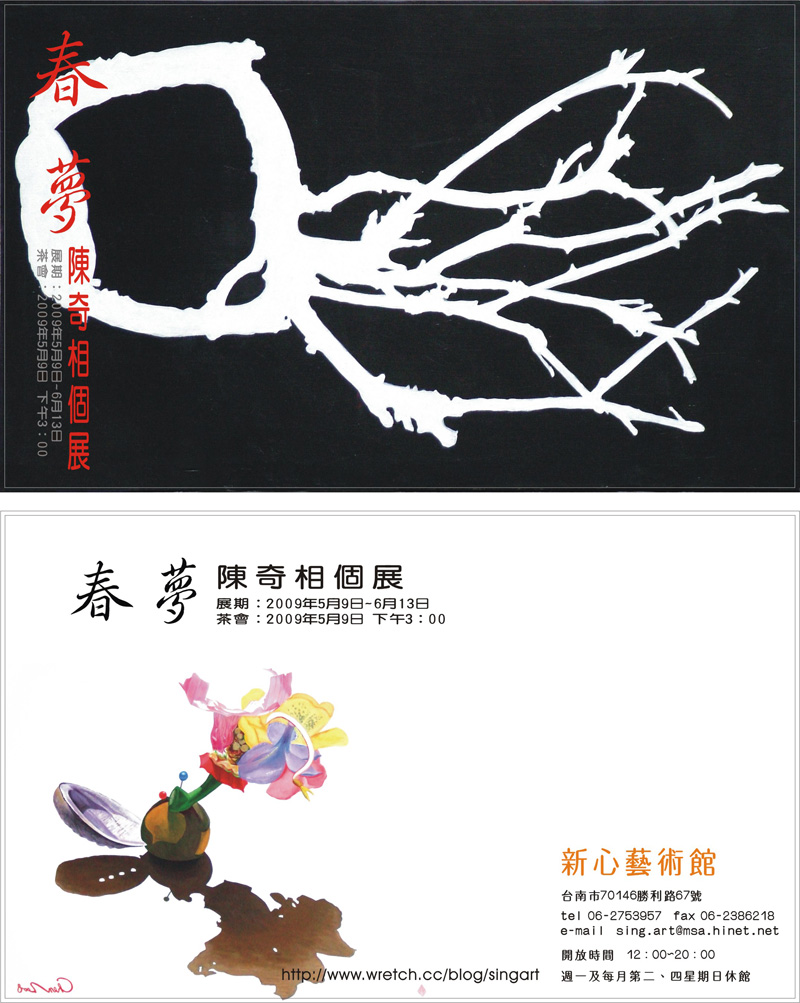
Chen Chi-Hsiang’s "Spring Dreams" solo exhibition runs from May 9 to June 13 at Tainan Xinxin Art Gallery. When evaluating an artist’s work, we often judge it by its interest, intrigue, or originality. An outstanding artist or exceptional artwork must possess a moving commonality, or perhaps a new exploration in visual language and aesthetic thinking. However, amidst the vast sea of art, determining what constitutes a good work or artist inevitably involves too many coincidences. It depends on whether the artist’s personal traits can adapt to the external world and engage in dialogue with it. Yet, hidden within this is the judgment of "powerful subjective conviction," which continues to dictate what art truly is. Therefore, an artist with unwavering beliefs, upon reaching a certain stage of creation, should be conversing with themselves, like a mirror reflection projecting a sincere state of mind.
From this perspective, Chen Chi-Hsiang’s recent series titled "Mirror Flowers, Water Moon" reflects the genuine experience of long-term cultivation by an artist. These works approach the levels of "state of mind" and "mind mirror," transcending our customary values and angles for assessing artworks. The "mind mirror" pertains to the visible arrangement of these works; the "state of mind" reflects his invisible emotions and philosophical thoughts. The two circulate like blood vessels and nerves, forming a cognitive framework necessary before interpreting this series.
These images, seemingly blurry yet meditative, actually originate from real objects casually picked up in Chen Chi-Hsiang’s life—true reflections and projections of his reality. Upon closer inspection, we find that the images are generated through the mirror reflection or projection of objects, creating a combination of yin-yang and virtual-real relationships, rather than through reverse copying. As Chen Chi-Hsiang states:
"This series is presented in the form of dialogue, merging into one like left and right palms, possessing similarities akin to the joyous reunion of identical twins. They can be independent yet complement each other to achieve a seamless intimate relationship. Similarity becomes the symbol of this series."
In Jacques Lacan’s famous "Mirror Stage" theory, he proposes that the reflection of the mirror serves as the "matrix of the symbolic," arising from people’s need for identity. Through mirror reflection, one shapes the "self" to discover the "inner self" and the "outer self" [Note 1]. These two are both two sides of the same coin and mutually integrated, inseparable like blood relations, interacting and entering each other. Perhaps when people discuss the state of mind, it distills like kinship, becoming increasingly rich, revealing a true spiritual aspect. In Chen Chi-Hsiang’s confession, he writes:
"Life is nature; the external is an extension of the internal, or more precisely, the internal and external are one body without boundaries, like shadows following objects. Time wraps around space; space itself is time. Substance combines with emptiness; truth has no form, yet contains all forms... From image to painting, clearly what is sought is neither image nor painting. Of course, it is using image or painting to observe the realm and survey the mind, or observe perception and survey the realm, evoking deeper consciousness or presenting that aware spiritual state through material forms. Observing the artist’s state of mind from the realm, perceiving the original face and appearance of life by surveying the realm."
The "deeper consciousness" and "aware spiritual state" referred to here imply experiencing with the heart, or a kind of realization. This approximates Carl G. Jung’s quote from his final work Man and His Symbols: A Summary of Jungian Thought, citing the famous Italian "Metaphysical Painting" artist Giorgio de Chirico:
"Every object has two sides: the common side—the layer we usually see and everyone sees; the dark metaphysical side—which only a very few people can see in their metaphysical meditation and in the instant of abnormal perspective. An artwork must connect to something that does not appear in visible form." [Note 2]
I think the role an artist plays lies in deeply exploring these ineffable things, or ultimately, fundamental matters concerning humanity. They can be visual, or they can be the "realm beyond physical imagery," similar to the relationship between "state of mind" and "mind mirror."
Writing this, I recall watching Edward Yang’s final film Yi Yi several years ago, which used extensive glass and mirror reflections to hint at the confusion, blind spots, and dilemmas of modern urbanites trapped in glass houses like fog. The imagery was rich, and the film also pointed out the need to return to simplicity and nature in life, reverting to authenticity. Especially in the scene set in the natural science audiovisual classroom, it felt exactly like the conclusion of Chen Chi-Hsiang’s exhibition text:
"In this vast and ever-changing universe, consciously and silently observe its changes, or use the unchanging nature of life to capture fragments of reality with romantic sentiment as an eternal contemplation of existence. Seeking nothing externally, authentically and originally, experiencing that art itself naturally manifests the essence of life."
This fulfills the subtle relationship of "mirror resembles realm, realm resembles mirror."
[Note 1] Mirror, Sabine Melchior-Bonnet, translated by Yu Shu-chuan, Taipei, Blue Whale Publishing Co., Ltd., 2002, pp. 22-24. [Note 2] Man and His Symbols: A Summary of Jungian Thought, edited by Carl Jung, translated by Gong Zhuo-jun, Taipei, Lixu, 1999, p. 324. Lu Ren-yang, March 20, 2009.