Chen Chi-Hsiang Solo Exhibition "The Collective Memory of Rice: Intuition and Imagination"
Full view of the spatial installation "Consciousness Voyage" from "The Collective Memory of Rice: Intuition and Imagination". Black and red cloth, mirrors, glass, spoons, rice of various colors, and plants. 2000.
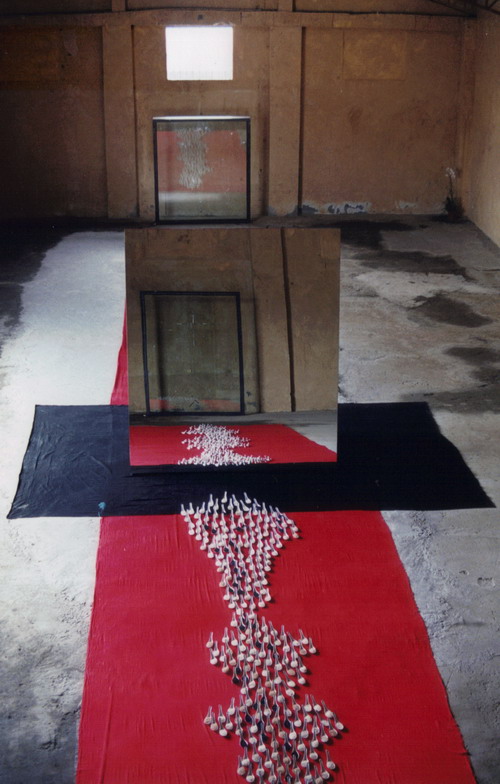
Full view of the spatial installation "Consciousness Voyage" from "The Collective Memory of Rice: Intuition and Imagination". Black and red cloth, mirrors, glass, spoons, rice of various colors, and plants. 2000.
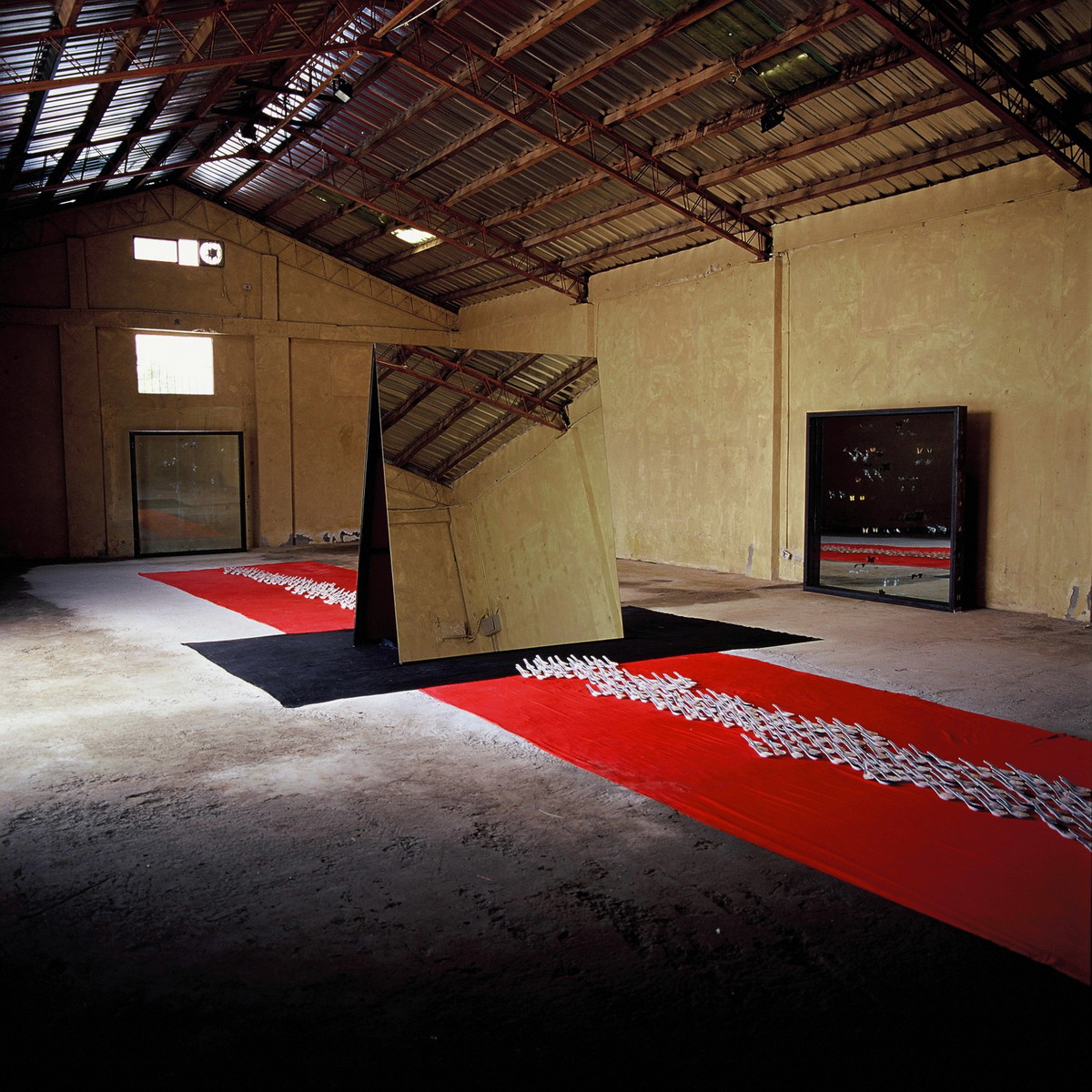
Spatial installation "Consciousness Voyage" from "The Collective Memory of Rice: Intuition and Imagination". Another scene of geometric symmetry. Center: two large mirrors. Left and right sides: one large glass painting each. 2000. Zhuwei Studio.
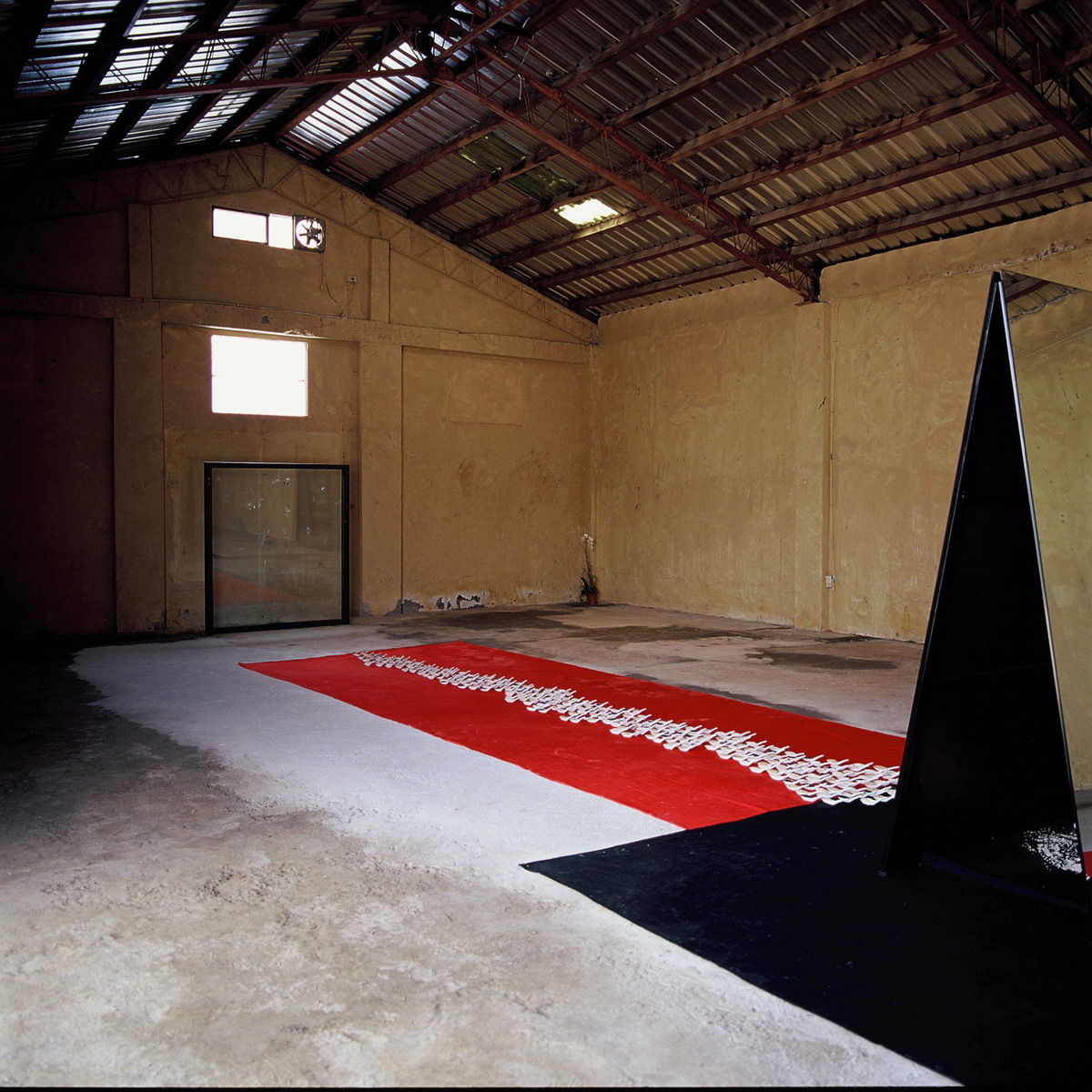
Spatial installation "Consciousness Voyage" from "The Collective Memory of Rice: Intuition and Imagination". Another scene of geometric symmetry. 2000. Zhuwei Studio exhibition space.
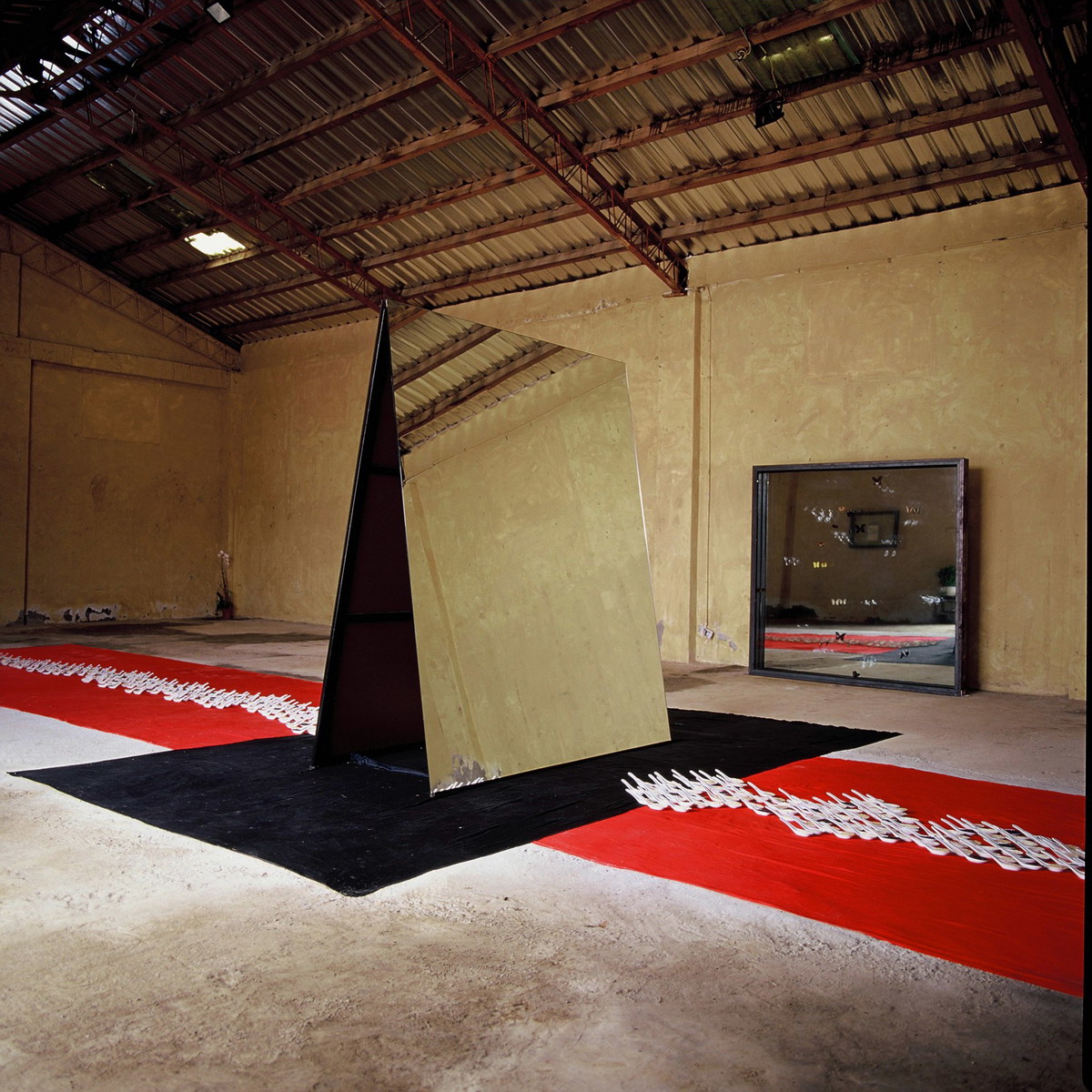
Spatial installation "Consciousness Voyage" from "The Collective Memory of Rice: Intuition and Imagination". Another front view - Consciousness Voyage. 2000. Zhuwei Studio exhibition space.
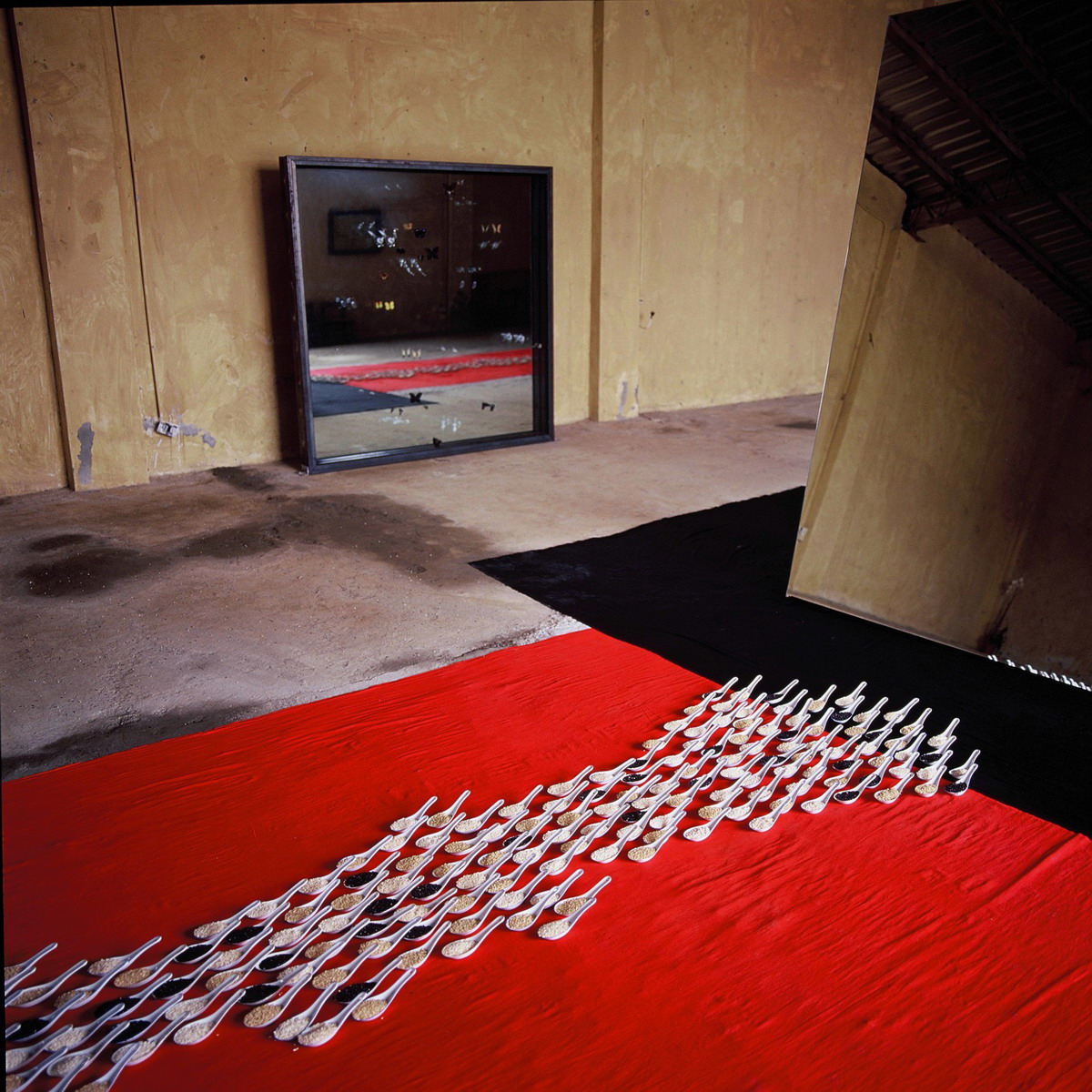
"Consciousness Voyage like a river" from "The Collective Memory of Rice: Intuition and Imagination". 2000. Zhuwei Studio.
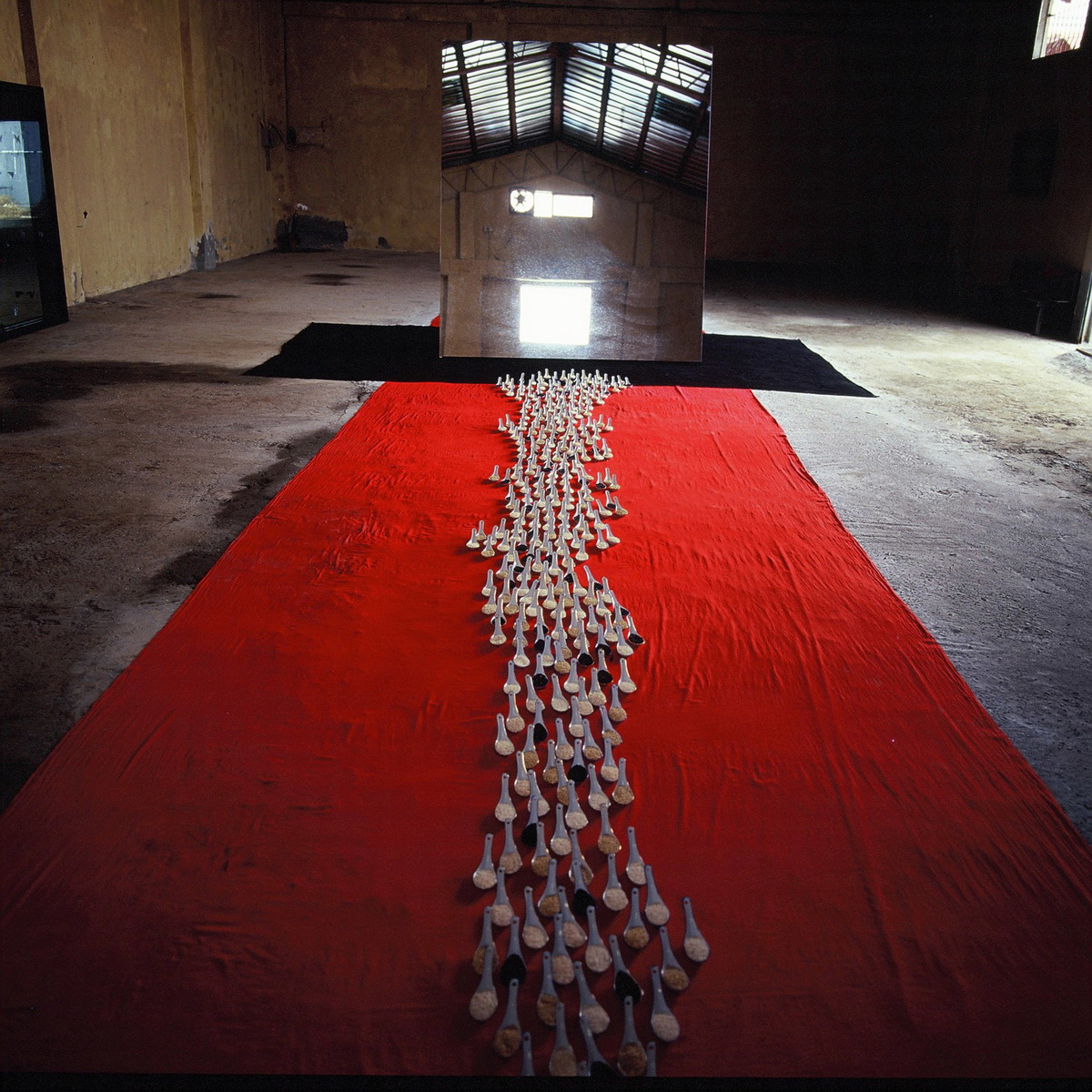
"Consciousness Voyage like a river" from "The Collective Memory of Rice: Intuition and Imagination". 2000. Zhuwei Studio.
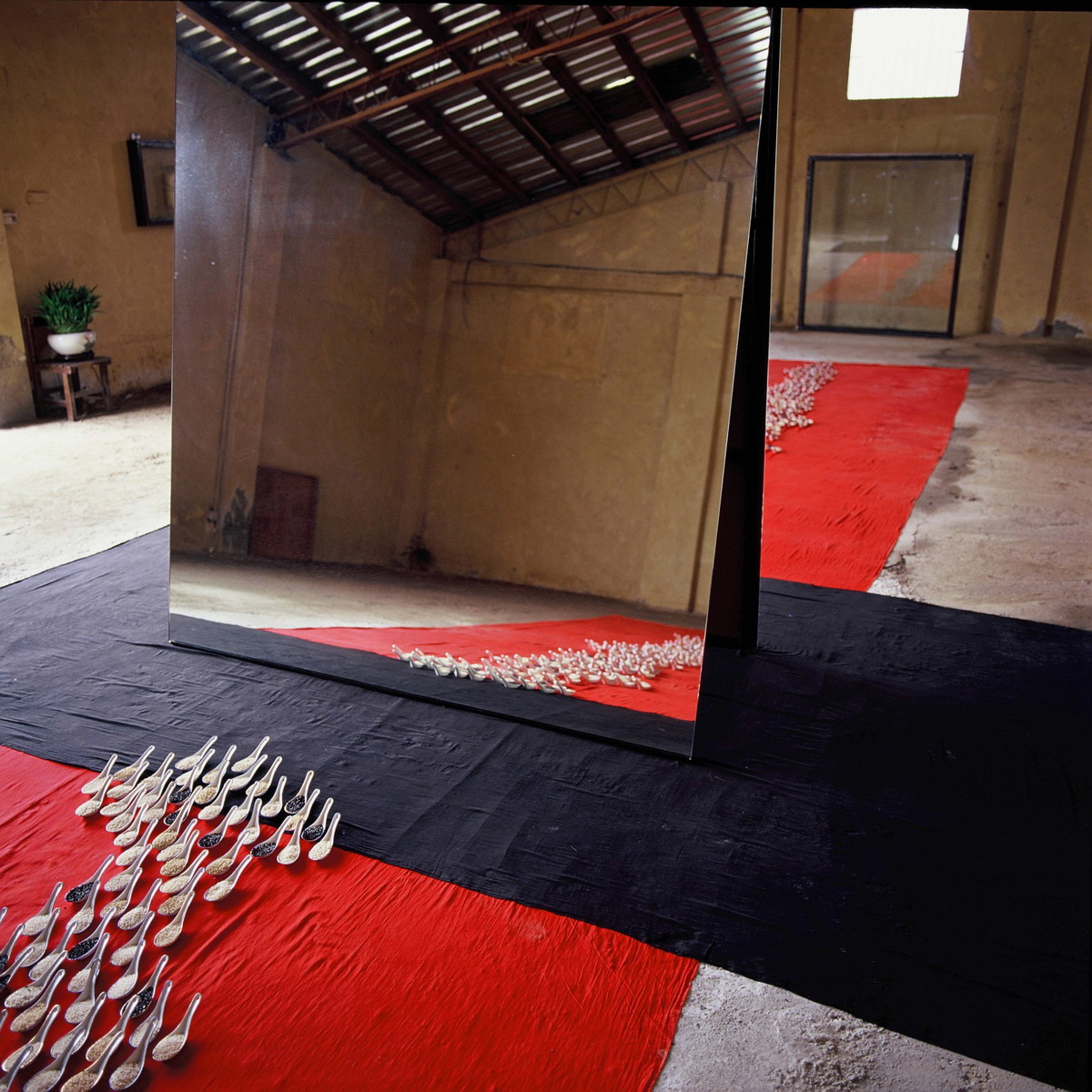
"Consciousness Voyage like a river" from "The Collective Memory of Rice: Intuition and Imagination". 2000. Zhuwei Studio.
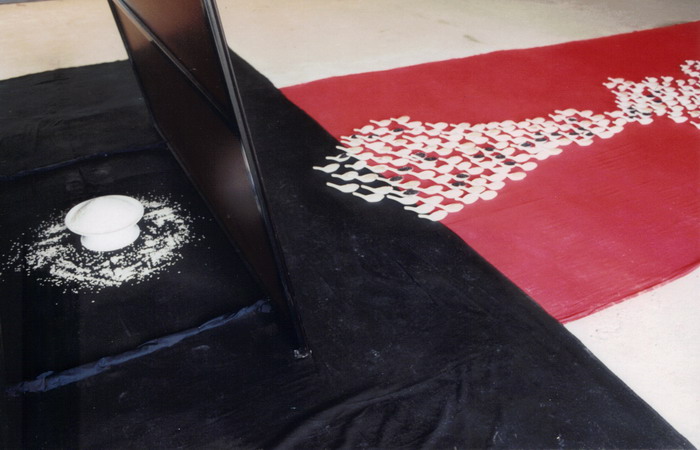
"Consciousness Voyage like a river" from "The Collective Memory of Rice: Intuition and Imagination". 2000. Zhuwei Studio.
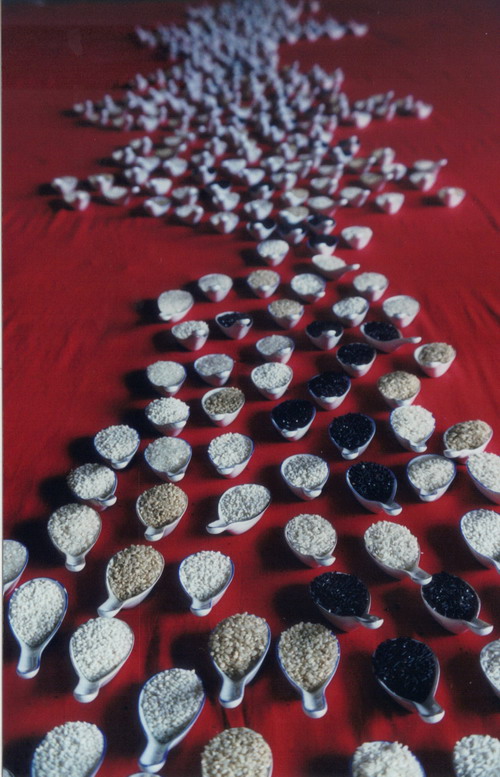
Spatial installation of "Rice's" consciousness voyage - detail - Stream of Consciousness. 2000.
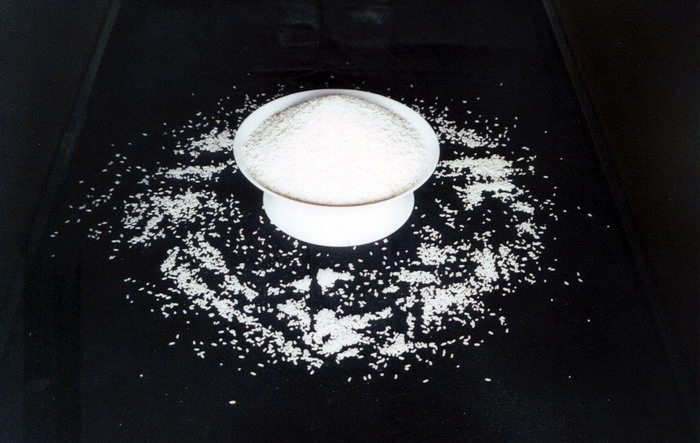
Spatial installation of "Rice's" consciousness voyage - detail - White rice on black section. 2000.
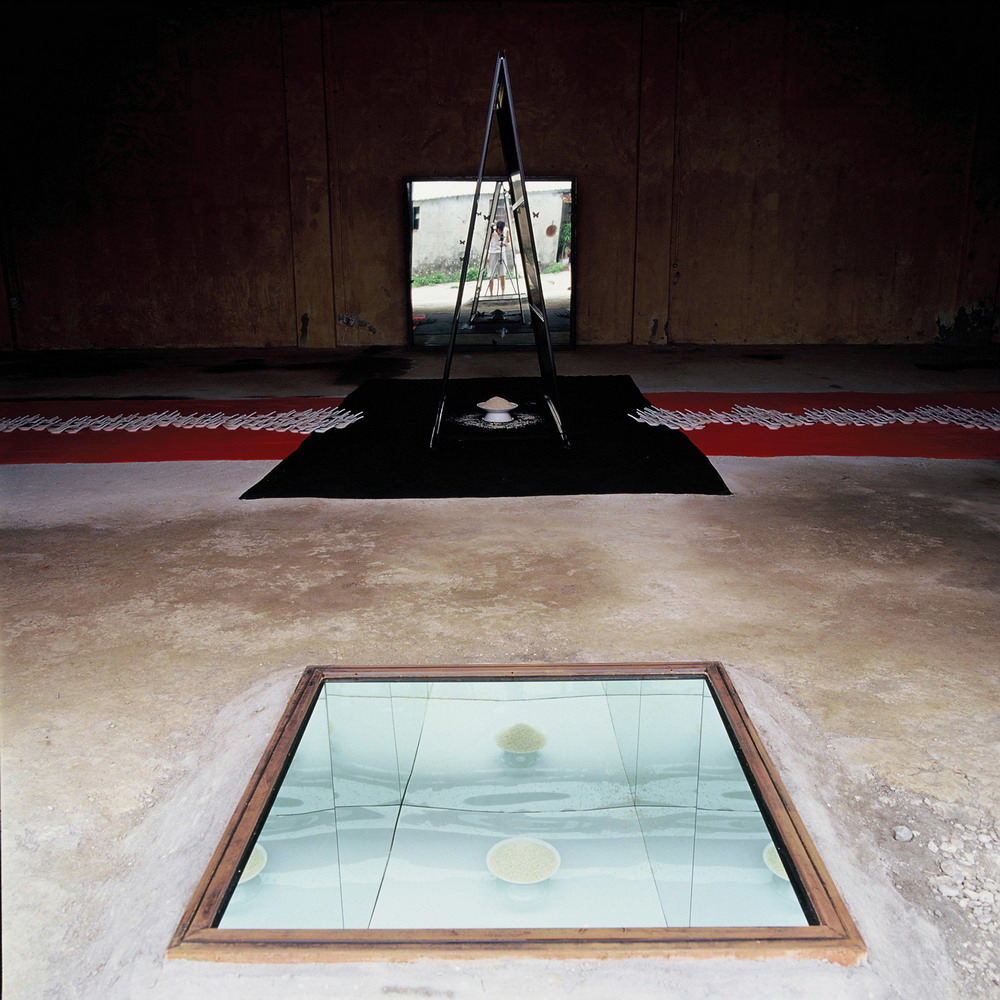
Entrance spatial installation of "Rice's" consciousness voyage - Front - Embedded in the ground - Subconscious flow. Glass, iron, mirrors, rice. 100x100x100cm. 2000.
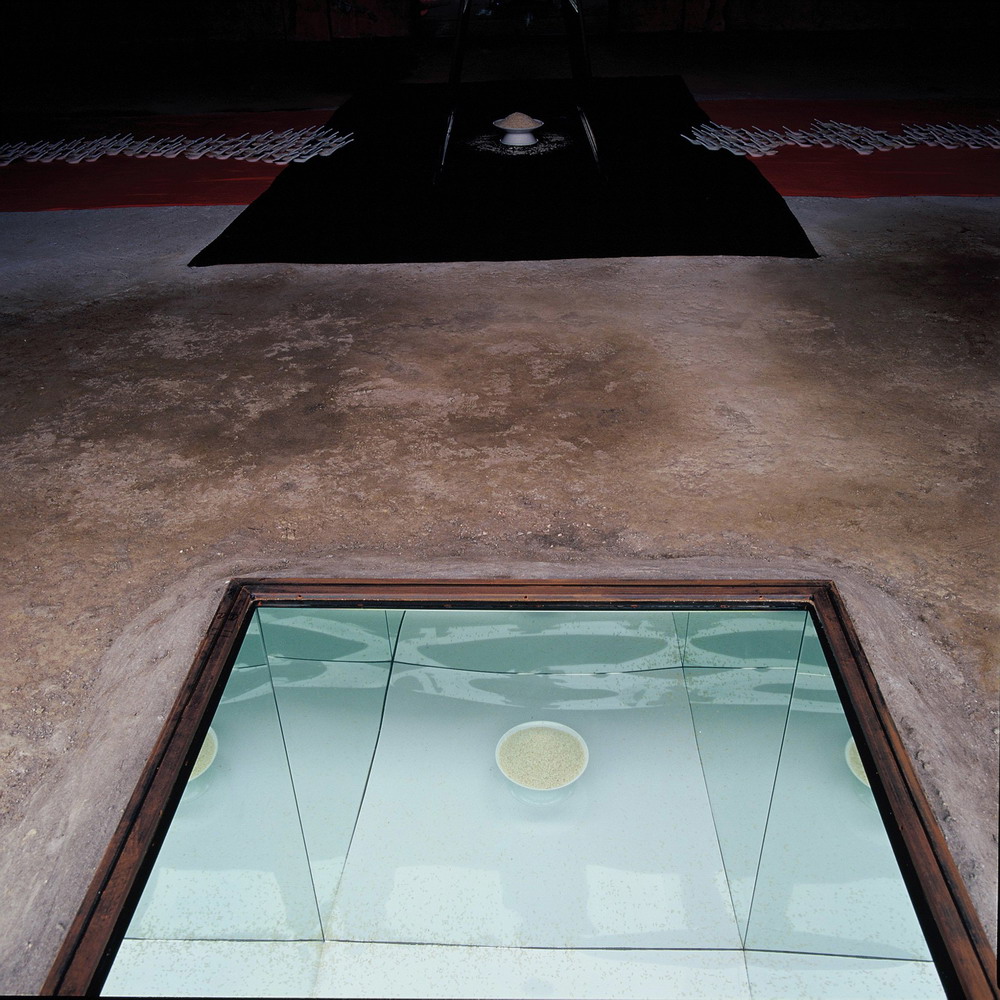
Entrance spatial installation of "Rice's" consciousness voyage - Front - Embedded in the ground - Subconscious flow. Glass, iron, mirrors, rice. 100x100x100cm. 2000.
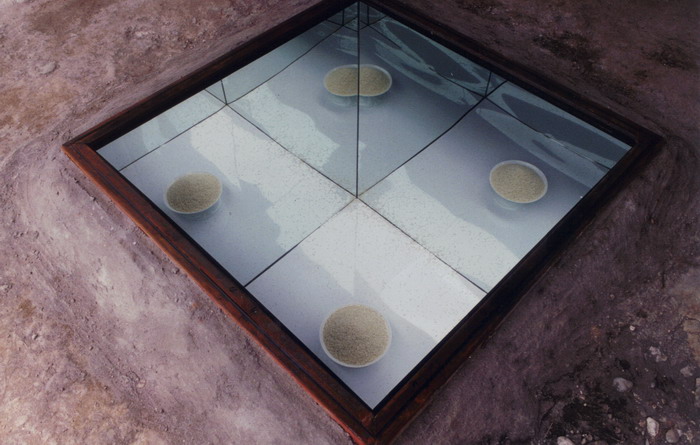
Embedded in the ground - Subconscious flow. Glass, iron, mirrors, rice, and plates. Spatial installation. 100x100x100cm. 2000.
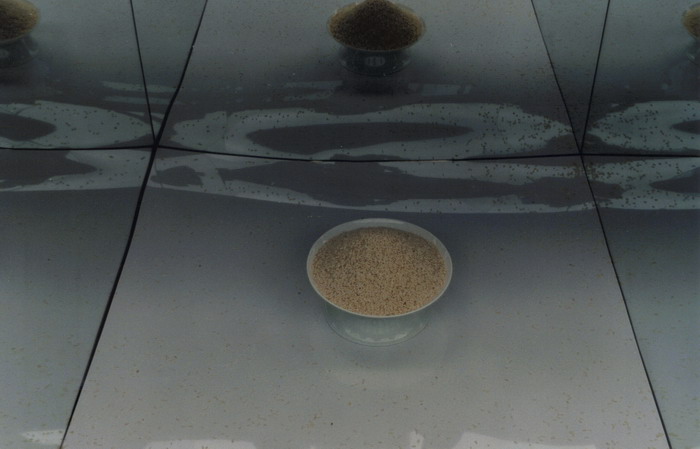
Embedded in the ground - Subconscious flow. Glass, iron, mirrors, rice, and plates. Spatial installation. 100x100x100cm. 2000.
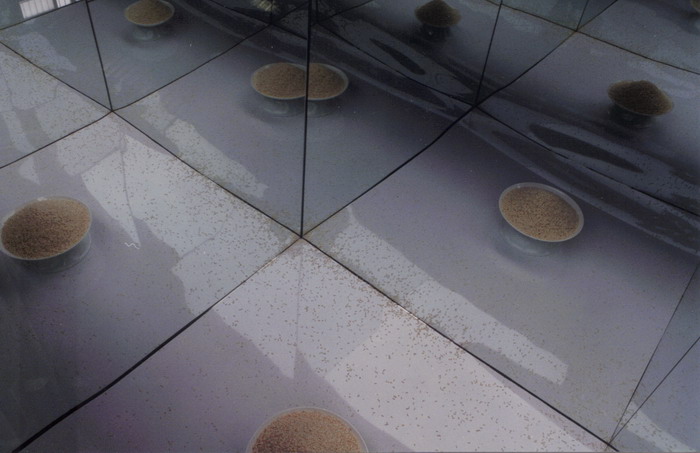
Embedded in the ground - Subconscious flow. Spatial installation - Infinitely extending visual image - Metaphor for the vast boundlessness of the subconscious. 100x100x100cm. 2000.
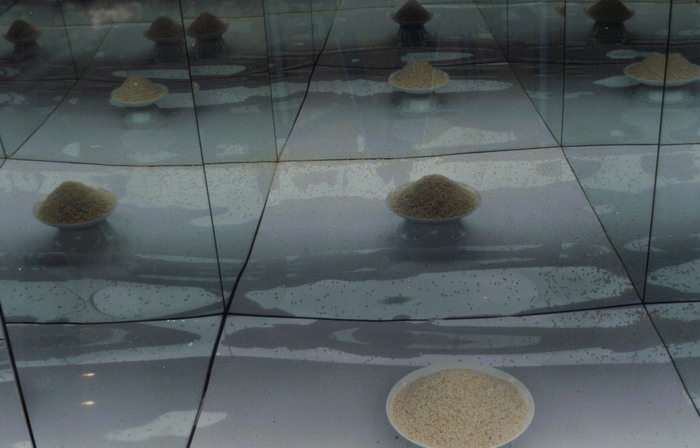
Embedded in the ground - Subconscious flow. Spatial installation - Infinitely extending visual image - Metaphor for the vast boundlessness of the subconscious. 100x100x100cm. 2000.
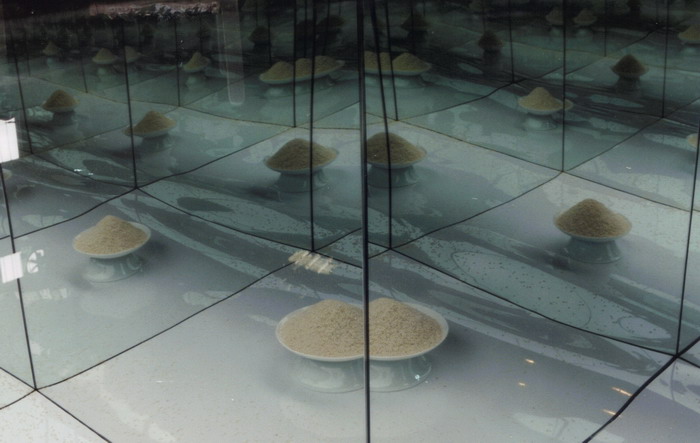
Embedded in the ground - Subconscious flow. Spatial installation - Infinitely extending visual image - Metaphor for the vast boundlessness of the subconscious. 100x100x100cm. 2000.
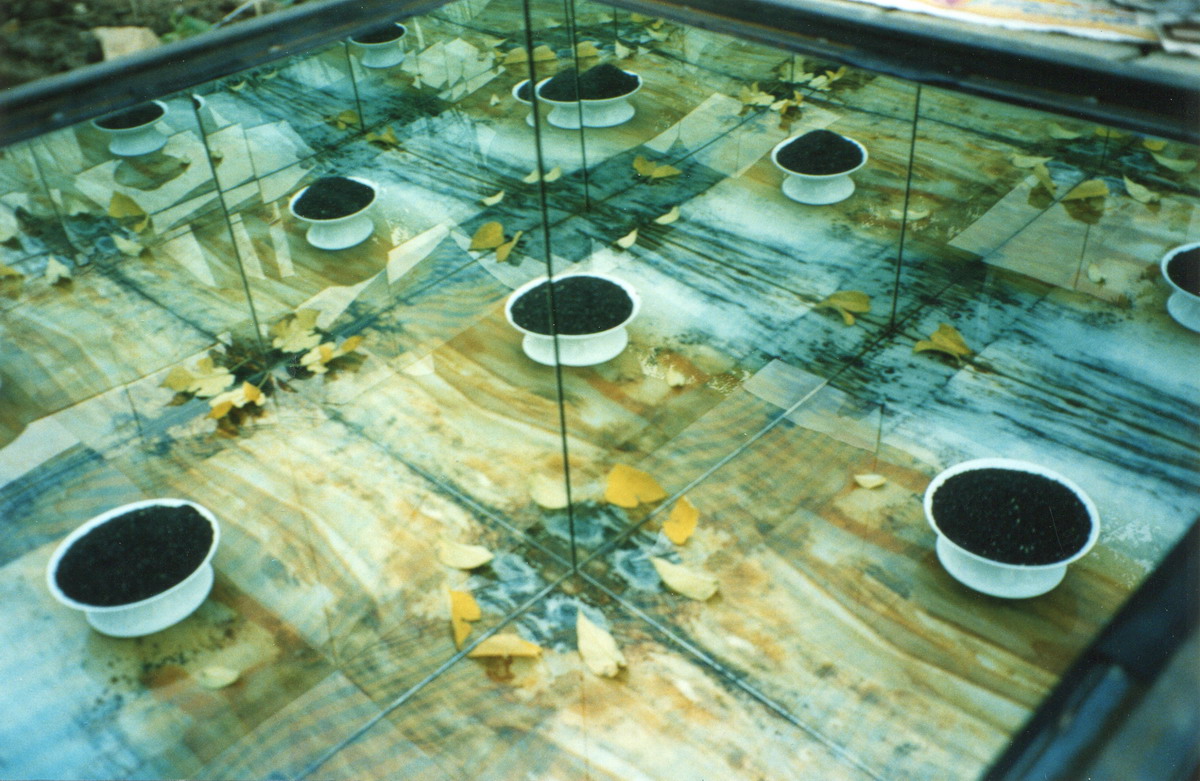
Embedded in the ground - Subconscious flow. Spatial installation - Infinitely extending visual image - Metaphor for the vast boundlessness of the subconscious. 100x100x100cm. 2000.
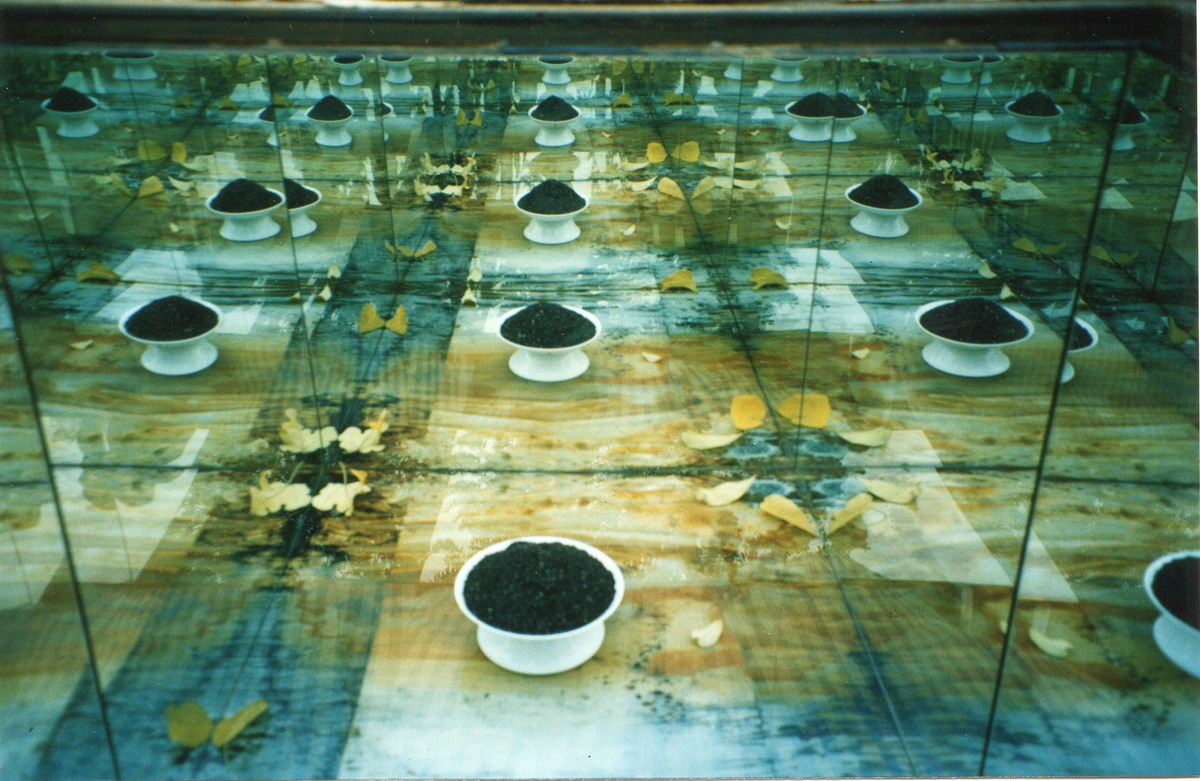
Embedded in the ground - Subconscious flow. Spatial installation - Infinitely extending visual image - Metaphor for the vast boundlessness of the subconscious. 100x100x100cm. 2000.
Chen Chi-Hsiang "The Collective Memory of Rice: Intuition and Imagination" Exhibition Location - Taipei Zhuwei Studio. Exhibition Period: May 7 to June 10, 2000. This is Taiwanese artist Chen Chi-Hsiang, who has lived in France for many years. For over ten years, he has developed themes based on "rice culture," divided into three major topics: "The Collective Memory of Rice," "The Collective History of Rice," and "The Collective Consciousness of Rice." This is the most complete and grand spatial installation presentation since his 1994 solo exhibition in Paris. Interview for the "Stream of Consciousness" solo exhibition: Conducted by the Taiwan European Union Research Association, published in Understanding Europe Journal Issue 6, June 2000, pp. 107-121. Interview with Professor Chang Wei-Bang, Chairman of the Taiwan European Union Research Association; Assistant Chen Xin-ji recorded and organized. Record of Exclusive Interview with Artist Mr. Chen Chi-Hsiang Have you ever thought about this question? It turns out that our daily staple food—"rice"—is also a source and material for creation. Through the artist's creation, what "rice" displays is not just a dietary culture, but a "collective memory." Artist Chen Chi-Hsiang, who has lived in France for many years, is an art worker who uses "rice culture" as a creative theme. Especially in the past ten-plus years, Artist Chen has used "rice" as a background to conduct exquisite research on "The Collective Memory of Rice," "The Collective History of Rice," and "The Collective Consciousness of Rice," enriching the profound meaning hidden behind "rice," giving people another different experience and understanding of "rice." Taking advantage of this opportunity when Artist Chen held a solo exhibition at the Zhuwei Studio in Danshui, Taipei—"The Collective Memory of Rice"—we interviewed him to provide the public with a chance to understand "rice culture." This solo exhibition is the most complete presentation of "rice culture" by Artist Chen since his 1994 Paris solo exhibition. The following is the content of the interview during our visit to Artist Chen's solo exhibition: The Collective Memory of Rice — "Rice is our cultural background and cultural issue. I have been using rice as a theme for creation for over ten years." — Why did you choose to create with "rice"? We live in this world and know the importance of food; it is a necessity of life, and life is sustained by it. Due to differences in human regions, environments, and climates, similarities and differences in living customs arise in each area. Food constitutes these conditions and is itself culture. Food affects human physique, constituting material life forms, transforming into cultural essence, and further affecting human conscious existence. My artistic creation foundation is built on food culture, rooted in the essence of anthropology. So, what kind of food is it built upon? I come from the Far East; my basic food is "rice." We grew up eating rice. I deeply realized the cultural essence from this material, delving into its spirit. However, as artists, we know that the foundation of artistic creation is built on matter, and only through various materials can thoughts be conveyed, and only through matter can art be displayed. Thus, I chose the most basic food of Asians, "rice," as the basic creative material. From this linguistic transmission ("paddy" milled becomes "rice," "rice" cooked becomes "rice porridge/meal," "meal" boiled down becomes "congee," "congee" boiled again becomes "paste"), progressing from material display to cultural essence. With rice as the basis for various attempts, I summarized three themes: First, The Collective Memory of Rice; Second, The Collective Consciousness of Rice; Third, The Collective History of Rice. Furthermore, I turned rice paintings into constructions, meaning moving from two-dimensional painting to three-dimensional display, then developing into objects, seeking liberation from visual plastic language to direct installation, diversely presenting the essential state and imagery of rice. Rice is not just a material, but a culture, and another (unique) spirit of humanity worldwide. Rice has not only various symbols and metaphors but also substantial value and stories full of blood and tears. When I delved into the study of this material, I also grasped the essence of consciousness, from external form to internal instinct inspiration, gradually forming ontological plastic visual language, and displaying the unique and delicate style of the South, emitting taste and possessing the "fighting spirit" of "rice." — Using this painting embedded in the ground as an example (please refer to the picture), what imagery do you want to express? Primarily, it is the management of space. The four sides are mirrors, so countless spaces can be derived, and space diffuses invisibly. This image is a picture embedded in the ground, but it is three-dimensional. A picture embedded in the ground can be viewed from a two-dimensional angle or seen as a three-dimensional painting. This is a painting dug out from the ground (size one meter by one meter, volume 100cm x 150cm x 100cm). It is all white, with white neon lights installed at the bottom and a pile of pure white glutinous rice on top, attempting to grasp an ineffable aura and state through material transformation. Is it a painting? Yes, it is a painting, a painting embedded in the ground. However, it transcends the framework of a painting; it is three-dimensional with deep space, its volume surrounded by the earth. People can stand on or walk over this work. In various intuitions, it becomes a spiritual state condensed into an aura; in various imaginations, it becomes poetry, becomes a painting. — What is the concept expressed in the indoor exhibition room? The entire exhibition takes as its main axis the colored porcelain spoons on a large red cloth in a monument-like form indoors: In this spacious exhibition space, a large red cloth serves as the core, crossing the entire space. Its center is crossed by a large black cloth with strong contrast. Two large mirrors are erected diagonally on the black cloth, forming a triangular space. A pile of white rice is arranged below, becoming the visual core where the overall space condenses. The large red cloth is divided left and right, orderly arranged with colorful porcelain spoons filled with rice of various colors (over 500 spoons), constructing a fluid formal rhythm. The handles of the colorful porcelain spoons point towards the mirrors in both directions. Under physical reflection phenomena, they expand deep space and visual imagination, constructing complex plastic forms, synthesizing a contrasting visual power structure, containing the construction of the collective consciousness of rice. — Unique "glass" paintings are hung on the wall. What does this "painting" represent? They are purely made of glass frames of various characteristics in modern-style iron frames, according to the inevitability of visual plasticity, plus various objects (rice, red beans, black beans, glass pieces, glass beads, clay, dough, balls, vermicelli, and thin noodles, etc.). It can be a painting because it can be irresistibly hung on the wall. It can become a three-dimensional object because it can detach from the wall and stand alone. It is not just a painting or an object; they can be juxtaposed and overlapped under the collective consciousness of rice to construct another form, structure, and meaning, like the visual plastic language of chemical or physical combination elements, flexibly and keenly displaying the deep meaning of the material. The vermicelli in the painting represents white lines to me. We all have ordinary constraints when looking at paintings. Generally, there are three ways people look at paintings: some use experience, some use knowledge, and some use the soul. Experience, knowledge, and soul—this is interesting. This painting is abstract sketching. This painting can be hung on the wall as a picture because it is transparent and can be viewed from both sides. In terms of light changes and lines, the black butterflies on the painting represent points of color, and the thin noodles are lines. Both sides of the painting are glass. Originally one butterfly, through spatial changes, it becomes two. All mirrors are a phenomenon. So this is also a public art that can be placed in public spaces. The interest point of glass in glass paintings lies in light; different angles of light illumination produce different changes, so this is also a type of line. I am drawing lines. — Can Africans accept such concepts? This may not be a problem of the Third World, but whether Third World artists will propose such views. We do not have the Western view of modern art or cultural background. Because our concerns and views with African artists are different. Of course, I was influenced and cultivated by Western education, and explored rice within local culture. — Can you talk about the current situation of the art environment in Taiwan or France? In Taiwan, there is no title of "artist." If you are engaged in artistic creation, your occupation on your ID card is written as "unemployed," treated as an unemployed vagrant. How much Taiwan values "culture and arts" can be roughly known by looking at the staffing of the Cultural Construction Committee. Inside the Cultural Construction Committee, only three secretaries manage all art affairs nationwide. But in France, art types are clearly divided. At least ten staff members work in one plastic arts center (Centre de la plastique), each with their own duties. Their attention to cultural issues is evident here, and they make overall planning for the arts. Taiwan's cultural resources are controlled by a few fixed people; how can reform happen? Taiwan's cultural agencies seem to me to be offices, bureaucratic culture within the system. Organizing cultural activities is like holding big temple fairs, gathering political resources. — Talk about your books and exhibition creations? Since the postmodern period began in the 1980s, from 1982 to 1989, I started writing a book called Art in Europe in the 1980s, introducing the art of France, Italy, Spain, Germany, the UK, and the Soviet Union based on my observations and experiences in Europe over seven years. My exploration center focused on how Spanish modern art broke through Spanish military dictatorship and how Soviet art changed from official art to unofficial art. Why did I research "Spain"? Because I believe Taiwan's situation is very similar to Spain. Of course, we do not have Spain's art and cultural tradition, because they have Picasso, Miro, and Dali. What we can understand is how the Socialist Party promoted culture when Franco's totalitarianism was in place. I feel this can serve as a reference for Taiwan. Under military rule, what policies can the government operate, how to promote culture to the world and exchange with other cultures? Of course, Spain is on the border of France, part of Europe. After the change of regime, politics continued more easily because they have a Western humanistic tradition. The theme of new intellectual trends is also interesting. Why was Soviet official art overthrown by unofficial art? This is the same as the struggle between institutionalized culture and non-institutional culture in Taiwan currently. During the process of regime change, new thinking is an open space, which is why the Cold War ended. I conducted considerable research on this in Art in Europe in the 1980s. Many people misunderstand German art in the 1980s. Because German art was to compensate for the suppression of art during Hitler's time, making a reward in the 1980s, affirming its democratic freedom, not just artistic freedom. So German critics believed that German art in the 1980s was fictional rather than factual, because this was constructed by the West to affirm Germany's economic success and Germany's change of heart during Hitler's rule, which is something ordinary people cannot observe easily. After 1989, I started writing a book every year. I think this is quite important because I have a lot of contemporary art data; furthermore, as a Taiwanese, returning to Taiwan, I felt our art was influenced by the US, but our understanding of France was zero percent. We didn't even know which French artists existed, what trends were emerging in France, otherwise we would only have fragmented information. Therefore, I organized and translated contemporary French artists in France. Next, I began caring about Taiwanese artists, writing art criticism for them, through writing poetry, namely "Taiwan Art Criticism," simultaneously integrating Taiwan's society, politics, and art in the 1980s. Because economically Taiwan had the spirit of Yu Gong moving mountains, in art, 1980s Taiwanese art was a rebellious art, so some painted Chiang Ching-kuo, protests, and Taiwanese money flooding feet. The art issues of the 1990s concerned objects, expression on things, treating real objects as art. Many artists transformed objects into art. Therefore, I organized some data regarding the issue of object usage in the 1990s and wrote The History of Object Usage in the 1990s. Then, in the 1990s, I began to feel dissatisfied with Western art because I thought Western art had many negative aspects and fewer positive ones. Therefore, after the mid-1990s, I looked back at the Renaissance and researched it, thus writing a book about the Renaissance. Since I am familiar with Paris museums, I also wrote A Tour of Paris Art. Additionally, besides the Renaissance, I felt Western art had too many negative themes. Rather than that, simply appreciating flowers is better. So I also watched and appreciated flowers, writing a book Flower City Watching Flowers. Due to my understanding of Western art, in 1989 and the 1990s, I published Conditions of Painting, exploring the conditions and dilemmas of Western contemporary art paintings. The conditions of painting mainly explore, for example, whether a painting should be painted or not; if not, how to express it? If yes, what materials to use? What methods to paint? I have a total of 10 books. I also spent much time and energy producing, collecting, and organizing data, so I did not focus completely on creation. I held solo exhibitions in Paris in 1994 and 1993, and participated in a few group exhibitions, all held in France. In 2000, I returned to the country to select the president and held a garden art exhibition at Shin Kong San-Yue in Taoyuan. Additionally, this August, I will hold a solo exhibition at Yidi Department Store in Chiayi. These are all art, and all are one. My greatest interest lies in transforming Western mirrors into part of Taiwanese humanities. Therefore, this is my first solo exhibition in Taiwan in 18 years. — Talk about your life in France? I held a solo exhibition in 1984, married in 1985, and had a daughter in 1986. During this time, I drew pictures and exhibited in Tours, then returned to Paris. I usually like taking photos, shooting slides, and collecting data. I have been collecting continuously until now, about eighteen years, having collected over twenty thousand slides and photos. I did not study in French schools. The places I learned were galleries and museums. Because I lived next to museums and the Paris City Hall, and right next to the Centre Pompidou, these places became my temples. Later, my French level improved more and more, and I joined symposiums to participate in discussions. There are often many forums and issues to participate in Paris, some free, some paid. From here, I entered another stage of learning space. Pompidou has first and second discussion rooms, and also many large exhibitions and activities. After exhibitions and activities, symposiums and discussion meetings are held. In addition, I have membership cards for many museums and art galleries such as the Centre Pompidou, Musée d'Art Moderne, and Louvre. These places are my learning spaces. To me, Paris art galleries are as familiar as my home. I also wrote a book Paris Art Processing. My visual imagery is stronger. Where is a painting hung? How high? In which art gallery? Approximately where? I remember all of it. — During the process of living in the West for over ten years, were there any conflicts in thought or life? I was like a fish in water in Europe. As soon as I arrived, I could immediately accept European concepts. Europeans' way of thinking is expressed in life thinking, with no conflict with my ideas. To me, there was no conflict in thought or marriage. Paris is the capital of art. I went to Paris with a learning mindset. In France, I did not read Chinese books, but to maintain my Chinese expression ability, I wrote. From graduating high school and writing diaries until going abroad, and continuing to write diaries after returning to Taiwan, but later decided to transform thoughts into articles, practicing Chinese expression through writing. Except for reading Chinese newspapers during the 1996 Chinese missile exercises, I hadn't read Chinese newspapers for over ten years. Due to the rich humanistic atmosphere in Europe, I was quickly influenced by the left wing, immediately solidifying into left-wing thought. In Paris, right-wing thought belongs to the upper social class mark, while left-wing is the thought of commoners, and I envy upper-class life less. The government also supports and cares for workers, which is a point worth our reference. Generally, artists are more left-leaning because art is most important in breaking systems, social rules, and norms. This is what avant-garde artists have always insisted on. Breaking previous freedoms and rights is part of modernism. — Under Taiwan's secular, money-making culture, are your artistic concepts accepted? Always there are some like-minded people who accept it, which is more important. The problem lies in whether you put forward arguments, because raising questions makes people think; without raising them, there is never this opportunity. I also held exhibitions in Taiwan based on this concept. To me, artworks are not the most important thing; education is the main purpose of my solo exhibitions. Taiwan lacks fine arts education; the notion is that studying math and English is more important than studying art and molding clay, not knowing that beauty is a lifelong topic, while math is a procedural, technical issue. Taiwan's society is function-oriented. Learning English and math is more important than learning painting and sculpture; Taiwan has not yet transformed functional concepts. I feel that if a person has no understanding of beauty in their life, that person lives without dignity. Because work is busy, English is fluent, but the person has no aesthetic sense, doesn't know how to dress. Language can communicate with people, but thought cannot. What Taiwan lacks is the thought of beauty. Every rainy day, the road to the studio accumulates water because there are no drains to clear, yet our computer information industry is the most developed in the world. Our focus is on the information computer industry, but we ignore many small places and details, such as how to handle our own living space? Just like a painter draws beautiful pictures, and the home is also a beautiful big house, but garbage is thrown randomly outside the residence. The conflict between people and society is the same. So artists' protest methods don't necessarily need knives or guns; speaking with mouth and writing with pen is enough. What is beauty? Or how to handle these problems? If social problems have aesthetic harmony, they will be gentler, and this is what Taiwan lacks. Another feature of French society is that you don't have to be an official to exert influence. Outside the system, one can still exert influence and prestige; the influence outside is greater than inside. Taiwan does not teach non-systemic thought or suspect the system much. Many people hope to become national civil servants one day. Teachers in Taiwan normal schools, through systemic training, have already solidified in thought. — What is your definition of "culture"? Taiwan has developed to the current situation, with many political problems still waiting to be solved. We proposed localization in education, but to what extent is true localization achieved? If local beauty or secular beauty does not improve in hierarchy, I think Taiwan still has no future. Therefore, there is much space and opportunity in this aspect, depending on how we strive. What is local culture? Localization also includes part of computers and informatization, to be integrated and applied. It doesn't mean primitive is beautiful. Local means love for the land. Otherwise, going out, one is treated as an exotic fruit from a foreign country. We must affirm past culture, but we cannot always talk about five thousand years of culture, three thousand years of culture, or three or four hundred years of Taiwan culture. If we do not create now, there will be no culture in the future. To me, creation is culture. Things created on this land are the culture of this land. Culture itself must have regenerative ability. Museums are in one place, the public in another. The relationship between museums and the public is very alienated, which is fundamentally ineffective. The most exquisite art or culture, if ordinary people cannot enjoy it, is still futile. For example, Tainan is the first prefectural city, possessing many historical sites, but if they have no relation to other places and surrounding people, how can they be considered historical sites? Historical sites are cultural resources. Cultural resources are the biggest resource for tourism. What we need to do is develop them to drive other developments. If historical sites are alienated from crowds, people cannot be affected by them, cannot draw nutrients from them, and if cultural historical sites have no interactive relationship with crowds, art and culture are fundamentally useless. If culture and art cannot drive social harmony and perfection, art becomes just a slogan. If culture does not regenerate, it is just a pool of stagnant water. Traditional culture can be used flexibly. The French folk museum has a folk research center, specializing in researching this part—the redevelopment of folk culture. This is what is meant by culture; otherwise, museums are dead. Taiwan has many community universities and literature and history studios, but they stop at a certain level. Others coming only do guided tours. I feel this is still not enough. After understanding local literature and history, further development is needed. After understanding the surroundings, further development is needed. Without development, there is no market. Actually, many young people invest in literature and history studios, exploring the development history and stories of their hometowns, but all stay at one stage, not even reaching academic discussion. This does not help elevate the development of the whole community. Community culture needs development. This is humanities—having regenerative ability. Studying history is to change history and build future history on top of history, which helps the future. — Speaking realistically, returning to your creation—the rice theme. Like this innovative creation with rice as the theme is not common. Holding this solo exhibition, perhaps the number of visitors is not large. Do you expect to achieve any effect? Many contemporary arts are just a role of conveying concepts. We do not require many people to come to the exhibition, because those who come are still people from the cultural circle and contemporary art circle, a minority. So I do not expect many people to come or to achieve any effect. This is just a wish, a concept, and a space for expression. I focus on mental thinking, how to practice, making art enter the folk. So this time I also participated in the construction of Sanxia Old Street, which is very important, because what remains of the old street is cultural assets and cultural value. If demolished, how will future generations mourn? This is also the social responsibility and task of artists. So where is culture? If there is no culture, future generations will walk more bitterly, not knowing my positioning, who I am, where I came from? Where to go? Without a root. — Often seeing some paintings very large, or occupying a lot of space, like installation art, is this not good for collection? In fact, museums or art galleries have special places for collecting paintings, because this is also one of their purposes for building. French people are good at collecting paintings. They buy paintings when artists are young. When artists are seventy or eighty years old, the paintings appreciate tens or hundreds of times. Art galleries are temples for collecting paintings. Pompidou renovated for one year to make more space for collecting and exhibiting artworks, because Pompidou collects much more works than it exhibits, so it changes and renovates every year. How should cultural engineering operate and play a role? How to conduct academic research? The cultural space is large, this road is long, and may also be narrow, depending on how to think and operate. — How can Taiwan exchange culture with Europe? We can attach clauses to weapon transactions or other commercial purchases, asking Europeans to hold art exhibitions, which is their specialty, and can add points to Taiwan's culture and art development. Additionally, operations can be carried out through private foundations. For example, when doing business with large French companies, we can require them to host cultural activities incidentally. Interestingly, France's cultural system falls under the jurisdiction of the Ministry of Foreign Affairs. Taiwan can use economic power to drive culture, but our rulers do not have this concept. It is suggested that when establishing sister cities with European cities, fully utilize them for cultural and art exchanges. — How to appreciate a painting? Ordinary people appreciate paintings through text, not through images. Appreciating paintings also requires learning. For all art, everyone says at the first glance, "I feel how this painting is," but to me, "feeling" is just the initial reaction. This is just the beginning, not the end. Having feelings is only the first step, and only then can one proceed further. No feeling means no interest, not understanding. Not understanding means this has exceeded your scope of experience and knowledge, which is also the first step in learning to look at paintings. Not understanding is when learning, learning to open the mind, how to accept. So I wrote a book Conditions of Painting, Methods of Looking. How to paint? This is the same principle as how to look at paintings. How to observe and appreciate objects constitutes how to paint. Looking from another different angle gives different viewpoints. Changes in viewpoint are related to viewing angles. The levels of appreciation are divided into three: Look, Observe, Feel. Art is the beauty of truth, goodness, and beauty. The center point of the triangle of truth, goodness, and beauty is love. Love is the most important, and is the core of truth, goodness, and beauty. Beautiful things without love are not truly beautiful; truth without love is not truth; without love, where is goodness? Only hypocrisy. Exploring beauty is a philosophical issue. I have discussed this with others. As a result, someone asked me what religion I believe in. I answered: "I believe in the religion of beauty." Beautiful things need development. I think beauty is in a person's heart. All beauties have conditions and will change. Only the beauty of the heart is eternal.