Middle Ages (500-1400)
Martini 1333 Annunciation - Duccio 1300-1305 Madonna and Child
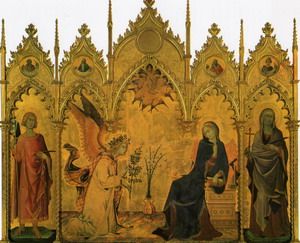
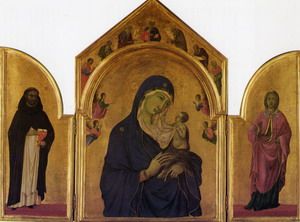
Martini 1333 Annunciation - Duccio 1300-1305 Madonna and Child
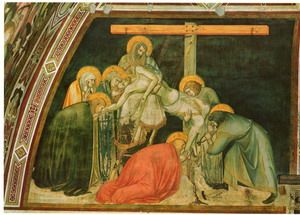
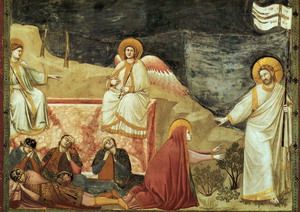
P Lorenzetti c. 1320-22 Descent from the Cross - Giotto 1304-1306 Resurrection
After the northern barbarians invaded Italy in 476 AD, the Roman Empire fell and Europe entered the Dark Ages of the Middle Ages. There was no longer a unified empire; Europe entered the feudal era.
Amid natural disasters and man-made calamities, the Middle Ages plunged people into superstitious panic. Under religious fervor, art clearly departed from ancient aesthetic sensibilities and developed an original Christian civilization. Like Byzantine art, it was a degeneration of Greek and Roman art, a return to primitivism. All art was "dedicated to Christ," especially in sacred religious subjects: God, the Madonna, saints, and angels. They seemed entirely unconcerned with perspective, space, or volume, relying only on simple forms, with figures overlapping one another.
The art of the Middle Ages culminated in the great cathedral era of the fourteenth century—Gothic art—whose most celebrated feature was the exquisite and resplendent stained glass within the churches, a mysterious union of color, light, and space.
The prelude to the Italian Renaissance came in the late period of the Western medieval Dark Ages, that is, the early fourteenth century. The long-standing feud between the Pope and the Emperor erupted in turmoil between the papal faction supporting the Pope and the imperial faction favoring the Emperor. The city-states of Lombardy and Tuscany (Toscane) seized the opportunity to gradually grow stronger. In this chaotic era, artists Giotto and the Lorenzetti brothers nonetheless opened a new century for painting. The poet Dante, Petrarch, and the writer Boccaccio also laid the foundations for Italian literature. Yet this vibrant prelude ended with the Black Death of 1347-1349, and it was not until after 1425 that the Florentine painter Massaccio carried the legacy forward.
(Giotto and the Lorenzettis, grounded in sensibility, observed nature and explored images approaching reality.)
Painting themes of the Middle Ages: from the "Annunciation," "Nativity," "Madonna and Child," "Adoration," "Crucifixion," "Last Supper," "Descent from the Cross," "Pietà," "Resurrection," "Ascension," and so on.
(Dante (1265-1321) is most famous for the Divine Comedy, which describes journeys through Hell, Purgatory, and Paradise. Petrarch (1304-1374) is one of the earliest and greatest lyric poets of Italy, whose works first reveal the beginnings of humanism. Boccaccio (1313-1375) is most famous for the Decameron, a brilliant depiction of contemporary society.)
Giotto and the Lorenzetti brothers are the most representative, as they had already stepped beyond the International Gothic style and entered an early physical three-dimensional painting space, laying a solid foundation for modern Western painting. Others include: Duccio, Cimabue, Cavallini, and Martini, while the most important sculptor was Pisano, and so on.