Maze by A. Masson
A. Masson Maze 120×61cm 1938 Collection of the Centre Pompidou, Paris
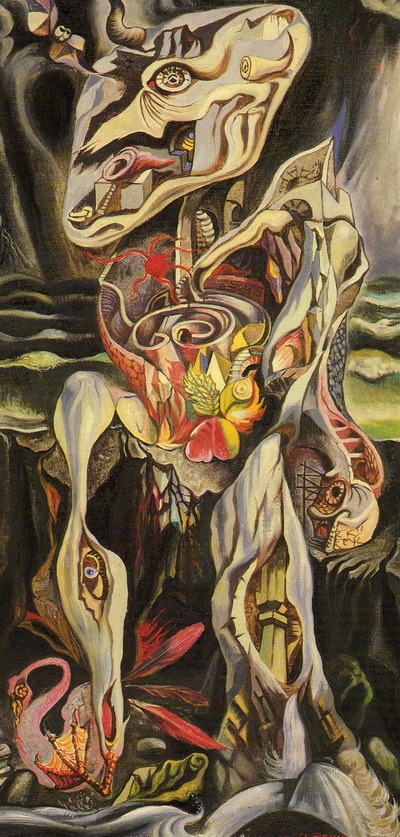
A. Masson (1896–1987), a French painter and one of the most representative artists of Surrealism, began exploring the subconscious and creating with automatic techniques as early as 1924. This technique involves the painter abandoning conscious intent, allowing the hand to move faster than thought, which led him to invent sand painting. Like indigenous art, Masson's work possesses a primal quality, presenting an irrational and hallucinatory art form. During World War II, he took refuge in New York, where his influence on the Action Painting movement of the 1950s in the United States was considerable.
Masson, a Surrealist painter, was among the first to practice automatic techniques, attempting to explore the artistic realm from the unfamiliar territories of the human subconscious, much like Baudelaire's notion of "seeking the new in the unknown." Sand painting was Masson's unique invention; it involves adhering sand of various tones onto the canvas to create accidental and chance effects, combined with his agile brushstrokes, allowing spots, lines, colors, and rhythms to flow freely as if in a dream. For instance, The Death of a Horse resembles an amorphous abstract painting, where intersecting, overlapping sensitive lines form non-conscious images that approach the essence of primitive art, deeply revealing the artist's unconscious mental state.
His influence on contemporary French art was significant, particularly on artists like Fautrier and Dubuffet in the 1950s, and certainly on the post-war New York Abstract Expressionist movement as well. Maze: In this incredible image, a massive explosion within a chaotic world, a deformed, hybrid creature resembling a minotaur with horns, its body dissected and filled with bewildering muscular structures, creates an unimaginable labyrinth. Upon closer inspection, one can discern bear-like genitals, plant forms, mineral rocks, animal feet, diamond shapes resembling eyes, etc. Within this saturated composition full of mystery, it resembles the labyrinth deep within the human psyche! The work liberates visual imagination from rational and traditional concepts.