A. P. Penck "Painting-System-World" Retrospective
Monumental sculpture Future of the soldiers 1984
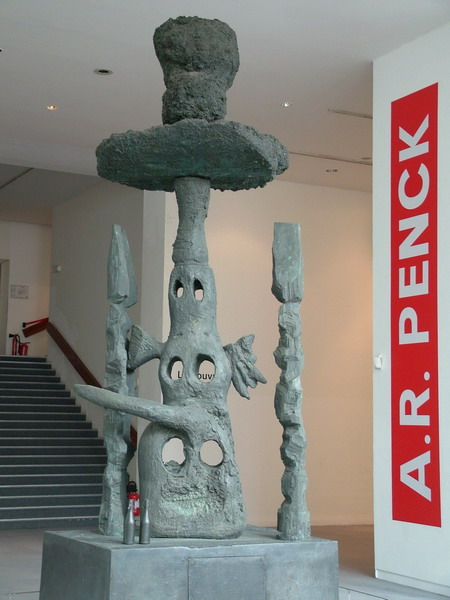
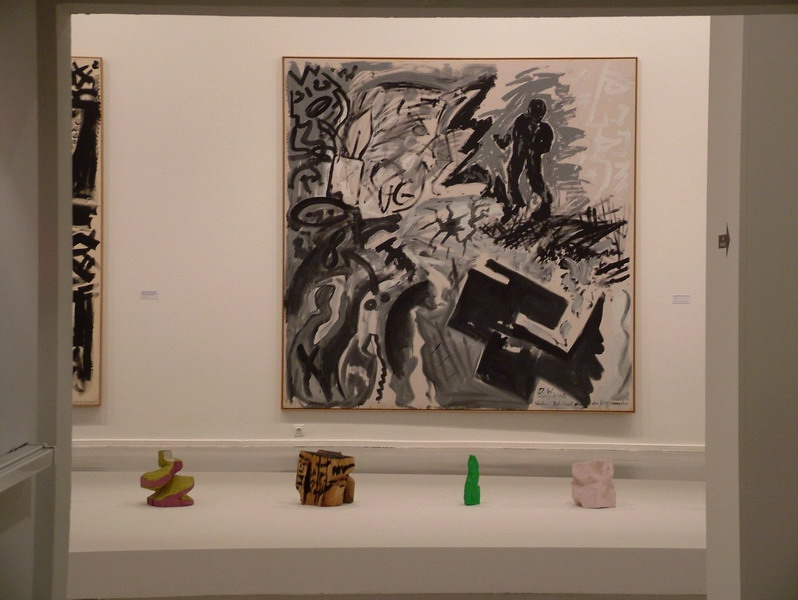
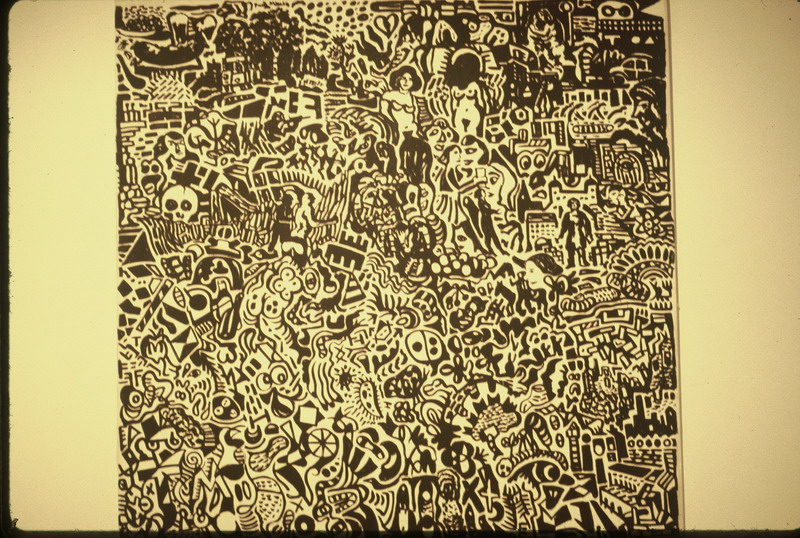
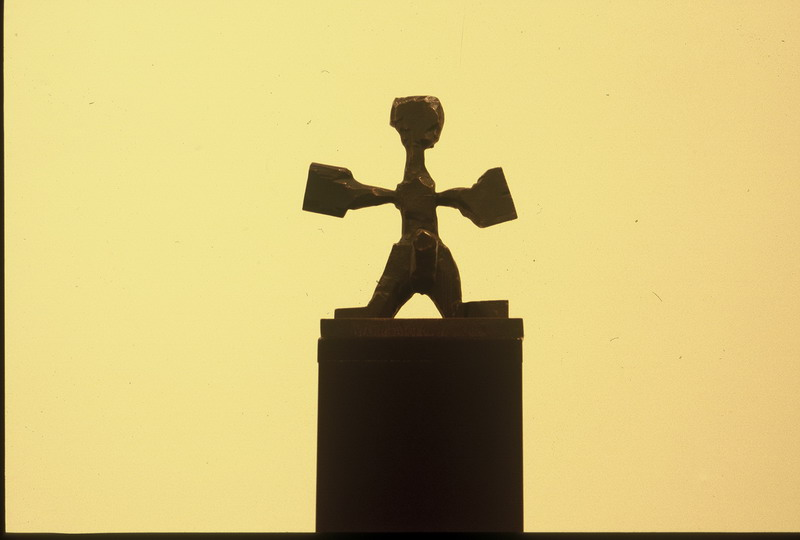
Primal human sculpture 1987. A. P. Penck "Painting-System-World" Retrospective: On display at the Paris Municipal Modern Art Museum from February 14 to May 11. This retrospective features paintings, objects, sculptures, and books, offering a clear view of his lifelong creative system and style. Within a highly systematic stylistic world, realized through theoretical scientific methods, he pioneered a unique personal style.
Penck (A. P. Penck, born 1939 in Dresden, East Germany) was the least nostalgic painter among German Neo-Expressionists, also a sculptor, musician, and theorist. He explored social messages and symbols within mass communication. In his expressive paintings, figures are highly symbolic, graphic, and abstract, forming a universal vocabulary that mixes prehistoric and contemporary history into a modern science.
He began painting at age ten and decided to become an artist at sixteen. Early on, he was deeply influenced by the extreme madness of Van Gogh-like emotional painting. Working within East Germany's socialist art scene, where he had to serve the people or the regime, left him disheartened. However, this contrast between Eastern and Western ideologies became the source of his creativity. In 1965, he created his unique theory of "Standart," based on models of feeling or established systems, and military sensations. In German, "Standart" implies a point of contact visible on the battlefield. These two themes constructed the new word "Standart," providing a model for a new synonym.
Thus, he organized a system starting with meaningful graphics. Through figurative formal symbols, written directly in strong black contrast on white canvases, he displayed ideological messages of Eastern and Western societies and history. The dense, crowded black forms create a strong impression. The artist believed that "behavior is guided by these messages—stimulating or constraining ones—that can trigger action and the breath of overall vitality." Clearly, his artistic expression bets on personal tragedy and perception within mobile and opposing environments, where every symbol and sign is either a threat or an expectation.
Through "Standart," he explored a scientific method, attempting to create a universal language of symbols, strengthening the connection of his works to vocabulary, existence, and culture. His paintings aim for simplified clarity and obvious feelings, interpreting the tension of a modern world, especially under two global systems and regimes. Since the 1990s, his work has been liberated into more diverse and colorful compositions. Simple yet powerful images are often filled with varied figures, unusual spaces, codes, and colors, featuring dynamic lines and imagery of animals, humans, and social/historical symbols such as warriors, Hitler, skulls, sickles, hammers, factories, women, balls, and butterflies. It resembles a media-systematized graphic world, reduced to simple writing and symbolic message types.
His works record history and location; his figuration is very "analytically simplified," presented within challenging and rough signs, showing diverse social meanings and intentions through various symbolic signs. The most striking part of the retrospective is Penck's rare display of music and fifty picture books. Visitors cross a music corridor where light jazz recordings, a collaboration between the artist and musician friends, play against walls adorned with series art posters. Next come the painting books, sampled from over 200 sketchbooks, including drawings, colored illustrations, and conceptual theoretical records. He said, "I live with books and music; I am interested in the relationship between images, sounds, and words."
Between symbols and images, he developed different reference systems for readers. Through unexpected or rhythmic repetitions, symmetrical or decorative forms, combinations of figuration and abstraction, and playing with images, words, symbols, and signs, all appear in these picture books. A. P. Penck is a subtle yet profound historical painter. His diverse perceptions, especially regarding music, distinguish him from other painters. He invokes memory, past or historical, but his forms are never nostalgic or propagandistic. He strongly expresses an extraordinary sense of freedom and modernity, full of vitality. If Baselitz belongs to pure painting expression, Penck's art leans toward wall writing, making him the most distinctive figure in German Neo-Expressionism.